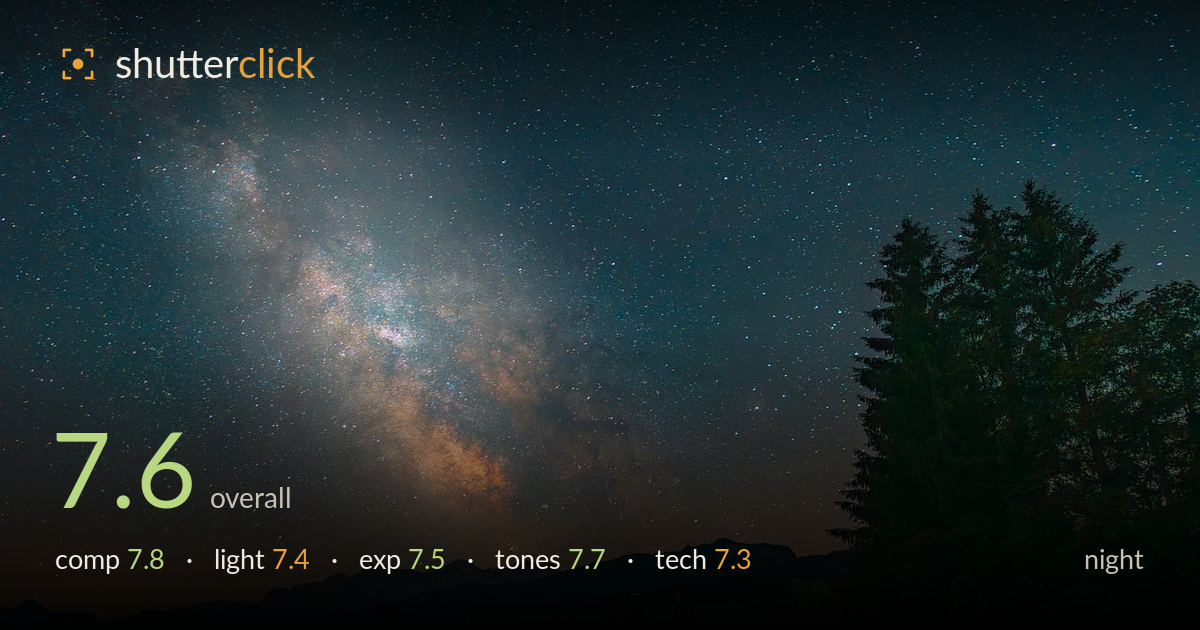
Milky way over the alpine ridge
Photo by ChiemSeherin

No EXIF metadata in this file
Technical analysis based on visual assessment only.
A well-executed Milky Way frame that anchors the galactic core over a mountain ridge with a grounded, storytelling foreground. The core sits at a strong point in the left third, and the tree mass on the right balances the composition while framing the sky. What holds it back most is the foreground: the alpine building and grass slope are underexposed and muddy, offering little detail to reward the eye once it descends from the sky. The tree's silhouette also crowds the right edge. Cleaner foreground light and a touch more separation would lift this from a solid capture to a memorable one.
The galactic core placed in the upper-left third works well, and the mountain ridge gives the sky a firm horizon to sit above. The dark conifer mass on the right balances the bright core and frames the scene, though it presses tight against the edge and eats considerable frame area. The building and grassy slope provide grounding foreground interest, a smart choice for astro work. A slightly lower horizon or more space around the tree would let the sky breathe and reduce the right-side heaviness.
This is natural night light handled with care. The Milky Way core reads with genuine colour and structure, and the faint warm airglow along the horizon adds a subtle gradient that separates ridge from sky. The scene appears free of harsh light pollution intruding on the core. The foreground, however, has no meaningful light on it — the building and slope fall into near-featureless shadow, so the lower third contributes little tonally. A faint low-level foreground illumination would have carried interest down through the frame.
The sky exposure is judged well: stars are bright without blowing out, and the core retains colour and gradation rather than clipping to white. The horizon glow holds detail. The trade-off is the foreground, which sits too deep in shadow to reveal the building's texture or the grass, reading as a heavy black base. This looks like a single-frame compromise between sky and land. Blending a longer foreground exposure, or lifting the shadows selectively, would recover the lower third without harming the sky.
The blue-teal sky against the warm amber horizon and orange core is a pleasing, natural night palette that avoids the over-cooked look common to astro edits. White balance sits in a believable range and the core's dust-lane colour reads authentically. Contrast in the sky is well controlled. The foreground tones collapse into an undifferentiated dark green-black, flattening what could be tonal variety. A gentle shadow lift with restrained saturation would open the lower tones without introducing colour noise or breaking the mood.
The star field is reasonably crisp and the core shows fine structure, suggesting a wide aperture, a controlled shutter, and focus set well on the stars — pinpoint rather than trailed, which indicates the exposure length stayed within the trailing threshold for the focal length used. Noise is kept in check across the sky, a sign of sensible ISO discipline or noise reduction applied without smearing detail. The wide field of view suits the subject, capturing both the core and a broad foreground. The main technical limitation is the foreground rendering: it lacks the detail a dedicated blended exposure or light painting would provide, and the tree edge shows some softness where it merges with the sky. Depth of field appears sufficient throughout given the wide framing. Overall the astro capture is technically sound; the execution gap is in not committing a second exposure to the land, which would have balanced the dynamic range far better than a single frame can.
What would elevate it
Tags
Shot something like this?
Expert photo critique, on demand — scored across six categories, EXIF-aware. Start with 3 free critiques, no credit card.
critique my photo — free