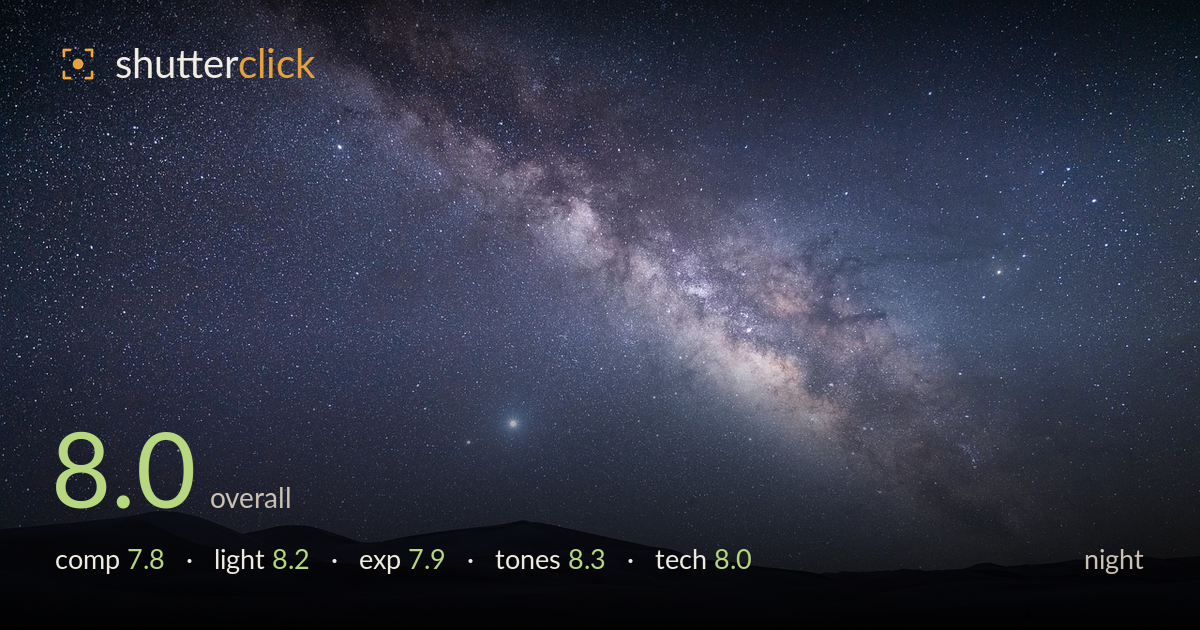
Milky way over the dunes
Photo by Venrike

No EXIF metadata in this file
Technical analysis based on visual assessment only.
A confident Milky Way capture where the galactic core rises diagonally through the upper right, balanced against the dark, textured dunes below. The core is rendered with genuine detail and colour, and the low horizon gives the sky room to dominate — the right call for this scene. What most holds the shot back is the foreground: the dunes read as an undifferentiated dark mass with little of the rippled sand texture the frame hints at in the lower zone. Slightly more foreground illumination or a brighter blend would add the depth this composition is reaching for. Strong, atmospheric, and clearly worth refining.
The diagonal thrust of the Milky Way from lower-centre to upper-right is the frame's strongest structural idea, and placing the horizon low gives the sky the space it deserves. The bright star at left anchors the mid-frame and balances the core's weight on the right. The dune ridgeline undulates pleasingly across the lower third. The weakness is the foreground: the vast dark expanse below the ridge carries little visual interest, so the eye has nowhere to travel before the sky. A stronger foreground anchor would complete the depth.
Natural starlight is the only illumination, and the shoot was well-timed to catch the galactic core high and prominent with the sky otherwise free of moon wash. The core's internal structure — dust lanes and brighter nebulosity — is clearly separated, which speaks to shooting on a genuinely dark night. The dunes receive only faint ambient skyglow, rendering them as near-silhouette. A touch of low-angle light or twilight blend on the sand would have shaped the ripples that the darkness currently swallows.
The exposure balances a bright core against a dark landscape well, holding star colour and core detail without blowing the brightest highlights near the galactic centre. Shadow detail in the dunes is minimal but appears deliberate rather than accidental — the near-silhouette suits the mood. The lower foreground retains just enough tonal information to read the sand ripples. Pushing the shadows any further would introduce noise, so the current placement is a reasonable compromise, though a blended foreground exposure would open real detail there.
The cool blue-to-slate palette of the sky is handled with restraint, and the warmer tans and pinks within the core provide welcome contrast without oversaturation. White balance sits believably for a dark-sky scene, neither pushed too magenta nor too green. The transition from deep sky blue at the edges to the luminous core is smooth. The dunes carry a subtle violet cast that ties the frame together. Tonal separation in the sky is excellent; the foreground is where gradation flattens out.
The image shows careful astrophotography execution. Stars are rendered as tight points across most of the frame, suggesting either an appropriately short exposure for the focal length or star-tracking, with no obvious trailing to distract. The Milky Way core is resolved with clean structure, indicating solid focus at infinity and a lens capable of gathering detail wide open. Noise is controlled well for a high-ISO night scene — the sky remains smooth without heavy-handed smudging from noise reduction, which preserves faint stars. The dunes carry a little more noise in their shadows, as expected. Corner stars appear reasonably clean, suggesting a competent lens. The main technical limitation is the foreground: whether single-exposure or blended, the sand lacks the fine texture and light the composition wants. A dedicated foreground exposure, or light painting at low intensity, would resolve the ripples that currently dissolve into darkness while keeping the sky's quality intact.
What would elevate it
Tags
Shot something like this?
Expert photo critique, on demand — scored across six categories, EXIF-aware. Start with 3 free critiques, no credit card.
critique my photo — free