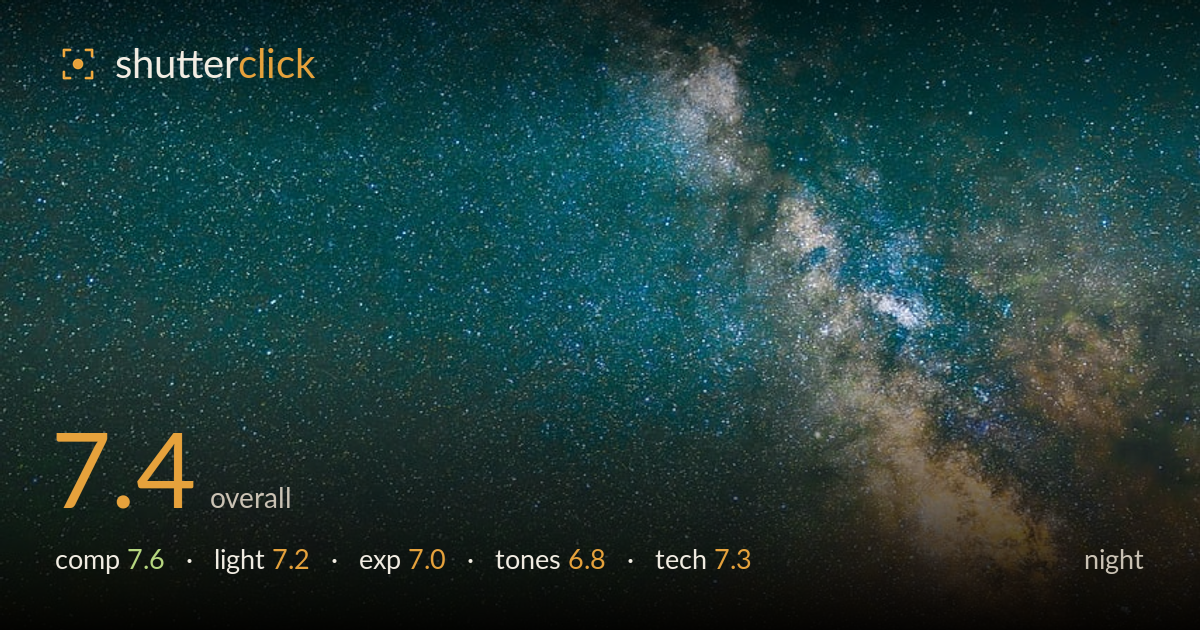
Milky way over the mountain cabin
Photo by ChiemSeherin

No EXIF metadata in this file
Technical analysis based on visual assessment only.
A clean Milky Way capture with a strong diagonal core sweeping from upper left to lower right and a grounded alpine foreground that anchors the composition. The galactic core rendering is detailed and the mountain silhouette gives scale. What most holds the image back is the tonal handling at the horizon: a muddy green-to-orange gradient from light pollution and airglow competes with the sky, and the foreground buildings sit in near-featureless black with little separating detail. Tightening white balance and lifting the darkest foreground values slightly would let both the sky and the land read as intentional rather than lost.
The diagonal thrust of the Milky Way across the frame is the strongest element, carrying the eye from top-left corner down into the brightest core near the right edge. The mountain ridge provides a stable horizon low in the frame, giving the sky dominance appropriate to the subject. The cabin and terraced foreground add human scale, though they crowd the bottom-right corner. The core sitting so close to the right edge feels slightly cramped; a touch more room on that side would let it breathe within the frame.
Natural light here is essentially the sky itself, and the core's brightness gradient is captured well, with the dense star field and dust lanes clearly resolved. The warm airglow along the horizon adds a subtle band of interest beneath the cold sky. The foreground, however, receives almost no illumination, leaving the cabin and terrain as flat shadow. A faint, low-level light on the structure or a moonlit exposure would have shaped the land and balanced the luminous sky against the dark base.
The exposure holds the star field without significant clipping in the core's brightest regions, and the sky retains good tonal separation between dust lanes and open field. The trade-off shows in the foreground, which sits crushed into near-black with little recoverable detail in the buildings and slopes. That is a common single-frame compromise in astro work. Exposure blending or a slightly longer foreground frame would have preserved shadow information without over-brightening the sky, giving the base of the composition substance.
The cold teal-blue sky reads convincingly for a dark-sky night, and the golden core adds welcome warmth. The weak point is the horizon band, where green airglow and orange light pollution blend into a muddy transition that muddies the lower sky. White balance leans slightly green overall. Pulling green out of the midtones and cleaning the gradient would sharpen the contrast between the warm core and the cool surrounding field, letting the star colours register with more clarity and the horizon feel deliberate.
The frame shows solid astro execution from the visual evidence: stars appear as points rather than trails, suggesting the exposure length was matched sensibly to the focal length, and the core detail indicates careful focus on the stars. Noise is reasonably controlled across the sky, with the dust lanes holding structure rather than dissolving into grain, though some chroma noise likely lurks in the darkest foreground where the signal is thin. Depth of field is not a concern at these distances. The main technical limitation is the single-exposure approach forcing a choice between sky and land; the land loses. A separate, longer foreground frame blended in, or a tracked sky exposure paired with a static foreground, would resolve both cleanly. Corner stars appear acceptably tight, indicating a lens performing well wide open. Overall the capture is competent and the core rendering is the standout, with the foreground compromise the clearest area to address on a return visit.
What would elevate it
Tags
Shot something like this?
Expert photo critique, on demand — scored across six categories, EXIF-aware. Start with 3 free critiques, no credit card.
critique my photo — free