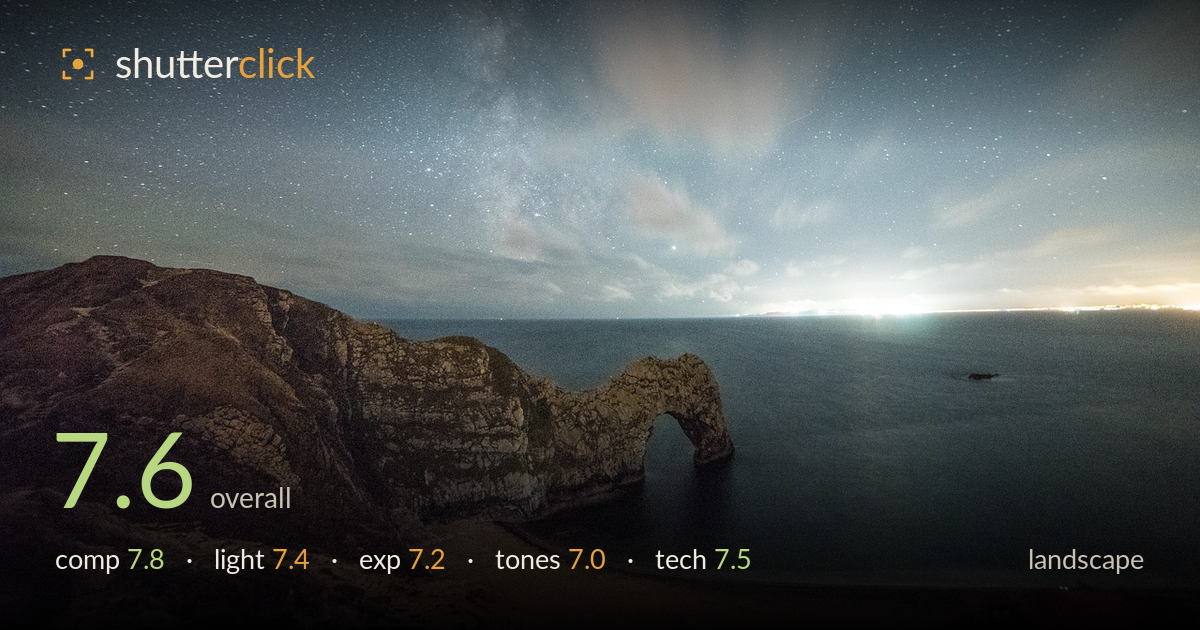
Milky way over the sea arch
Photo by Whitechappel79

No EXIF metadata in this file
Technical analysis based on visual assessment only.
A confident night landscape that pairs an iconic sea arch with the Milky Way arcing overhead — the ambition and the payoff are both real. The rock formation reads as a strong anchor in the lower-left third, and the diagonal sweep of the cliff leads the eye toward the arch and out to sea. What most holds it back is the tonal handling of the sky: the light dome on the right blooms hot and desaturates a large section, and an overall cool-magenta cast flattens the star field. Tighter light-pollution control and a cleaner white balance would let the composition's strengths sing.
The cliff and arch occupy the lower-left third well, and the ridgeline forms a natural diagonal that carries the eye toward the arch and the horizon. The Milky Way's arc balances the dark landmass with luminous sky, a smart weight distribution. The horizon sits low, giving the star field room, which suits the genre. The bright light dome on the right competes with the arch for attention, though, splitting the focal load. Slightly more foreground beach detail would strengthen the near-to-far depth.
Ambient starlight and a low moon or residual glow model the chalk cliff softly, giving the rock enough shape without harsh contrast — a fortunate balance for night work. The distant town glow warms the horizon and adds atmospheric layering. That same glow, however, dominates the right half and overwhelms the subtler celestial light. Timing that placed the Milky Way core higher and away from the brightest light pollution, or shooting on a darker night, would let the sky's natural gradient carry more of the mood.
The exposure holds shadow detail in the cliff face and keeps the star field readable, a difficult balance in low light. The foreground rock retains texture rather than blocking up, which is well judged. The town light on the right horizon clips to pure white and blooms outward, losing all detail there — the weakest exposure zone. A shorter exposure blended for that highlight region, or a graduated approach, would recover it. Midtones in the sky sit slightly muddy, suggesting the shadows were lifted a touch aggressively.
The blue-teal sky against the warm sandstone cliff creates a pleasing complementary contrast, and the beach's warmth anchors the palette. White balance drifts cool-magenta across the upper sky, however, giving the stars a slightly artificial tint and muting the Milky Way's natural warmth. The bright light dome desaturates to a green-white that clashes with the surrounding blues. A more neutral balance in the star field, with the light pollution toned toward a natural sodium-orange, would unify the frame and restore depth to the mid-tones.
The wide framing and deep field are appropriate for a night landscape, keeping both the near cliff and the star field acceptably rendered. Stars appear largely point-like rather than trailed, suggesting the exposure length was well matched to the focal length — a key discipline in astro work. Noise is controlled reasonably for the conditions, with the shadows holding together without heavy smearing, though close inspection of the darker cliff areas shows some luminance grain and softening consistent with noise reduction. Focus lands well on the cliff and arch; the star field is sharp enough to read structure in the Milky Way. The main technical limitation is the blown light dome, which no in-camera setting fully solves — it calls for exposure blending or a foreground-and-sky bracket. Overall the execution is solid and the fundamentals of astro-landscape capture are clearly understood; the refinement lies in managing dynamic range across the extreme highlight on the horizon.
What would elevate it
Tags
Shot something like this?
Expert photo critique, on demand — scored across six categories, EXIF-aware. Start with 3 free critiques, no credit card.
critique my photo — free