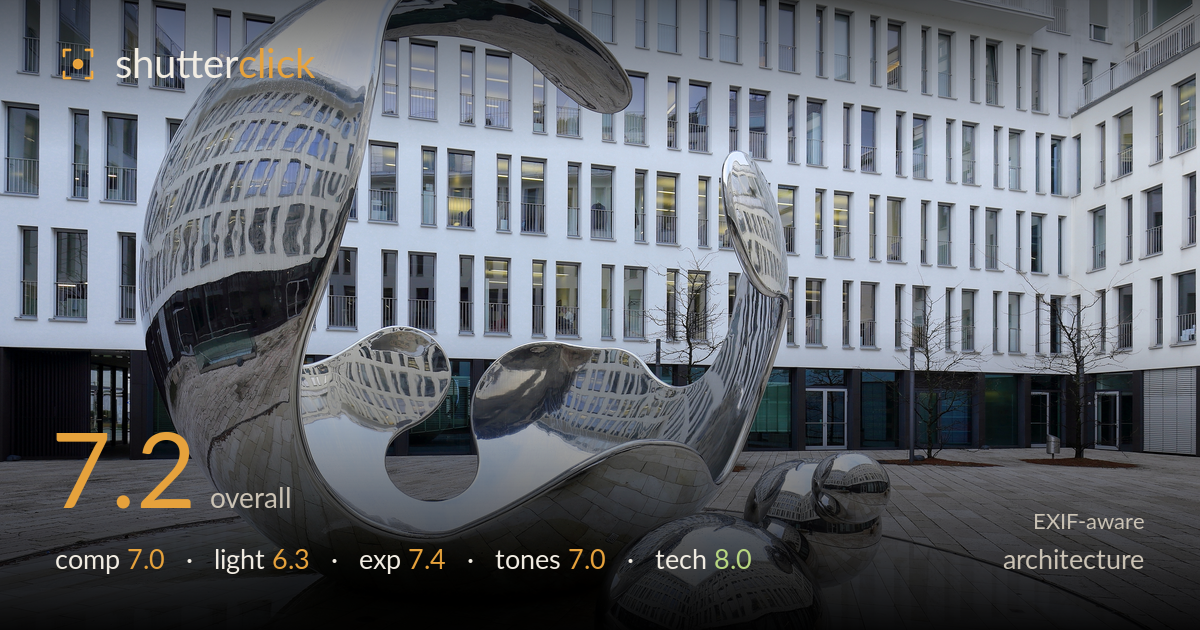
Mirrored sculpture in the courtyard
Photo by Martin Falbisoner

| Focal length | 16 mm |
| Aperture | f / 8.0 |
| Shutter | 1/40 s |
| ISO | ISO 200 |
| Exp. comp. | 0.67 EV |
| Shot at | 15:37 · Feb 17, 2017 |
A polished stainless-steel sculpture set against a rhythmic grid of white facade windows — the mirror-finish forms and their distorted reflections of the building make this a genuinely engaging subject. The frame reads clean and controlled, with verticals held well for a 16mm shot. What most holds it back is the flat, overcast light: the sculpture's chrome depends on directional light and specular contrast to sing, and here it renders somewhat grey and lifeless. The tight cropping of the sculpture's top edge and the slightly empty right side of the courtyard also leave the composition feeling a touch cramped on one axis and loose on the other.
The curling primary form anchors the left and dominates as intended, with the trio of spheres providing a satisfying descending rhythm toward the lower right. The building's window grid supplies a strong geometric backdrop. However, the top of the sculpture's arch crops uncomfortably close to the frame edge, and the right third of the courtyard reads as dead space with little to counterbalance the mass on the left. A slightly wider top margin and a subject shifted marginally right would balance the tension between the two masses better.
The flat, overcast light is the weakest link. Reflective chrome sculpture lives on directional light and specular highlights — hard sun or the raking, warm light of golden hour would carve dimension into the curves and make the mirror surfaces glint. Here the diffuse sky renders the metal as an even grey with soft, low-contrast reflections, and the white facade stays flat and shadowless. The even light does keep detail readable across the whole frame, but it robs the subject of the drama its material invites.
Exposure is well judged for a bright, high-key scene. The +0.67 EV compensation lifts the pale facade appropriately without blowing the windows, and the chrome highlights retain detail rather than clipping to white. Shadow areas under the sculpture and in the recessed ground-floor entrances hold information. The histogram sits high but controlled, suiting the airy courtyard. The wet pavement in the foreground carries a subtle reflection that adds interest without drawing attention through overexposure. A deliberate, competent handling of a tricky bright subject.
The palette is restrained and cool — white facade, grey chrome, buff paving — which suits the modern setting. White balance leans slightly cool, reinforcing the overcast mood but leaving the image a little clinical. Tonal range is compressed toward the highlights, and contrast is modest, which matches the light but limits punch. The chrome's mid-tone gradation is smooth. A touch more warmth in the paving and a gentle contrast lift would separate the sculpture from its bright background more convincingly.
The technical execution is the strongest aspect. At 16mm on the EF16-35mm f/4L, the wide angle captures the full courtyard sweep while verticals on the facade stay largely upright — impressive control at this focal length, suggesting careful leveling or minor correction. f/8 is the right aperture for landscape-of-architecture work, delivering front-to-back sharpness across sculpture, building, and paving. ISO 200 keeps noise negligible in the bright conditions. The 1/40s shutter is on the slow side for handheld work at 16mm, but the IS lens and static subject make it viable, and the frame shows no obvious motion blur. Focus sits appropriately on the sculpture's near surface with adequate depth to cover the background. The main technical limitation is not gear but the residual slight distortion at the extreme wide setting, mildly stretching forms at the edges. Overall a clean, deliberate capture that gets the fundamentals right.
What would elevate it
Tags
Shot something like this?
Expert photo critique, on demand — scored across six categories, EXIF-aware. Start with 3 free critiques, no credit card.
critique my photo — free