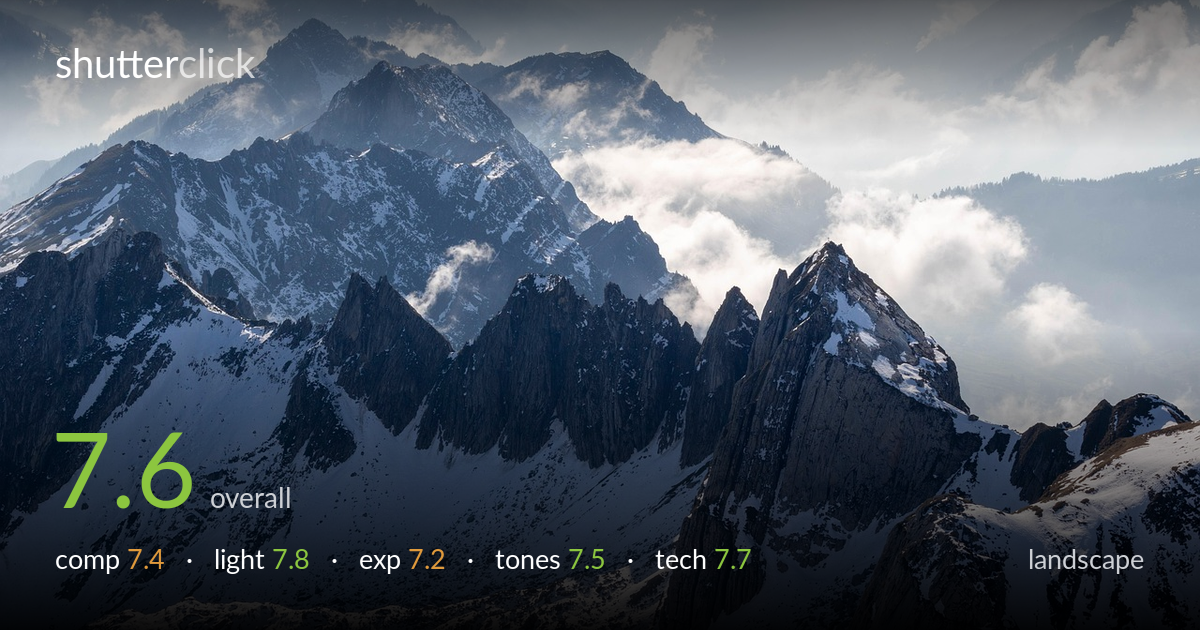
Misty alpine snow peaks
Photo by ewirz

No EXIF metadata in this file
Technical analysis based on visual assessment only.
A commanding alpine scene that uses atmospheric haze to build genuine depth, with serrated foreground ridges anchoring layered peaks that fade into cloud. The strongest asset is the recession of tone from the dark, textured front spires to the pale, vaporous background — it reads as scale and distance. What holds it back is a slightly diffuse focal hierarchy: several peaks compete for attention and no single subject is given clear priority. The midtones in the snow also sit a touch flat under the soft light. Tightening intent and lifting local contrast in the rock would sharpen the impact considerably.
The layering works well — jagged foreground ridges give way to softer, haze-dimmed peaks, creating strong depth. The dark pyramidal spire on the right is a natural anchor and the diagonal ridgelines guide the eye upward into the frame. The weakness is that attention is split between the right-hand peak and the central serrated ridge, with neither fully dominant. The top edge crowds the most distant summits, and a little more sky or a slightly lower crop would breathe. Overall a balanced, ambitious frame that lacks one decisive focal point.
Soft, diffused light from a hazy sky flatters the layered atmosphere and renders the cloud banks luminously, separating the receding ridges by tone alone. There is enough directional quality to model the foreground rock faces and reveal their texture. However, the flat overcast quality robs the snow of sculpting shadow, leaving some slopes reading as undifferentiated mass. A raking lower-angle light would carve more dimension into the central ridge. As it stands the light serves the mood and depth more than it shapes individual forms.
Exposure is well-judged for a high-key alpine scene — the bright snow and clouds hold without significant clipping, and the dark rock retains detail rather than blocking up. The histogram clearly spans a wide range, with deliberate preservation of highlight texture in the cloud. Shadow areas in the rock crevices stay readable. The midtone snow sits slightly flat, leaving the brightest slopes a touch muddy rather than crisp white. A modest highlight lift on the snow paired with a small shadow nudge would give the tonal scale more snap without risking clipped peaks.
The cool blue-grey palette suits the wintry atmosphere and the tonal recession from dark foreground to pale haze is the image's defining strength. White balance leans cold, which reinforces the alpine chill but flattens the warmth in the exposed rock. Contrast is gentle, appropriate to the misty conditions, though the rock could carry a little more local punch to separate it from the snow. Saturation is restrained and tasteful. A subtle warm bias in the rock midtones would add tonal variety against the dominant blue without breaking the mood.
Focus appears accurate across the foreground ridges, with crisp detail in the rock fissures and snow edges of the nearest spire — the key plane is well chosen. Depth of field is deep enough to carry sharpness from the front ridge into the middle distance, consistent with a stopped-down landscape approach. The most distant peaks lose definition primarily to atmospheric haze rather than focus error, which is acceptable and even desirable here. Noise is well controlled in the shadowed rock, and there is no visible motion blur. The apparent focal length compresses the layers effectively, stacking ridge behind ridge for a strong telephoto landscape feel. The only execution caveat is that the brightest snow lacks micro-contrast, which can be a symptom of slightly soft rendering or under-sharpening rather than a focus miss. Careful capture sharpening targeted at the rock and snow texture, plus a touch of dehaze on the mid-distance, would extract more from what is already a technically sound frame.
What would elevate it
Tags
Shot something like this?
Expert photo critique, on demand — scored across six categories, EXIF-aware. Start with 3 free critiques, no credit card.
critique my photo — free