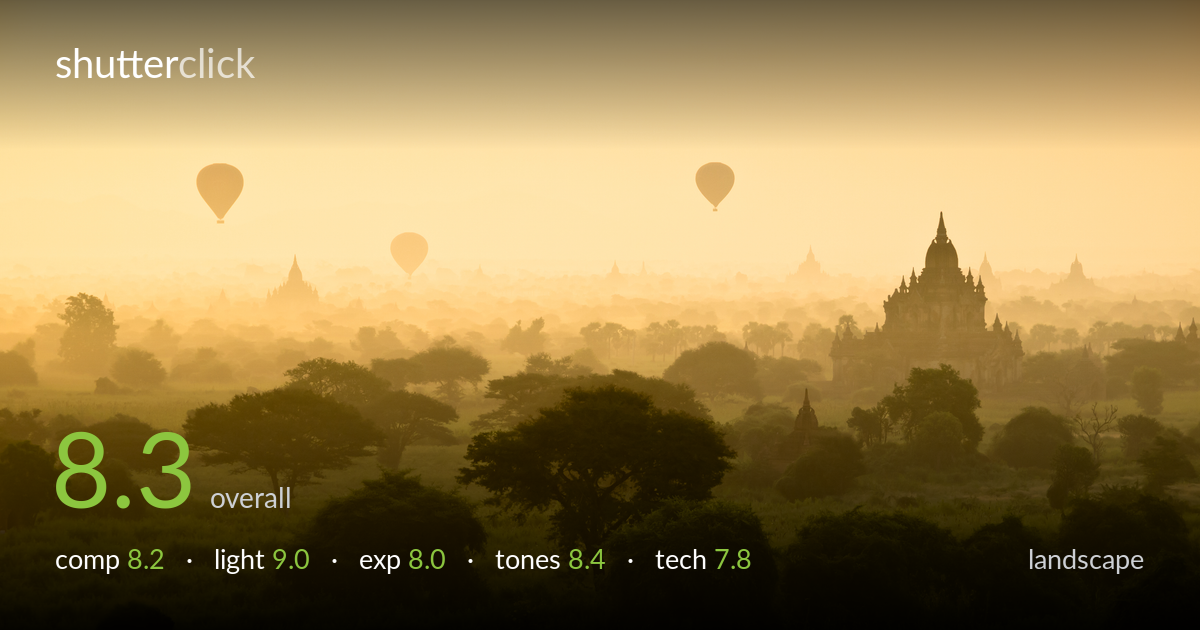
Misty bagan dawn
Photo by Martin Sojka
.jpg)
No EXIF metadata in this file
Technical analysis based on visual assessment only.
A quintessential Bagan dawn that earns its iconography through atmospheric layering rather than just subject matter. The receding planes of mist build genuine depth, the large temple anchors the right third, and the three balloons punctuate the sky with rhythm and scale. The light is the real achievement — warm, directional haze that separates each row of trees and stupas. What holds it back slightly is sky management: the upper third is a large expanse of near-uniform amber that, while pretty, carries little information and could be tightened. Foreground detail also goes a touch murky in the lower corners.
Strong layered structure: foreground scrub, mid-ground trees and stupas, and the dominant temple on the right third all stack into convincing depth. The three balloons are well spaced and lead the eye across the sky. The large temple anchors the frame on a natural strong point. The weakness is the upper third — a broad sweep of empty amber sky that pushes the horizon low and leaves dead space above the highest balloon. The dense foreground reads as a single dark mass rather than offering a clear entry point into the scene.
The standout element. Low backlight rakes through layers of dust and mist, separating each receding plane and giving the temples and trees their silhouetted edge glow. The haze diffuses the sun into a soft directional wash that builds atmosphere without harsh contrast. Shadow rendering is gentle and the highlight on the sky rolls off smoothly. This is precisely the timing — first light at golden hour — that makes Bagan work, and the balloons catch just enough rim light to register as forms rather than flat cutouts.
Exposure is well judged for a high-key, hazy scene. The bright sky stays controlled with no obvious clipping, holding the soft amber gradient intact. Midtones in the misty mid-ground sit nicely, preserving the layered tonal separation that carries the image. The shadows in the lower foreground get heavy, losing some texture in the darkest scrub, though this reads as deliberate weighting toward the luminous distance. A slight lift in the foreground shadows would recover detail without flattening the atmosphere.
The monochromatic amber-to-green palette is cohesive and evocative, true to the dust-and-dawn conditions. White balance leans warm, which suits the mood, though it tips close to a single-hue wash in the sky. The greens of the foreground vegetation provide welcome tonal contrast against the orange haze and keep the image from becoming wholly monochrome. Contrast is appropriately low for an atmospheric scene; the gradation between mist layers is smooth and natural. Saturation is restrained and believable.
Execution reads as competent for the conditions. Depth of field carries the layered scene front to back, and the temple and balloons hold enough definition to register clearly despite the intervening haze — the softness in the distance is atmospheric, not focus error. The foreground trees show reasonable sharpness where the light catches them. Focus appears placed in the mid-to-far ground, which is the right call for this kind of depth-driven landscape. The lens choice — a moderate telephoto compression — works well, stacking the temple rows and balloons into a tighter, denser frame than a wide angle would allow. The main technical limitation is the lower foreground, where the darkest vegetation collapses into a muddy mass with little recoverable detail. A marginally higher viewpoint or a graduated approach to the foreground exposure would help. Noise is not an issue at this scale, and the overall capture is clean and stable.
What would elevate it
Tags
Shot something like this?
Expert photo critique, on demand — scored across six categories, EXIF-aware. Start with 3 free critiques, no credit card.
critique my photo — free