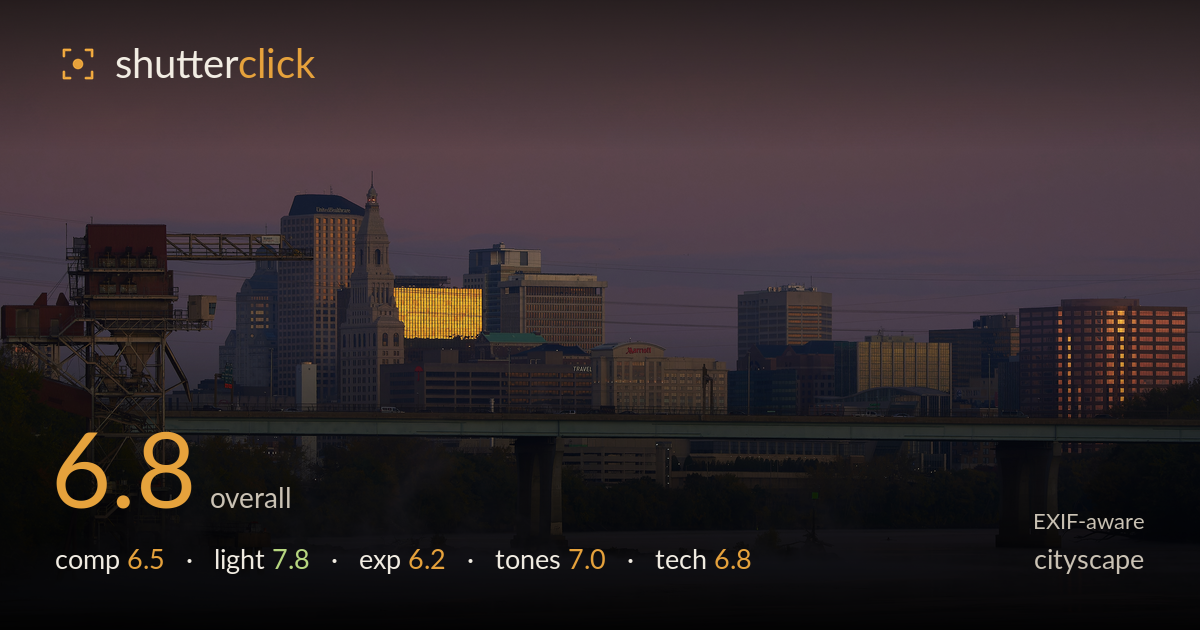
Misty dawn over the city skyline
Photo by Paul Danese

| Focal length | 150 mm |
| Aperture | f / 5.0 |
| Shutter | 1/640 s |
| ISO | ISO 640 |
| Exp. comp. | 0.0 EV |
| Shot at | 07:04 · Oct 16, 2019 |
A quietly atmospheric dawn cityscape whose best asset is the fleeting golden reflection catching just a few glass facades against an otherwise muted purple skyline, with mist drifting over the river below. What most holds it back is the overall darkness: the frame sits low on the histogram, the foreground bridge piers and water plane fall into murk, and much of the skyline loses definition to underexposure. The compact telephoto compression works well, but the mid-frame reads flat and the large empty sky dominates. Lifting shadows and tightening the crop would let the strongest elements — the lit buildings and the misty water — carry the image.
The telephoto compression stacks the industrial structure, skyline and bridge into a satisfying layered band, and the bridge provides a strong horizontal anchor with its reflection leading down. The mist over the water adds depth. However, the sky occupies well over a third of the frame and is largely featureless purple, pulling weight away from the subject. The horizontal bridge line sits low, leaving the busy midground compressed. A tighter crop from the top would concentrate attention on the skyline and its reflection, strengthening the balance considerably.
The timing is the real strength here — that narrow window at dawn where the low sun ignites a handful of glass facades into pure gold while everything else stays in cool twilight shadow. That selective catch of warm light against the muted purple gives the frame its focal energy and mood. The soft, directionless ambient light on the rest of the skyline is characteristic of blue hour and renders the buildings gently. The mist adds a further luminous quality low in the frame. Well observed for the moment.
Exposure is the weakest link. The overall frame sits dark, and while some of that is intentional dusk mood, the foreground bridge piers, near water and shadowed building faces lose too much detail to murk. The golden highlights are held without clipping, which is good, but the midtones across the skyline are crushed low. A slightly brighter exposure or exposure-compensation lift, then careful shadow recovery, would reveal structure now buried while preserving the twilight feel. The histogram is bunched too far left.
The purple-to-magenta cast across sky and water sets a coherent dusk palette, and the warm gold accents provide effective contrast against it. White balance leans warm-magenta, which suits the hour but flattens the skyline into a somewhat uniform mauve where more tonal separation would help. The reflection in the water carries the colour story nicely. Contrast is on the low side through the midtones, contributing to the flat middle band. A touch more separation between building tones would add dimension.
The 150mm setting on the 150-600 gives a workable compression for stacking the skyline layers, and f/5.0 keeps the distant subject acceptably sharp front to back at this distance. 1/640s is far faster than needed for a static cityscape from a presumably stationary position — that shutter speed was spending light this frame badly needed. Dropping to 1/60s or slower (with support) at ISO 640 would have allowed a fuller, cleaner exposure and pulled more detail from the shadows and mist. ISO 640 is reasonable and noise is controlled, though the deep shadows show some muddiness that a brighter capture would have avoided. Focus appears accurate on the mid-skyline. For a tripod-based dawn scene like this, a longer exposure at base ISO would have been the stronger technical choice, smoothing the water and lifting the whole tonal range without penalty. The gear handled the reach well; the exposure settings simply left detail on the table.
What would elevate it
Tags
Shot something like this?
Expert photo critique, on demand — scored across six categories, EXIF-aware. Start with 3 free critiques, no credit card.
critique my photo — free