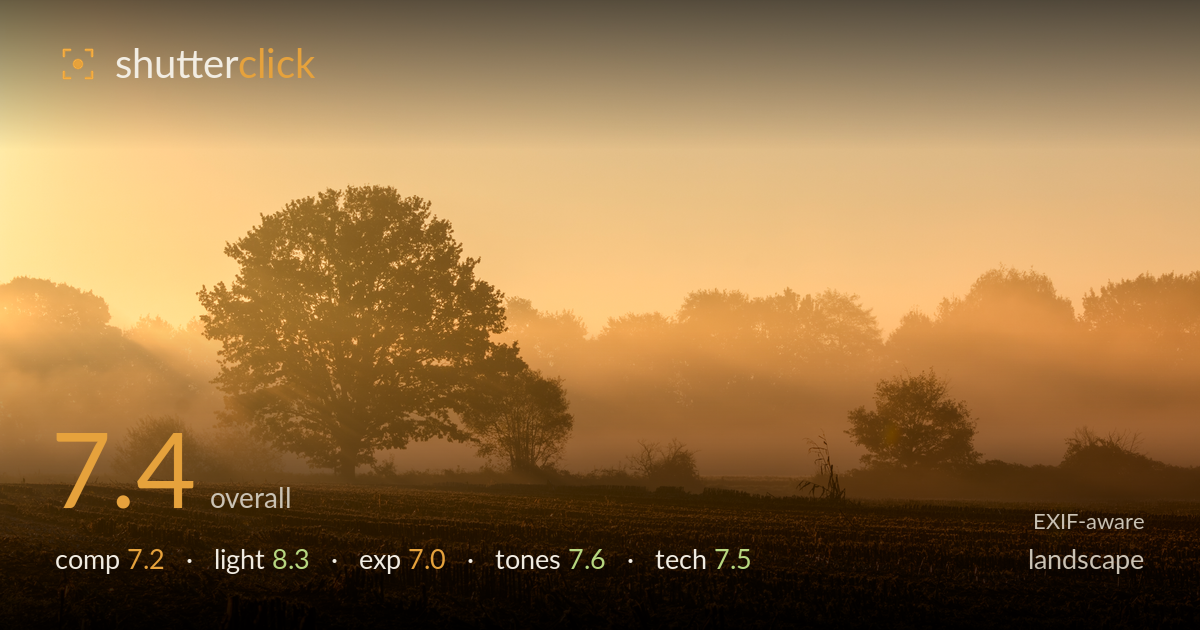
Misty sunrise over a stubble field
Photo by Dietmar Rabich

| Focal length | 88 mm |
| Aperture | f / 13.0 |
| Shutter | 1/320 s |
| ISO | ISO 100 |
| Exp. comp. | 0.0 EV |
| Shot at | 08:31 · Oct 15, 2017 |
Backlit morning mist is the real strength here — the sun rakes through fog and separates the oak from the treeline behind it, delivering atmosphere that would be impossible to fake. The lone oak anchors the frame well left of centre, and the field of stubble adds foreground texture and depth. What holds the shot back is that foreground: it dominates the lower half without a clear point of interest, and the near stubble reads muddy and dark against the glowing distance. The strong single amber cast, while evocative, flattens tonal separation. A stronger foreground anchor and a touch of tonal restraint would elevate it.
The oak placed left of centre works, giving the mist and distant treeline room to breathe across the frame. The horizon sits roughly at the upper third, which suits the emphasis on the field. The problem is the foreground: the lower half is a large expanse of stubble without a clear anchor to draw the eye through it. The small burnt stump lower-left is the closest candidate but sits too far into the corner to lead effectively. A stronger diagonal or a nearer feature would give the space purpose.
This is where the image earns its keep. Low backlight through mist produces glowing volumes of fog and clean rim separation on the oak — genuinely atmospheric and well-timed for golden hour. The sun's diffusion through the trees creates radiating light beams that read naturally rather than gimmicky. Shadows fall toward the camera, giving the stubble rows some raking dimension. The only caution is that the intense backlight compresses contrast in the distance into a single warm glow, softening the separation between the far treeline layers.
Exposure is broadly well judged for a backlit scene — the sky glow retains gradation without blowing out to pure white, which is the hard part here. The foreground stubble, however, sinks quite dark and muddy, and shade detail in the near dirt is largely lost. This looks more like a byproduct of protecting the highlights than a deliberate silhouette choice. Lifting the shadows slightly, or bracketing to blend, would recover foreground texture and balance the tonal weight between the glowing distance and the heavy near ground.
The warm amber grade suits the misty sunrise and carries genuine mood. White balance leans heavily golden — evocative, but it saturates the whole frame into one hue, leaving little tonal variety between sky, mist, and soil. The mid-tones in the fog roll off nicely, but the foreground reds and browns edge toward oversaturation, particularly in the near stubble. Pulling back global saturation a touch and introducing a cooler note in the shadows would give the palette more range and stop the field from reading as a single orange mass.
The settings are sensible for the conditions. At 88mm on the 70-300, f/13 delivers front-to-back depth of field appropriate for landscape, and at ISO 100 the file is clean with no noise concerns. 1/320s is more than enough to freeze a static scene, and image stabilisation plus the fast shutter rule out camera shake. Focus appears placed around the oak and mid-field, which is the right call. The main technical observation is that f/13 on this sensor risks slight diffraction softening — f/8 to f/11 would likely have held marginally more crisp detail across the frame with the same depth. The 70-300 is a modest lens optically, and there's a hint of softness in the far treeline, though much of that is genuine atmospheric haze rather than lens weakness. A tripod would have allowed a lower ISO to matter less and enabled exposure bracketing to hold both the glowing sky and the shadowed foreground. Overall, competent execution with no significant errors.
What would elevate it
Tags
Shot something like this?
Expert photo critique, on demand — scored across six categories, EXIF-aware. Start with 3 free critiques, no credit card.
critique my photo — free