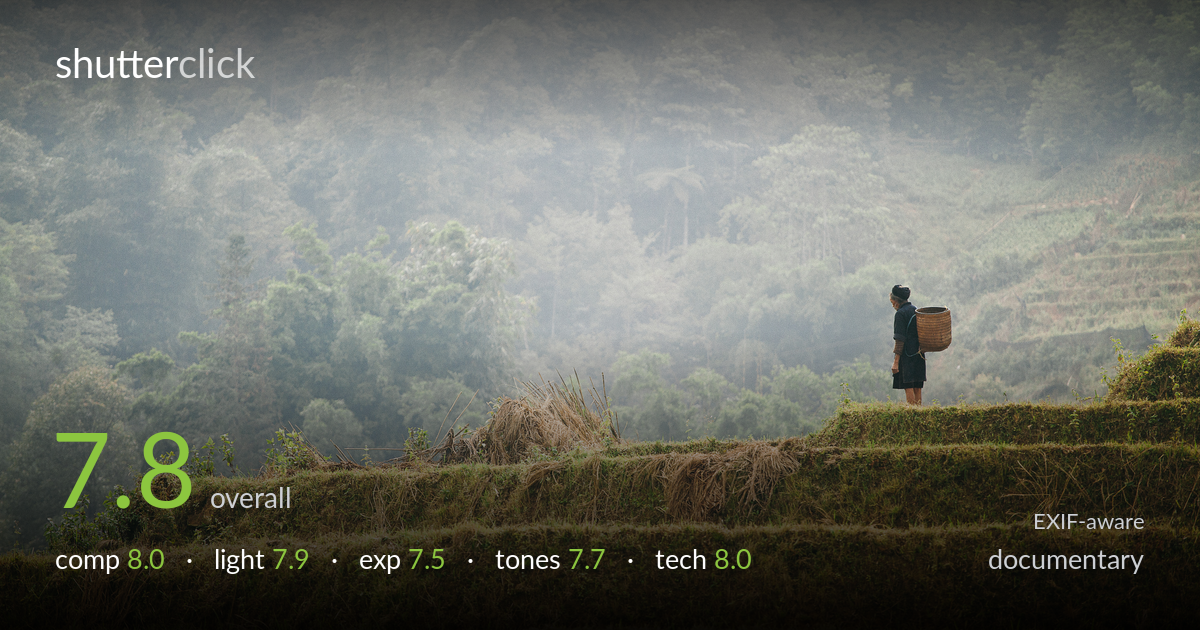
Misty terraced fieldwork
Photo by Martin Sojka
.jpg)
| Focal length | 200 mm |
| Aperture | f / 4.0 |
| Shutter | 1/1000 s |
| ISO | ISO 200 |
| Exp. comp. | 0.0 EV |
| Shot at | 13:35 · Oct 8, 2012 |
A patient, atmospheric frame that places a single figure against a hazy mountainside and lets scale do the storytelling. The basket-carrying woman, set high on the right with the misty forest opening behind her, reads instantly as a moment of rural labour. The terraced foreground builds layered depth and earns its space. What holds it back is the small, slightly dark subject competing with a busy treeline directly behind, and a foreground band that occupies a lot of frame without quite as much interest as the upper third. Stronger separation between figure and background, and a touch more presence in the subject, would lift this from quietly good to memorable.
Placing the figure high and right against the open misty gap is the smart move — she gets breathing room and the negative space of the hillside isolates her well. The receding terraces lead the eye up from bottom-left, and the harvested hay clusters give the midground texture and human trace. The risk is the deep foreground band, which is large and uniform enough to feel slightly empty. A composition weighting the subject a little larger, or angling the terrace lines more decisively toward her, would tighten the narrative pull.
Soft, diffused haze light flattens the distant forest into receding tonal layers, which is exactly what gives this image its sense of depth and quiet. The atmospheric perspective — paling and cooling toward the back — does real compositional work. Light on the terraced grass in front is gentle and even, lending warmth against the cool background. The trade-off is low directional modelling: nothing rakes across the foreground to reveal texture, so the lower terraces read a little flat. Early raking light would have shaped those banks more.
Exposure is well-judged for a high-key, hazy scene: the misty background retains tonal separation without blowing out, and the foreground grass holds detail. The figure, however, sits dark against a bright surround and loses internal detail — her form reads as near-silhouette, which works for graphic clarity but sacrifices the textile and basket detail that would add documentary specificity. A subtle local lift on the subject in post would recover that without harming the airy mood. Overall the histogram looks deliberate and controlled.
The cool-to-warm gradient — desaturated misty blues and greens behind, warmer harvested yellows and greens in front — is handled gracefully and reinforces depth. Saturation is restrained, suiting the documentary register and the soft weather. Contrast is intentionally low, which serves the atmosphere but leaves the midtones a touch muddy in the lower terraces. The subject's dark clothing anchors the palette. A small contrast nudge on the foreground, leaving the haze untouched, would add tonal definition without breaking the mood.
The 200mm focal length on the 5D Mark II is the right call here — it compresses the terraces and mist into stacked layers and pulls the distant figure forward, which is what makes the scene cohere. f/4 gives enough depth that both the subject and the foreground terraces read acceptably sharp at this distance, though wide open the lens softens slightly and the figure could be crisper. 1/1000s is far faster than needed for a static subject at ISO 200 — there was clear headroom to stop down to f/8 or f/11 for more across-the-frame bite, or drop ISO further, with no motion concern. Focus appears placed on the figure, which is correct, and noise is a non-issue at base ISO. The EF70-200 f/4L is a sensible, sharp choice for reach-from-distance documentary work. The main refinement is aperture discipline: trading that surplus shutter speed for depth and edge sharpness would have rendered the terraced layers with more crispness without compromising anything.
What would elevate it
Tags
Shot something like this?
Expert photo critique, on demand — scored across six categories, EXIF-aware. Start with 3 free critiques, no credit card.
critique my photo — free