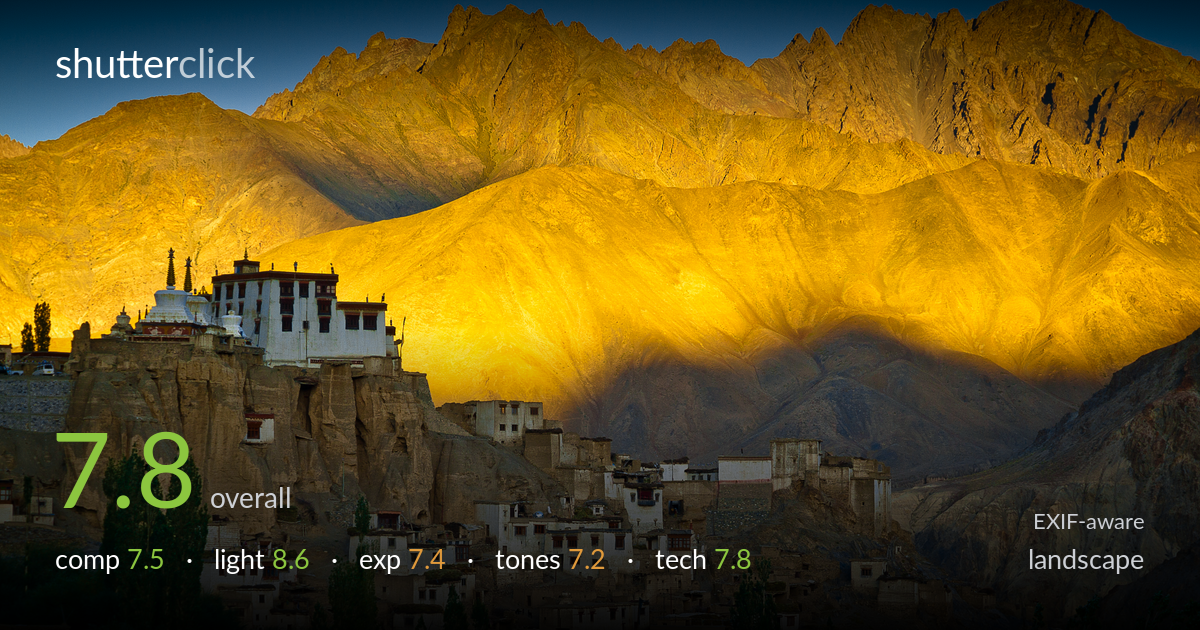
Monastery village at mountain sunset
Photo by Martin Sojka
.jpg)
| Focal length | 60 mm |
| Aperture | f / 5.6 |
| Shutter | 1/25 s |
| ISO | ISO 100 |
| Exp. comp. | 0.0 EV |
| Shot at | 12:20 · Sep 17, 2010 |
A monastery village catches a band of dying sunlight against vast, raking mountains — and that light is the photograph's clear strength. The diagonal line where warm gold meets cool shadow on the slopes is genuinely striking and gives the frame depth and drama. What holds it back is the colour, which tips well past believable into a heavy, almost neon orange-yellow that flattens the rock's natural variation. The deep blue sky reinforces a complementary contrast that feels pushed. Composition is solid but the white monastery and the village compete without a clear hierarchy. Dialled back, this is a memorable image.
The whitewashed monastery on its crag anchors the left third well and reads cleanly against the dark slope behind it, while the layered village steps down toward the foreground trees for a sense of place. The diagonal shadow line across the mountains adds welcome depth. The horizon sits high, which suits the towering terrain. The weakness is competing focal points: the monastery, the dense village cluster, and the bright golden band all pull at the eye without one clearly leading. A touch more breathing room around the monastery would strengthen its dominance.
This is the frame's standout. Low, warm sunset light skims the upper peaks and rakes across the slopes, carving out ridgelines and the great diagonal where light meets shadow. That transition gives the mountains real three-dimensional form and a moment-specific drama no midday shot could match. The whitewashed monastery picks up the warmth and glows against shadowed rock. The only caution is that the brightest golden band edges toward overpowering — its intensity draws the eye away from the architecture that should be the emotional centre.
Exposure is broadly well judged for a high-contrast scene. The shadowed lower mountains and village retain workable detail, and the sky holds without banding. The brightest golden slope sits close to the ceiling — not clipped, but saturated enough that texture is starting to compress in the most intense areas. The white monastery walls hold detail, which is the harder call here. Foreground trees and buildings sit a touch dark, with some shadow detail buried. A gentle lift to the foreground shadows would balance the tonal weight.
The colour is the most debatable element. The golden band has been pushed toward a saturated, near-fluorescent orange-yellow that reads as processed rather than natural sunset, flattening the subtle mineral variation of the rock. The deep, almost navy sky amplifies the complementary contrast, which adds punch but feels heavy-handed. White balance overall leans warm. There's a genuine tonal range from cool shadow to hot highlight, but pulling saturation back ten to fifteen percent and recovering some neutrals in the rock would let the light feel believable rather than dialled.
At 60mm, f/5.6, 1/25s and ISO 100, the settings are sensible for a tripod-steady landscape, and ISO 100 keeps the file clean with no meaningful noise. The 60mm reach compresses the village against the mountains effectively, building the layered sense of scale. Focus appears placed on the mid-distance monastery and village, which is the right call, and depth of field at f/5.6 holds the scene acceptably sharp front to back given the distances involved. The concern is 1/25s handheld would risk softness — if this was tripod-supported it's fine, and the detail in the rock suggests it was. Stopping down to f/8 or f/11 would have tightened critical sharpness in both the near trees and far peaks, since f/5.6 at this distance is workable but not optimal for a deep scene. Overall the execution is competent and the gear well matched to the subject; the main gains here are in post rather than capture.
What would elevate it
Tags
Shot something like this?
Expert photo critique, on demand — scored across six categories, EXIF-aware. Start with 3 free critiques, no credit card.
critique my photo — free