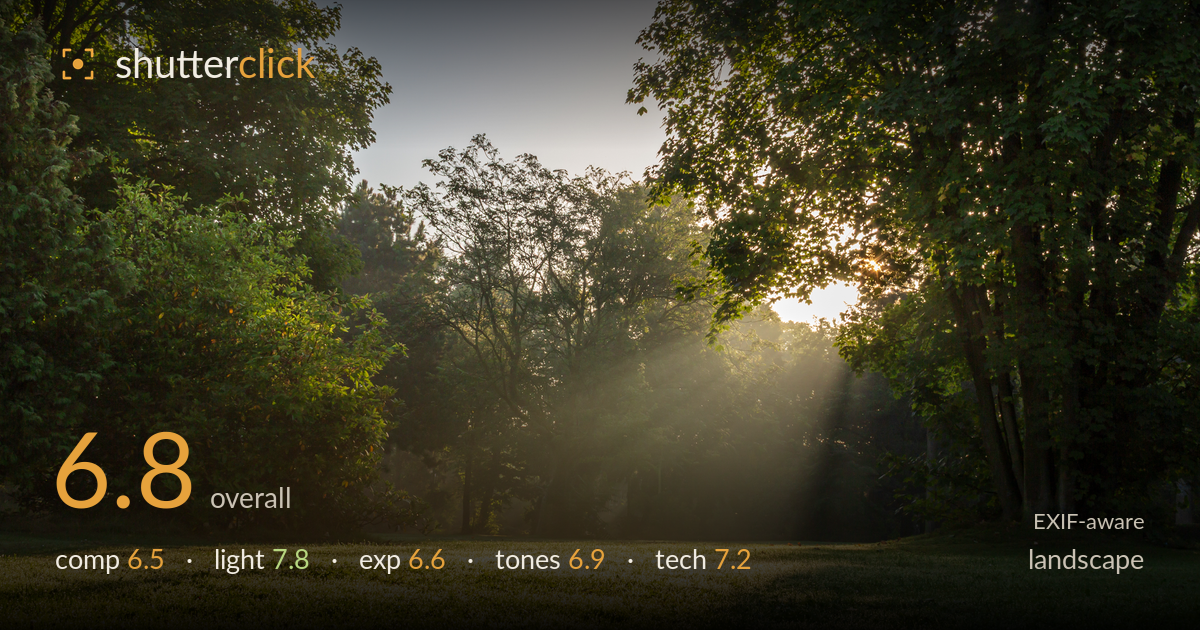
Morning sunbeams through the trees
Photo by Dietmar Rabich

| Focal length | 25 mm |
| Aperture | f / 16.0 |
| Shutter | 1/60 s |
| ISO | ISO 100 |
| Exp. comp. | 0.0 EV |
| Shot at | 08:22 · Sep 16, 2012 |
The light-rays cutting through the tree gap and catching the dew-laden grass are the whole photograph, and they carry it. Backlit sunbeams raking across a bright foreground meadow give real atmosphere at a golden hour. What holds it back is composition and structure: the frame is symmetrical and slightly static, the empty upper sky occupies a large, featureless block, and the sun and beam origin sit near dead centre without a strong anchoring foreground element. Exposure is a compromise — the flare washes the midground while corners fall dark. Refining the framing and taming the highlight bloom would lift a promising, atmospheric scene into a stronger one.
The scene reads as a symmetrical tunnel — dark tree masses framing left and right with a central gap of sky and sunbeams. That symmetry gives balance but also stasis; nothing leads the eye beyond the obvious central glow. The large expanse of empty upper sky feels underused and top-heavy, while the beautiful dew-lit foreground grass is given comparatively little room. A lower vantage emphasising the sparkling foreground, or a slight reframe to place the sunbeam gap off-centre, would introduce more dynamism and depth.
This is the image's strongest asset. Low backlight streaming through the gap in the canopy produces visible god-rays and lights the wet grass with a warm glow — genuine golden-hour atmosphere. The rim-lit foliage edges add dimensionality. The trade-off is that direct backlighting into the lens creates a bright, low-contrast bloom across the central meadow, flattening midground detail. Shooting a few minutes earlier or partially occluding the sun behind a branch would preserve the ray effect while retaining more contrast.
The exposure is a reasonable compromise for a high dynamic range scene, but it is stretched. The sun's flare and the brightest grass patches are close to clipping and lose texture, while the framing trees and lower corners sink into near-black with little recoverable detail. The overall balance leans toward protecting the highlights, which is sensible, yet the shadows carry no separation. Bracketing and blending, or a gentler exposure with shadow lift in post, would hold both ends more gracefully.
The warm-cool split — golden beams against cool blue-grey sky and deep green shade — is pleasant and appropriate to the hour. Greens are natural without oversaturation. The atmospheric haze softens contrast attractively in the midground. However, the brightest area shows a slightly milky, washed cast from the flare, and the sky is a flat, desaturated grey-blue that lacks the warmth the light suggests. A touch more contrast in the bloomed zone and a subtle warm-up of the sky would unify the palette.
The settings suit the intent well. f/16 delivers front-to-back sharpness appropriate for a landscape and also yields the faint sunstar in the gap, though at this aperture diffraction slightly softens fine detail — f/11 would have been a sharper sweet spot for this lens while keeping ample depth. ISO 100 keeps the image clean and noise-free. The 1/60s shutter is fine for a static scene with IS engaged, no motion issues visible. At 25mm the 18-135mm covers the framing adequately, though this consumer zoom is not the sharpest and flares readily when shooting into the sun, contributing to the central veiling glow. Focus appears set on the midground trees and holds acceptably across the frame. A lens hood or careful shading, plus stopping back to f/11, would sharpen the result and reduce the low-contrast wash. Overall execution is competent and deliberate for the conditions.
What would elevate it
Tags
Shot something like this?
Expert photo critique, on demand — scored across six categories, EXIF-aware. Start with 3 free critiques, no credit card.
critique my photo — free