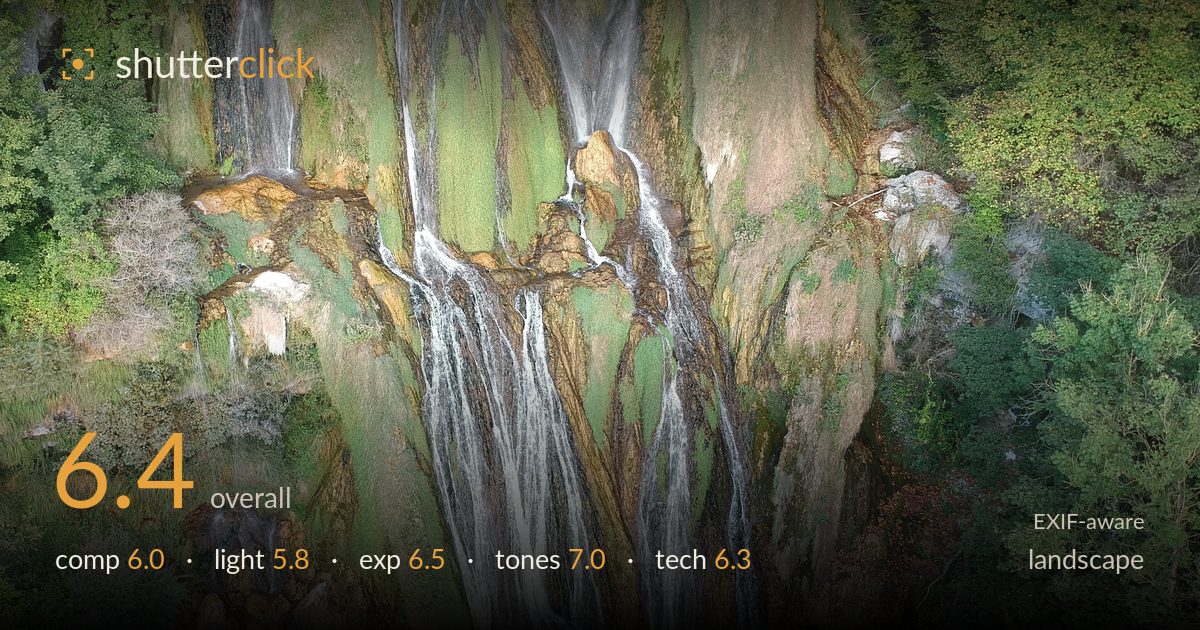
Moss-draped waterfall from above
Photo by Benoît Prieur

| Focal length | 4 mm |
| Aperture | f / 2.6 |
| Shutter | 1/60 s |
| ISO | ISO 100 |
| Exp. comp. | 0.0 EV |
| Shot at | 17:47 · Oct 7, 2019 |
A striking natural subject — a broad tufa waterfall draped in vivid moss green — captured from an elevated drone vantage that reveals the whole cascade at once. The moss-and-mineral colour palette is the strongest asset, genuinely unusual and worth chasing. What most holds the frame back is the flat, midday light that mutes the texture of the rock face and leaves the whole scene feeling even and low in contrast. The framing is also caught between two ideas: neither a clean symmetrical study of the falls nor a decisive off-centre composition. A more considered angle and softer light would lift this considerably.
The aerial view flattens the falls into a full-frame tapestry, which reads more as texture than as depth. The main cascade sits roughly centred, with green forest crowding both edges symmetrically — an arrangement that feels default rather than chosen. The plunge pool at the bottom edge is cropped tight, cutting off a natural resting point for the eye. Framing that let the water lead from the top-right feeder streams down to a fully included pool would give the strong diagonal flow of the falls somewhere to resolve, rather than trailing off the bottom.
Flat, high-sun light dominates. The illumination is even across the rock face, which keeps detail visible but strips away the modelling that would make the tufa's ridges and pockets read three-dimensionally. There are no shaped shadows to give the cascade form, and the whitewater lacks the sparkle that raking light provides. Soft overcast would tame the water highlights further and saturate the greens; low-angle side light near golden hour would rake across the mineral face and reveal its sculptural texture. As shot, the light describes the scene without dramatizing it.
Exposure is well judged for a high-dynamic-range subject. The whitewater retains texture rather than blowing to paper white, and shadow detail holds in the darker mineral streaks and the pool. Midtones in the moss sit comfortably. The frame errs slightly bright overall, which flattens contrast, and the darkest water at the bottom edge is a touch murky. A small negative exposure adjustment, or a graduated recovery on the brightest cascades, would add snap without sacrificing the shadow information that is currently well preserved.
The colour is the standout: the saturated moss green against warm ochre mineral and cool grey-white water is a genuinely appealing palette, and white balance is neutral and believable. The greens avoid tipping into cartoonish oversaturation. Contrast, however, sits low — a consequence of the flat light — so the tonal range bunches in the midtones and the image lacks a true black point. A modest contrast lift and a touch of clarity on the rock face would give the tones more separation and let the water read crisper against the green.
The DJI FC1102 (Mavic-series) settings are largely sensible for a static landscape from the air. ISO 100 keeps noise negligible and preserves the fine detail in moss and rock. The fixed f/2.6 is wide open, but at a 4mm sensor focal length depth of field is deep enough that near-to-far sharpness across the falls is maintained, so the aperture is not a limitation here. The main technical concern is the 1/60s shutter from a hovering drone: that is slow for an aerial platform and risks micro-vibration softness, and it also freezes the water into stringy strands rather than either a crisp freeze or a silky flow. Overall sharpness looks acceptable but not tack-crisp across the frame. A faster shutter (1/250s or quicker) would eliminate any airframe shake, while a deliberate long exposure with an ND filter and a stable hover would give the water intentional motion. Focus and noise control are both handled well.
What would elevate it
Tags
Shot something like this?
Expert photo critique, on demand — scored across six categories, EXIF-aware. Start with 3 free critiques, no credit card.
critique my photo — free