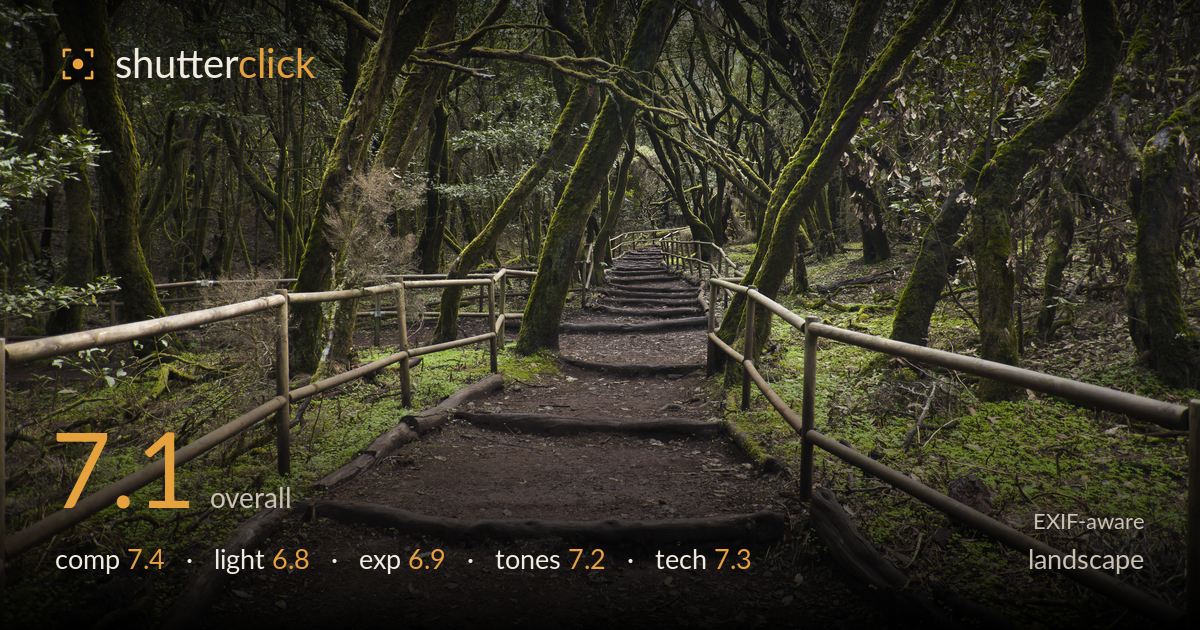
Mossy forest path winding upward
Photo by Diego Delso

| Focal length | 24 mm |
| Aperture | f / 4.0 |
| Shutter | 1/80 s |
| ISO | ISO 500 |
| Exp. comp. | 0.0 EV |
| Shot at | 14:07 · Dec 15, 2012 |
A well-structured woodland scene that uses its path and railings as strong leading lines drawing the eye into the moss-draped laurel forest. The wide 24mm framing captures the enclosing canopy and gives real depth as the trail climbs toward the steps. What most holds it back is the flat, overcast light — atmospheric for this humid forest, but it leaves the deep shadows muddy and the whole frame low in contrast and slightly murky. A touch more separation between the path and the dark understory, and cleaner shadow rendering, would lift it from a competent record into something more immersive.
The converging path and the twin runs of wooden railing form a natural funnel that pulls the eye from the broad foreground up the steps into the forest — a textbook use of leading lines. The foreground log and split trail add a genuine sense of scale and entry point. The canopy arching overhead completes the tunnel effect nicely. The busy tangle of trunks on the left edge competes a little for attention, and the very foreground centre is a touch empty, but overall the depth and layering are handled with intent.
The soft, shadowless overcast light suits the damp laurel forest and renders the moss evenly without harsh hotspots — a sensible read of the conditions. But it is also the frame's biggest limiter: the light is flat and directionless, so the trunks lack the raking modelling that would reveal their texture, and the deep understory falls into an undifferentiated murk. A break of dappled sun or a thin mist catching light down the path would have added the depth and mood this scene is reaching for.
Exposure is broadly well judged for a tricky high-dynamic-range woodland — the bright railings and lighter background gaps are held without blowing out, and the path retains detail. The shadows in the dense left and lower areas, however, block up into near-black with little recoverable detail, flattening that side of the frame. Midtones sit a shade dark overall, contributing to the murky feel. Lifting the shadows in post and nudging the midtones brighter would open up the forest floor without sacrificing the highlight control already achieved.
The green-and-earth palette is authentic to the environment, with the moss greens providing welcome pops against the brown path and grey trunks. White balance leans slightly cool-neutral, which reads honest for overcast shade. The tonal range is compressed, though — the flat light leaves contrast low and the darker regions muddy rather than richly deep. A gentle contrast lift with a little more separation in the greens, and marginally warmer midtones, would give the scene more vitality without pushing it into oversaturation.
Solid execution from the 5D Mark II and 17-40L. At 24mm and f/4, depth of field is sufficient to keep the path and most of the forest acceptably sharp, though f/8–f/11 would have tightened the far background and the near foreground simultaneously — worthwhile for a static landscape shot from a tripod. ISO 500 is a reasonable compromise for the dim forest and keeps noise well controlled on this sensor. The 1/80s shutter is fine for a handheld static scene with no moving subjects. Focus appears placed around the mid-path steps, which is a sensible choice for carrying the eye through. The wide zoom is the right tool here, and the moderate 24mm avoids the extreme distortion the 17mm end would introduce. The main technical gain available is a smaller aperture on a tripod for front-to-back sharpness, paired with a lower ISO for the cleanest possible files given the static subject.
What would elevate it
Tags
Shot something like this?
Expert photo critique, on demand — scored across six categories, EXIF-aware. Start with 3 free critiques, no credit card.
critique my photo — free