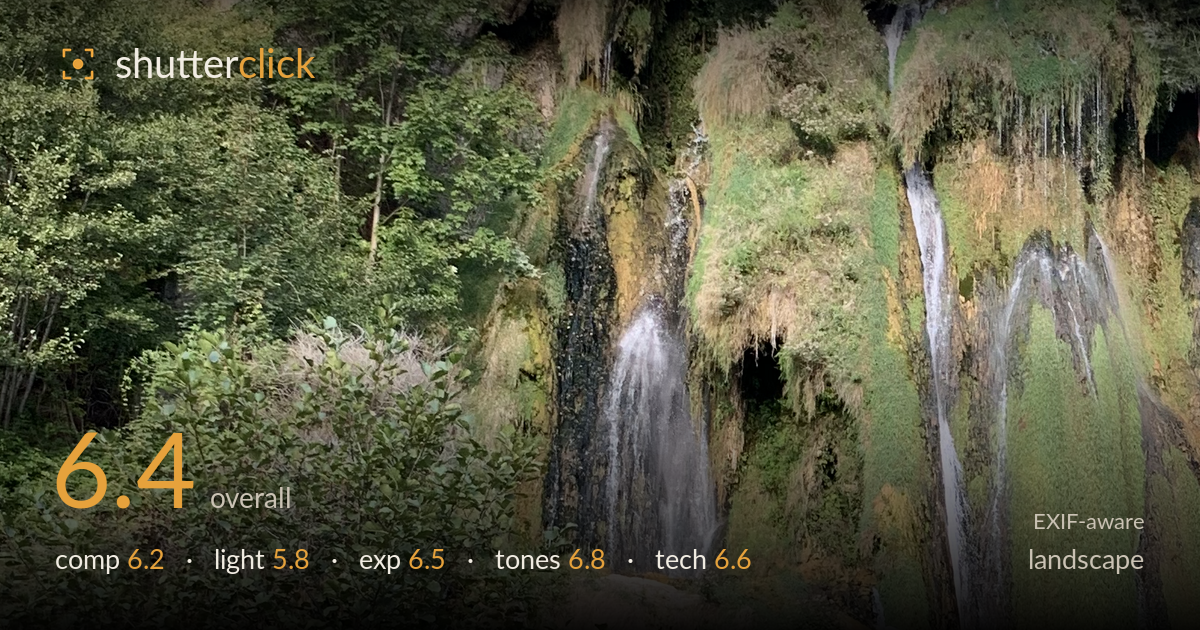
Mossy waterfall in the woods
Photo by Benoît Prieur

| Focal length | 4 mm |
| Aperture | f / 1.8 |
| Shutter | 1/121 s |
| ISO | ISO 32 |
| Exp. comp. | 0.0 EV |
| Shot at | 17:42 · Oct 7, 2019 |
A striking tufa waterfall cascading over vivid green moss-covered rock is the real draw here, and the frame captures its scale well. What most holds the image back is the busy, competing framing: encroaching foliage on both sides crowds the falls, and the eye is pulled between several parallel cascades without a clear anchor. The flat, midday overhead light dulls what could be a luminous scene. The stone wall in the lower right adds welcome foreground interest and a sense of place. A cleaner vantage and softer light would let this location's unusual colour and texture truly sing.
The vertical format suits the tall, layered cascade and conveys its height. But the heavy foliage crowding both edges pinches the falls and creates a cluttered frame rather than a clean channel to the water. The plunge pool and stone wall at the base give a useful anchor and scale reference, though the wall sits awkwardly cropped at the right edge. The multiple parallel water threads compete for attention without a single dominant line. A step to one side, or a longer focal length isolating the main plunge, would resolve the visual congestion.
The light is the weakest element: flat, overhead midday sun with a bright but hazy sky. This produces even but lifeless illumination that flattens the moss-covered rock and mutes the depth of the falls. The upper cascades sit in slightly harsher light while the pool falls into shade, giving uneven rendering across the frame. There are no shaping shadows to reveal the tufa's texture. Overcast diffusion or the softer, raking light of early morning would model the terraced rock far more three-dimensionally and lift the greens.
Exposure is well controlled for tricky conditions. The bright water retains detail without blowing out to pure white, which is a real achievement against dark surrounding foliage. The sky holds cloud texture rather than clipping. Shadows in the lower shrubbery and the pool go fairly dark but retain enough information to read. The overall brightness sits comfortably in the midtones. The main limitation is the compressed dynamic range imposed by the flat light rather than any exposure error — the histogram appears cleanly placed with minimal clipping at either end.
The greens are the standout: the moss and foliage carry rich, believable saturation, and the ochre-and-rust streaks in the tufa add welcome warm contrast against them. White balance reads natural, with the sky a clean blue. Contrast is a touch flat, a direct consequence of the diffuse midday light, leaving the scene slightly hazy overall. The water renders neutral white without colour cast. A modest contrast and clarity lift in post would separate the tonal layers and give the greens more punch without pushing into artificiality.
Shot on the iPhone XS at its native 4.25mm f/1.8, ISO 32, 1/121s — sensible automatic choices for bright daylight. The low ISO keeps noise negligible and the file clean. At this tiny focal length, everything from the near shrubs to the distant falls sits within the deep depth of field, so front-to-back sharpness is good, though fine detail in the water and moss softens under the phone's aggressive noise reduction and sharpening on close inspection. The 1/121s shutter freezes the water into crisp threads rather than rendering it as silky motion — a stylistic fork: a longer exposure with an ND filter or a phone long-exposure mode would give the falls a flowing, ethereal quality that better suits the subject. The wide lens also exaggerates the foreground foliage and pushes the falls back, reducing their apparent scale. A modest optical crop or the phone's tele lens, if available, would compress the scene and emphasise the cascade. Focus and handholding are both sound.
What would elevate it
Tags
Shot something like this?
Expert photo critique, on demand — scored across six categories, EXIF-aware. Start with 3 free critiques, no credit card.
critique my photo — free