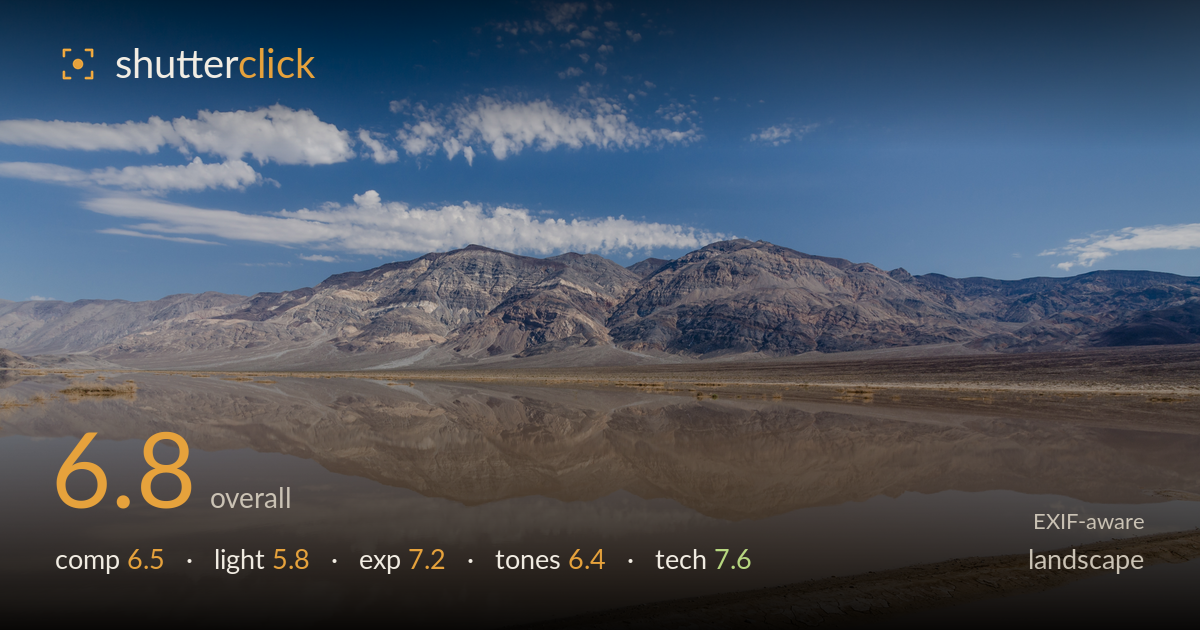
Mountain reflection on a desert lake
Photo by Tuxyso

| Focal length | 17 mm |
| Aperture | f / 10.0 |
| Shutter | 1/80 s |
| ISO | ISO 100 |
| Shot at | 10:08 · Sep 14, 2013 |
A temporary desert lake delivers a strong, clean reflection of the mountain range — the central draw here, and it holds together well. The diagonal mud bank crossing the lower frame is the smartest compositional element, adding foreground texture and a leading edge that keeps the eye moving. What most holds the shot back is the flat midday light, which leaves the mountains grey and low in contrast, and a horizon parked almost dead-centre that splits the frame evenly. The scene has genuine atmosphere; sharper timing and a decision about what the frame is really about would lift it.
The diagonal cracked-mud bank is the best decision in the frame — it breaks the symmetry, adds foreground texture, and pulls the eye through. Beyond it, though, the horizon sits almost exactly mid-frame, splitting sky, mountain, and reflection into near-equal bands and diluting the impact. Committing to the reflection by dropping the horizon, or to the sky by raising it, would give the image a clear priority. The mountain range is well placed left-of-centre, and the cloud spread balances the blue expanse nicely.
Flat overhead midday light is the main limitation. The mountains read grey and undifferentiated, their ridgelines and geological layering muted by the lack of directional shadow. Nothing shapes the terrain or gives the range depth. A low, raking side light at golden hour would carve out the ridges, warm the rock, and reward the reflection with far richer material to mirror. The bright even light does keep the reflection clean, but the scene is asking for drama the hour can't provide.
Exposure is well handled across a demanding range. The bright sky and clouds retain highlight detail without clipping, and the shadowed rock faces hold texture in the darker folds. The cracked mud bank keeps its highlights while showing surface detail. Nothing looks accidental — the histogram appears to sit comfortably with headroom at both ends. If anything, the midtones in the mountains sit slightly flat, but that stems from the light rather than the exposure choice itself.
The blue sky is clean and the muddy tan water reads honestly, but the overall palette leans flat and slightly cool through the mountains, which come across grey rather than the warmer earth tones the terrain likely holds. White balance is broadly neutral. The reflection is softer and more muted than the range above it, which is natural but flattens the lower half. A touch more contrast and warmth in the rock would separate the geological bands and give the tonal range more life.
Settings are well chosen for the scene. At 17mm the wide field captures the sweep of range, sky, and reflection, and f/10 delivers front-to-back sharpness that keeps both the near mud bank and distant peaks acceptably crisp — sensible for a deep landscape. ISO 100 keeps noise negligible and preserves clean tonal gradation in the sky. At 1/80s the static scene is comfortably sharp, though a tripod would have allowed stopping down further or a slower shutter for a mirror-still reflection surface. Focus appears set well into the scene, giving good depth-of-field coverage. The D7000 sensor handles the dynamic range adequately here, holding highlights and shadows. The only reservation is that f/10 on this body sits near the point where diffraction begins to soften fine detail; f/8 would have been marginally sharper with still-ample depth. Overall the execution is clean and deliberate — the technical decisions serve the image and impose no real limitation on it.
What would elevate it
Tags
Shot something like this?
Expert photo critique, on demand — scored across six categories, EXIF-aware. Start with 3 free critiques, no credit card.
critique my photo — free