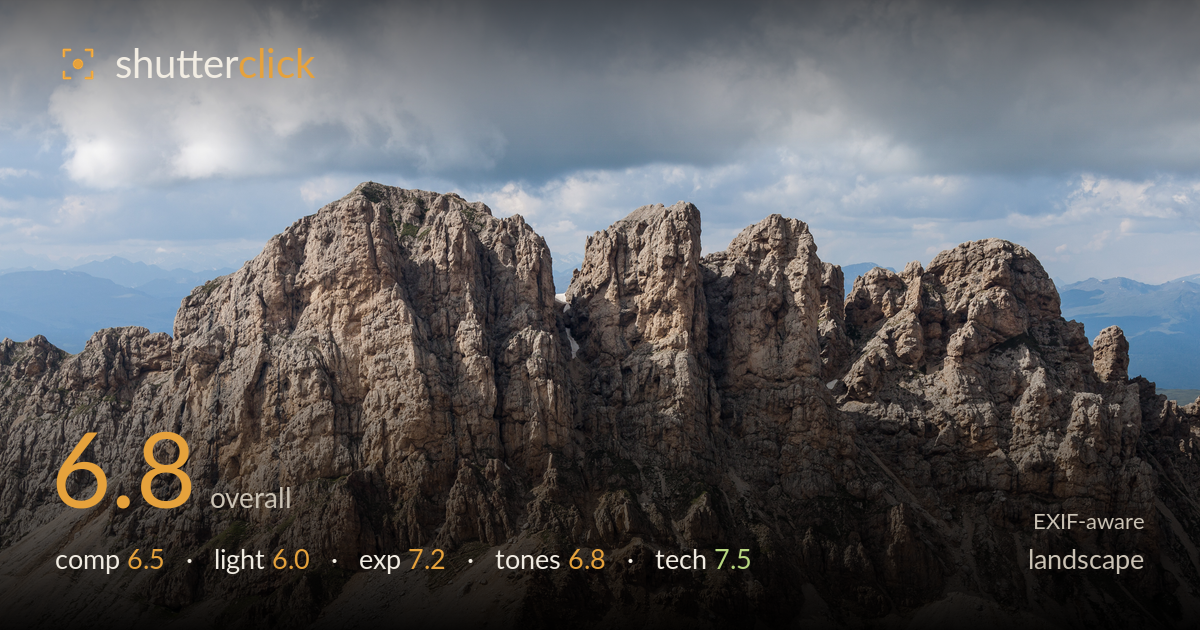
Mountain refuge below jagged peaks
Photo by Ansgar Koreng

| Focal length | 40 mm |
| Aperture | f / 11.0 |
| Shutter | 1/125 s |
| ISO | ISO 100 |
| Exp. comp. | 0.0 EV |
| Shot at | 16:48 · Jun 26, 2014 |
A commanding Dolomite massif fills the frame with genuine texture and scale, and the red-roofed refuge anchors the base with a welcome sense of human proportion. What holds it back most is flat midday light: the overhead sun leaves the rock evenly lit and slightly lifeless, robbing the jagged pinnacles of the dimensional relief they deserve. The composition leans heavily on the central peak with little foreground beyond the dark rock lip, which reads more as a distraction than an anchor. Stronger raking light and a considered foreground would transform a solid record shot into something with real depth and mood.
The ridgeline is placed well, filling roughly two-thirds and leaving breathing room above for the moody sky. The small refuge in the lower left is a smart scale cue and rewards a second look. Weaknesses: the dark, out-of-focus rock lip along the bottom edge adds little and crowds the base, and the framing is fairly centred on the dominant peak with the interest weighted left. A cleaner or more purposeful foreground element, and slightly more asymmetry in peak placement, would give the eye a stronger path into the scene.
This is the shot's main limitation. The light is broad and near-overhead, filtered through heavy cloud, which flattens the rock faces and mutes the deep shadow-to-highlight modelling that makes Dolomite spires read as three-dimensional. The pinnacles on the right catch a little more shape, but overall the relief stays soft. The overcast sky is dramatic in its own right, yet it isn't doing the rock any favours. Low, raking side light near golden hour would carve out the vertical fissures and gullies far more emphatically.
Exposure is well judged for the difficult tonal spread. The bright cloud retains detail without blowing out, and the rock holds midtone information across a wide range. The darker foreground rock at the base sits low but not crushed, and the distant blue ridges keep separation. The histogram appears to use its full width without clipping either end meaningfully. At ISO 100 the file is clean. A touch more overall brightness would open the shadowed rock faces slightly, but the balance here is deliberate and sound.
The warm sandstone browns of the rock sit naturally against the cool blue-grey haze of the far ranges, giving pleasant depth cues. White balance looks accurate under the overcast light. Contrast is a little flat overall — a direct consequence of the soft light — so the image reads slightly muted, particularly in the midtone rock. The sky's greys are handled well without going murky. A modest contrast and clarity lift in the rock, plus a small dehaze on the distant ridges, would add the punch the tones currently lack.
The settings are well matched to the subject. f/11 is an appropriate choice for a deep-focus landscape and, on the EF-S 18–55, sits near the sharpest part of the aperture range while avoiding heavy diffraction. Focus is placed on the massif and depth of field carries acceptable sharpness from the rock face through to the distant ranges. ISO 100 keeps the file clean with no visible noise, and 1/125 s at 40mm is comfortably fast enough to eliminate any hand-shake at this focal length. The 40mm setting gives a natural, undistorted rendering that suits the scale of the scene. The main technical ceiling is the aging 15-megapixel sensor and the kit lens's modest resolving power — fine rock detail is present but not razor-crisp when viewed closely, and the corners soften slightly. Nothing here is a mistake; the execution is competent throughout. A tripod and a two-frame focus blend, or a polariser to cut atmospheric haze and deepen the sky, would extract more from the same gear.
What would elevate it
Tags
Shot something like this?
Expert photo critique, on demand — scored across six categories, EXIF-aware. Start with 3 free critiques, no credit card.
critique my photo — free