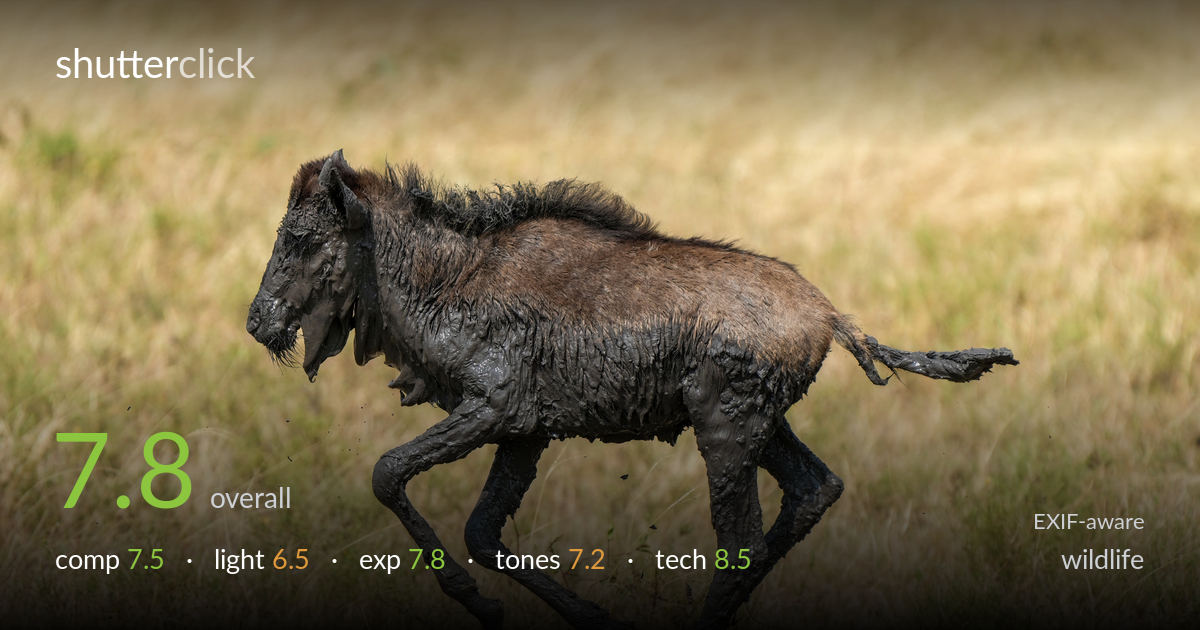
Mud-caked wildebeest calf at full gallop
Photo by Giles Laurent

| Focal length | 600 mm |
| Aperture | f / 6.3 |
| Shutter | 1/2000 s |
| ISO | ISO 400 |
| Exp. comp. | 0.0 EV |
| Shot at | 07:54 · Jul 10, 2024 |
A mud-caked wildebeest calf at full gallop, all four legs off the ground — the moment and behaviour are the real strength here, and they're frozen cleanly. The animal's textured, dripping coat reads beautifully against the soft golden grass, and the diagonal of the running pose carries energy across the frame. What most holds it back is the light: flat overhead midday sun does little to model the form or add depth. The head is slightly low and partly turned away, weakening eye contact, and the background, while pleasant, lacks separation in the lower legs where mud meets grass. Still, a strong, characterful capture.
Placing the calf left of centre and facing into the open frame gives the run somewhere to go, and the diagonal of the body and trailing tail builds momentum. The full mid-stride suspension, with all legs airborne, is well caught and anchors the frame. The lower legs tangle slightly against the grass, costing some clarity of the leg geometry. A touch more headroom and slightly less space behind would tighten the energy, and a marginally lower angle would lift the subject off the background.
Hard, near-overhead midday sun is the main limitation. It renders the wet, muddy coat with reasonable specular sheen, which actually suits the slick texture, but it flattens overall form and offers little directional modelling. Shadows fall directly beneath the body and add little shape. The face, already dark with mud, falls into a flat, low-contrast mass that struggles to read. Softer, lower side light — early morning or late afternoon — would rake across the texture and separate the animal from the grass far more convincingly.
Exposure is well judged for a tricky subject: a near-black, mud-coated animal against bright dry grass. The highlights in the grass hold without clipping, and the dark coat retains enough detail to show the dripping texture across the flank and legs. The face is the darkest zone and edges toward muddy shadow, but that's largely the subject itself rather than an error. Zero exposure compensation worked here. A small lift in the shadows during processing would recover a little more detail in the head region.
The warm golden grass and the cool near-black of the wet mud make a clean, natural colour pairing with good separation by value if not by hue. White balance reads accurate for harsh daylight. The coat shows a pleasing range from deep black through brown along the back and rump. Contrast runs a little high from the midday light, and the darkest areas of the face compress toward a single tone. A gentle reduction in global contrast with a shadow lift would restore gradation where it's lost.
Execution is excellent and the gear is used to its strengths. At 600mm on the ILCE-1, 1/2000s cleanly freezes a galloping calf with all legs airborne — no motion blur in the body, and even the flicked mud droplets are crisp. Focus sits on the shoulder and body, sharp where it counts on the textured coat; the face is marginally softer, a combination of its dark, low-contrast mud mass and the shallow plane at this reach. f/6.3 is the natural wide end of this zoom and gives just enough depth to hold the body while melting the background into smooth, non-distracting blur. ISO 400 is well chosen for the bright conditions, keeping noise negligible and tonal latitude high. The 200-600 is the right tool for the working distance, and the OSS plus high shutter combination delivers a clean, stable result. The only meaningful gain would be nailing critical focus on the eye rather than the shoulder.
What would elevate it
Tags
Shot something like this?
Expert photo critique, on demand — scored across six categories, EXIF-aware. Start with 3 free critiques, no credit card.
critique my photo — free