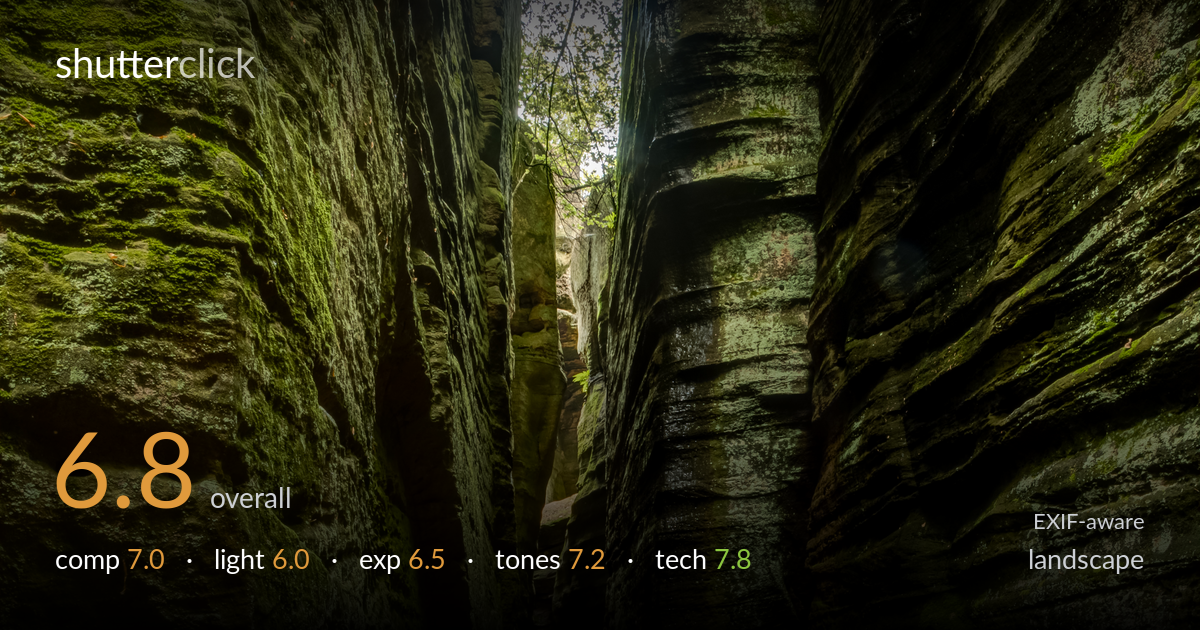
Narrow mossy passage through the rocks
Photo by Dietmar Rabich

| Focal length | 15 mm |
| Aperture | f / 14.0 |
| Shutter | 1.0 s |
| ISO | ISO 100 |
| Exp. comp. | -1.33 EV |
| Shot at | 10:39 · May 24, 2015 |
A claustrophobic slot canyon rendered with real presence — the converging mossy walls funnel the eye toward the bright sliver of sky and overhanging branches, and the leaf-strewn floor gives the depth a tangible anchor. The wide focal length exaggerates the squeeze effectively. What most holds it back is the lighting situation: the flat, shadowless overcast light flattens the rock texture that should be the star, and the blown sky gap at top fights the otherwise contained, moody interior. The frame also leans slightly, and the left wall dominates a touch heavily. Strong material, a hair short of fully resolved.
The narrowing passage creates strong depth, with both walls acting as converging leading lines toward the lit gap and the trickle of branches above — a natural vanishing point. The leaf-covered floor anchors the foreground and gives scale. The split between the heavy left wall and the textured right column is reasonably balanced, though the left mass carries slightly too much weight low in the frame. The vertical orientation suits the subject. The bright sky wedge at top, however, pulls attention out of the contained space rather than rewarding the upward look.
Soft overcast light fills the canyon evenly, which avoids harsh contrast but also robs the layered sandstone of the raking definition that would make its bedding planes and moss really read. The brightest patch is the open sky at top, creating a tonal imbalance against the dim interior. There is no directional shaping to model the rock faces — everything sits in the same flat register. Shooting when a shaft of directional light rakes across the walls, or in deeper shade to balance the sky gap, would transform the texture.
The -1.33 EV compensation was a sensible call to protect the bright sky slot, yet that wedge still clips to pure white, losing the branch detail silhouetted against it. The shadowed lower walls hold up reasonably with recoverable detail, and the midtone moss sits well. The overall balance is a touch dark in the deepest crevices. Given the static subject and tripod-length shutter, this was a clear candidate for exposure bracketing to recover the sky while opening the foreground floor a stop or so.
The green-on-stone palette is the photo's strongest asset — the moss reads in a believable range of olive to deep emerald, and the warm rust of the leaf litter on the floor provides a welcome complementary accent against all that green. White balance sits neutral and convincing for shade. Contrast is moderate and appropriate to the soft light, though the deepest shadow pockets verge on muddy. A gentle lift in the darkest crevices and slightly more separation in the green midtones would add dimensionality without looking processed.
The settings are well matched to the situation. At 15mm, f/14 delivers deep front-to-back sharpness across the entire passage, and the rock detail near and far holds together cleanly — focus appears well placed in the mid-passage. ISO 100 keeps the file clean with no visible noise even in the shadowed walls, which is exactly right for a static landscape. The 1-second shutter confirms a tripod, sensible for this light. One caution: f/14 on this APS-C sensor sits near the point where diffraction begins to soften fine detail slightly; f/9–f/11 would have preserved a touch more crispness in the rock texture while still covering the depth needed at this wide angle. The 15-85mm is a fine general lens here and the wide end serves the cramped space well. The slight tilt — the walls converge a little off-true — is the main execution flaw, easily corrected in post but cleaner fixed with a level on the tripod.
What would elevate it
Tags
Shot something like this?
Expert photo critique, on demand — scored across six categories, EXIF-aware. Start with 3 free critiques, no credit card.
critique my photo — free