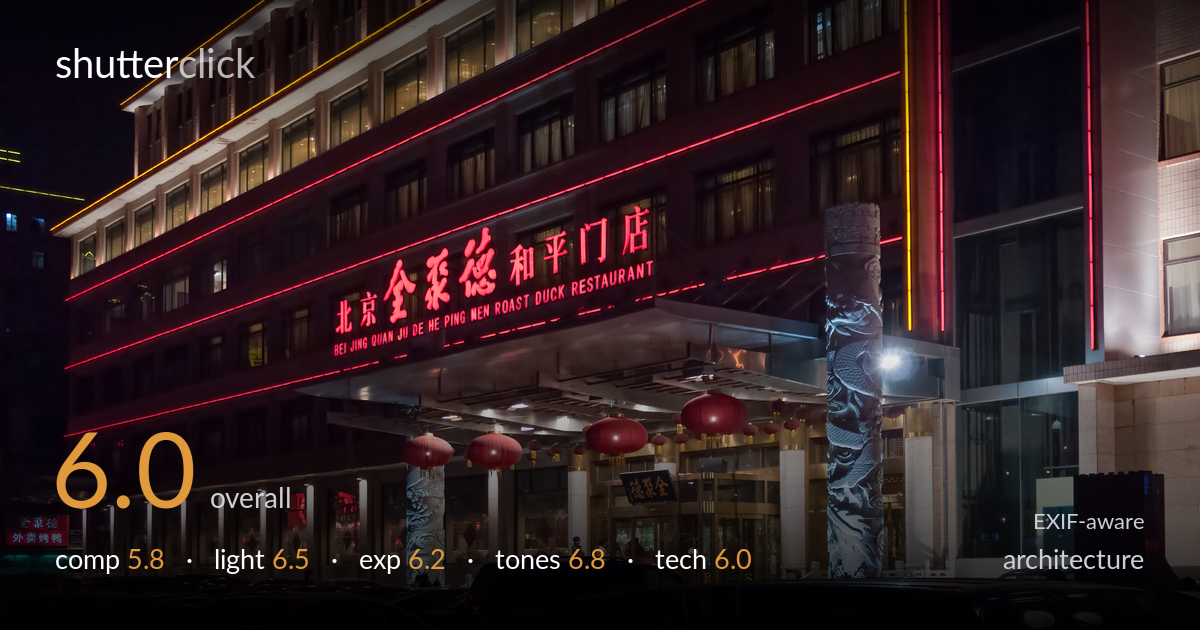
Neon-lit roast duck restaurant at night
Photo by Ermell

| Focal length | 20 mm |
| Aperture | f / 2.2 |
| Shutter | 1/100 s |
| ISO | ISO 400 |
| Exp. comp. | 0.0 EV |
| Shot at | 19:21 · Jan 2, 2011 |
A solid record of a brightly lit Beijing roast duck restaurant facade, with strong red neon and the carved dragon column giving the frame two genuine focal anchors. The biggest drag on the image is the foreground: a row of parked cars eats the bottom third and adds nothing but visual clutter, while the building's right edge runs out of frame, leaving the geometry feeling cut short. Converging verticals lean noticeably and the horizon sits a touch off. The colour rendering of the neon against the warm interior glow is the photo's real asset — a cleaner vantage point and corrected verticals would let that strength carry the shot.
The diagonal sweep of the facade and the vertical of the dragon column create a workable two-point structure, and the central entrance with its red lanterns gives the eye a clear destination. The foreground parked cars are the main weakness — they occupy nearly a third of the frame and contribute only clutter, pulling weight away from the architecture. The building's right side runs out of frame abruptly, truncating the geometry. A higher shooting position or a tighter crop excluding the car roofs would let the facade breathe and read as the subject.
The mix of red neon trim, warm tungsten interior glow, and the cool spotlit dragon column gives the scene genuine energy and depth, typical of strong night architecture. The illumination defines the building's layered floors well and the entrance canopy reads clearly. The carved column is nicely raked by its uplight, revealing relief detail. The weakness is range: the upper sky and recessed sections fall into featureless black, and the brightest neon edges are at the threshold of blooming. Overall the artificial light is used effectively to shape the facade.
Exposure is balanced for a difficult high-contrast night scene. The interior window glow and neon hold detail without heavy clipping, and the midtones on the stone facade are placed sensibly. The dragon column's spotlight is the brightest area and sits near the edge of blowout but largely holds. Shadows in the parked-car foreground and upper sky go fully black, which is acceptable at night but swallows some structure. The neon reds are dense and saturated rather than clipped, suggesting deliberate metering. A slightly brighter exposure with shadow recovery in post would reveal more facade texture.
The colour palette is the image's strongest aspect: the saturated reds of neon and lanterns play against warm interior amber and the cool silver-blue of the spotlit column, giving a rich, characteristically Chinese night mood. White balance leans appropriately warm without going orange. Contrast is high, which suits the subject, though it crushes the darker areas. The reds are dense and just shy of oversaturation — they remain legible. Tonal gradation in the mid-grey stone is smooth. A touch less red saturation would keep the neon from overwhelming finer detail.
At f/2.2 on the 20mm Lumix, depth of field is shallower than ideal for architecture — fine for a flat facade at distance, but the foreground cars and the dragon column sit at different planes and not everything is critically sharp. Stopping to f/5.6 would have sharpened edge-to-edge and tightened the neon, at the cost of a longer shutter needing a tripod. ISO 400 is a sensible choice that keeps noise low on this older Four Thirds sensor, and 1/100s comfortably freezes the static scene handheld. The 20mm pancake is a good walkaround focal length but its moderate field of view forces the building's right side out of frame and exaggerates the leaning verticals; a slightly wider lens from further back, or a shift lens, would correct the convergence. Focus appears placed on the mid-facade and holds adequately. Overall the settings are reasonable for a handheld grab, but a tripod and smaller aperture would have lifted the technical execution considerably.
What would elevate it
Tags
Shot something like this?
Expert photo critique, on demand — scored across six categories, EXIF-aware. Start with 3 free critiques, no credit card.
critique my photo — free