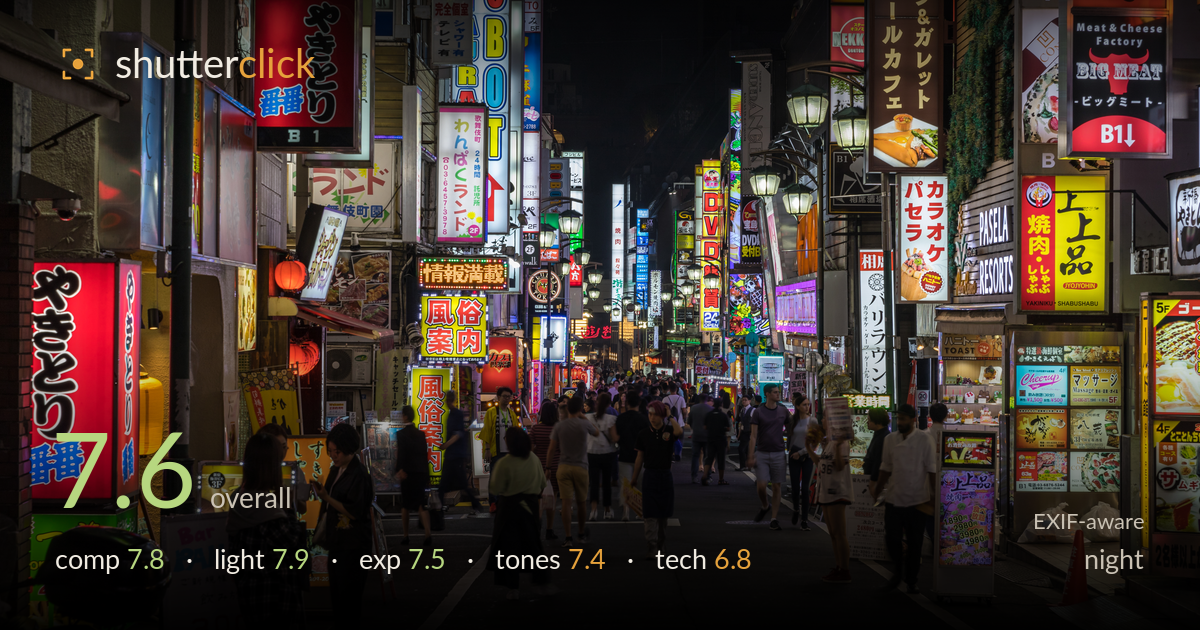
Neon-lit tokyo street at night
Photo by Basile Morin

| Focal length | 70 mm |
| Aperture | f / 8.0 |
| Shutter | 1/8 s |
| ISO | ISO 125 |
| Exp. comp. | 0.0 EV |
| Shot at | 19:44 · Jun 6, 2019 |
A confident, immersive rendering of a Tokyo entertainment district at night, where the density of neon signage becomes the true subject. The street funnels the eye into a dark vanishing point that anchors an otherwise busy frame, and the wall-to-wall signage layering earns the chaos rather than drowning in it. What holds it back most is the shutter speed: at 1/8 s, several foreground pedestrians are motion-blurred where a crisper freeze would have grounded the human scale. White balance also drifts warm-magenta, and the mixed signage colours could hold more separation. Strong sense of place with clear technical room to tighten.
The narrow street converging to a black vanishing point is the strongest structural choice here, pulling the eye deep while the neon walls press in on both sides. The near-symmetrical framing of signage suits the subject's density. Foreground figures on the lower left and right give scale and a place to enter the frame. The crowd thins toward the centre, which reads naturally rather than staged. A slightly lower angle might have separated the nearest pedestrians from the ground clutter, but the balance holds well.
The lighting is entirely the signage and hanging lanterns, and it is handled with a good eye for where the brightest patches sit. The reds and yellows dominate the flanks while cooler blues and greens recede into the distance, building depth through colour temperature. The dark upper sky gives the neon somewhere to breathe rather than a cluttered ceiling. Individual signs clip in their cores, which is nearly unavoidable with emissive sources, but the overall balance keeps the street readable rather than blown.
Exposure is well judged for a scene of extreme dynamic range. The dark sky and street shadows hold without turning to noise, while the majority of signage retains legible text rather than blowing out entirely. The brightest sign cores do clip, but that is expected and acceptable here. The midtones on the pavement and the pedestrians sit a touch dark, leaving the human element slightly buried against the luminous backdrop. A modest shadow lift would recover faces without harming the neon glow.
The colour palette is the appeal and the weakness at once. There is genuine richness in the reds, yellows and cyans, and the distance-based warm-to-cool separation adds depth. However, the overall white balance leans warm and slightly magenta, giving the neutral pavement and building faces a muddy cast. The many competing saturated hues also start to homogenise in the midground where signs overlap. Pulling white balance cooler and selectively taming red saturation would restore separation between the sign colours.
The 1/8 s shutter is the crux of the technical assessment. At ISO 125 and f/8 on the 5D Mark IV, image quality is excellent — clean shadows, deep sharpness across the street, and no meaningful noise. The f/8 aperture was a sound call for a scene where depth from foreground pedestrians to distant signage all matters. The 70mm framing compresses the signage into a satisfying stack. But 1/8 s is too slow for a handheld street scene with moving people: several figures show smearing, and any camera shake at this speed risks softening the whole frame. A tripod plus this exact exposure would have kept the static architecture tack-sharp while letting foot traffic blur intentionally. Alternatively, raising ISO to 800–1600 to reach 1/60 s or faster would have frozen the pedestrians cleanly with negligible noise penalty on this sensor. Focus appears set on the mid-distance signage, which is reasonable, though the nearest faces fall slightly soft.
What would elevate it
Tags
Shot something like this?
Expert photo critique, on demand — scored across six categories, EXIF-aware. Start with 3 free critiques, no credit card.
critique my photo — free