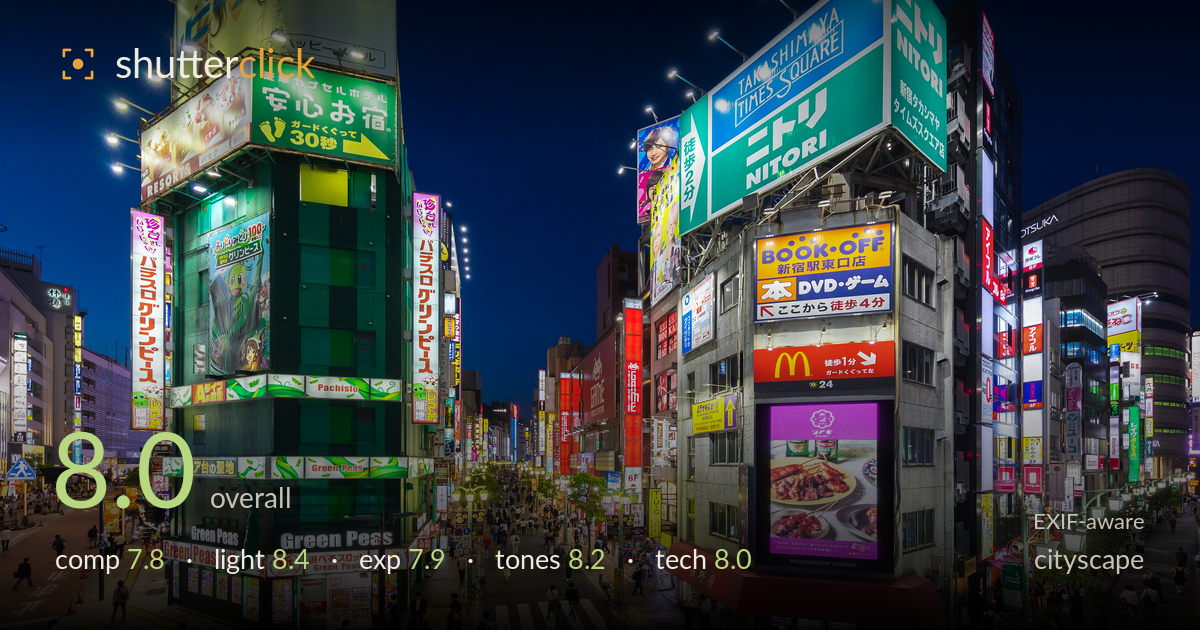
Neon towers at blue hour
Photo by Basile Morin

| Focal length | 11 mm |
| Aperture | f / 5.6 |
| Shutter | 1/30 s |
| ISO | ISO 250 |
| Exp. comp. | 0.0 EV |
| Shot at | 17:25 · Jun 13, 2019 |
A confident, well-timed blue-hour cityscape that captures the sensory overload of a Shinjuku entertainment district without losing structure. The two dominant buildings anchor the frame like bookends, with the central pedestrian street pulling the eye deep into the scene. The timing — that last band of deep cobalt still in the sky against the full blaze of signage — is the shot's strongest asset. What holds it back most is the near-symmetrical two-tower composition, which reads slightly static, and the extreme 11mm wide angle that stretches the flanking buildings at the edges. Clean exposure and rich colour throughout.
The two illuminated towers frame the receding pedestrian street effectively, and that central corridor of people gives real depth. The near-symmetry of the twin-tower arrangement, however, reads a touch static and predictable — the eye ping-pongs between the two anchors rather than settling. Verticals are kept impressively upright for an 11mm frame, though the far-left and far-right buildings splay outward from wide-angle stretch. The lower foreground of empty road and crosswalk is somewhat dead space; a slightly tighter framing or a beat waiting for foreground activity would fill it with purpose.
Timing is the standout here — shooting at the tail of blue hour keeps a rich cobalt in the sky while the neon and LED signage burns at full strength, giving colour separation the sky and the signs would lose an hour later. The mixed artificial sources (green facade wash, magenta video screens, warm street lamps) build genuine atmosphere and depth. The signage is bright but not yet blown, and the ambient sky fill keeps the building faces from going to silhouette. A textbook blue-hour cityscape window, well caught.
A well-judged balance for a scene with an enormous brightness range. The bright signage largely holds colour and legibility rather than clipping to white, and the deep sky retains its blue without crushing to black. Shadow areas in the lower street and building recesses stay open with usable detail. A few of the brightest LED panels and the video billboard nudge toward saturation clipping, which is nearly unavoidable here. Midtones sit comfortably, and the histogram appears to use the full range without accidental darkness — a deliberate, controlled result.
The colour handling carries the image: the cobalt sky plays against warm street lamps and the riot of neon greens, reds and magentas without turning garish. White balance is well judged — neutral enough that the mixed sources each keep their own hue rather than collapsing into one cast. Contrast is punchy but retains gradation in the sky. Saturation is high, appropriate to the subject, and stops short of looking artificially cranked. The overall grade feels true to how a neon district reads at dusk.
The 11-24mm at 11mm is the right tool for cramming two towers and a deep street into one frame, and stopping to f/5.6 gives front-to-back sharpness suited to the layered scene. Verticals are held remarkably straight for such an extreme wide angle, suggesting careful levelling or correction — the main penalty of 11mm is the edge stretching on the flanking buildings, which is inherent to the focal length rather than a fault of execution. ISO 250 keeps noise negligible in the shadows, sensible for a tripod or braced shot. The 1/30s shutter is the one compromise: it renders most pedestrians as soft ghosts, which suits the sense of bustle but means no single figure is crisp. For a static architectural read that's fine; if a sharper crowd were wanted, a faster shutter with a higher ISO would freeze them. Focus and overall corner-to-corner detail are strong.
What would elevate it
Tags
Shot something like this?
Expert photo critique, on demand — scored across six categories, EXIF-aware. Start with 3 free critiques, no credit card.
critique my photo — free