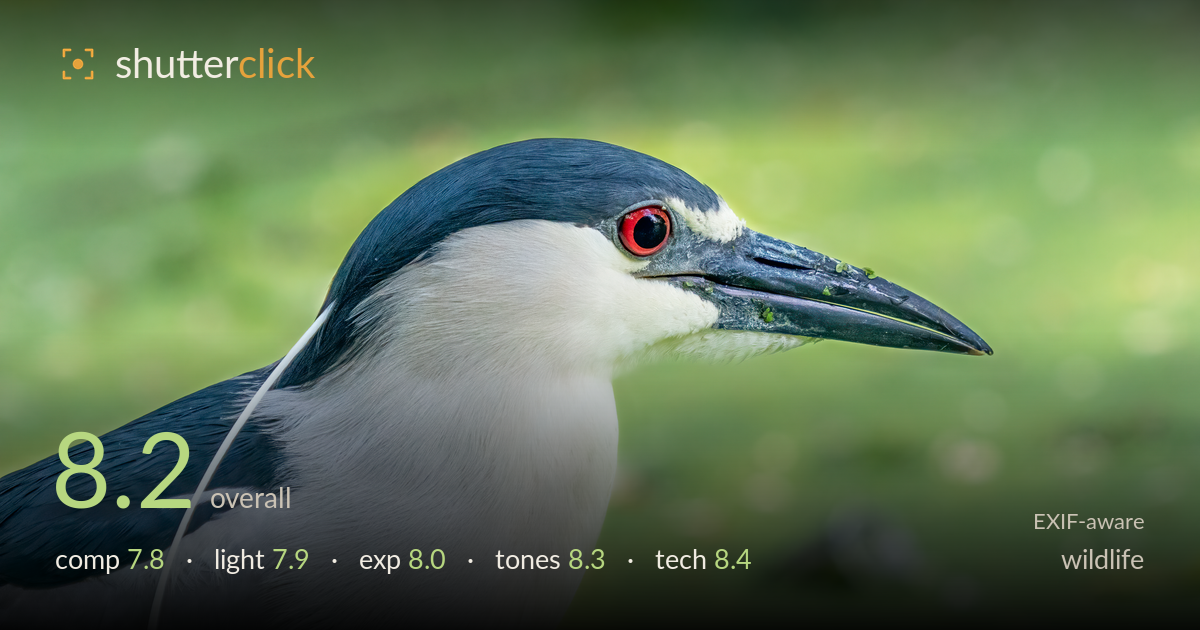
Night heron in soft profile
Photo by Rhododendrites

| Focal length | 270 mm |
| Aperture | f / 5.6 |
| Shutter | 1/500 s |
| ISO | ISO 1250 |
| Exp. comp. | -0.3 EV |
| Shot at | 16:21 · May 23, 2021 |
A clean, high-quality portrait of a black-crowned night heron with a tack-sharp red eye and beautifully rendered plumage detail. The smooth green backdrop isolates the subject perfectly and the diagnostic white plume trailing off the crown adds a graceful line. What most holds it back is framing: the bird sits close to the left edge with its body clipped, and while a heron staring into open space is defensible, the crop feels slightly tight behind the head. Light is soft and flattering but a touch flat. Excellent execution overall, with only compositional refinement separating it from a standout frame.
The profile placement works, with the beak leading the eye into open negative space on the right — a natural reading direction for wildlife. The subject fills the frame with authority and the trailing head plume adds an elegant diagonal. The left-edge crop through the body is aggressive, though, and the head sits high enough that a little more breathing room above the crown would help. The generous space ahead of the beak is the strongest choice here, giving the gaze somewhere to travel.
Soft, diffused light — likely overcast or shade — renders the white breast and grey wing cleanly without blowing highlights, and the red eye reads vividly. Direction is largely frontal-to-side, which keeps shadows gentle and preserves feather detail across the body. The trade-off is a slightly flat, low-dimension look; a touch more directional light would carve the breast contours and add depth. A small catchlight in the eye would have lifted it further, but the eye still holds strong presence.
Exposure is well judged for a subject with both bright white plumage and a near-black crown. The whites retain texture rather than clipping, and shadow detail in the dark cap and wing holds without muddiness. The slight -0.3 EV compensation was a sensible call to protect those highlights against the bright breast. Midtones sit comfortably and the histogram appears well controlled across a demanding tonal range. Nothing looks accidental here — a deliberate, balanced result.
Colour handling is a highlight. The soft green background is smooth and unobtrusive, complementing the neutral bird without competing. White balance reads accurate, with clean whites and neutral greys, and the red eye and blue-black bill carry saturation that feels natural rather than pushed. Contrast is well controlled across the plumage, and the mid-tone gradation on the grey wing is smooth. The overall palette is cohesive and calm, letting the subject dominate.
The 40-150mm f/2.8 with the MC-20 at 270mm delivers excellent reach and clearly resolves fine feather detail, and focus is placed precisely on the eye — exactly where it needs to be for wildlife. At f/5.6 the depth of field covers the head and breast while melting the background into clean bokeh, a good balance for a portrait at this distance. The 1/500s shutter comfortably freezes a stationary bird. ISO 1250 is a reasonable choice on the E-M5 II given the teleconverter's light loss, and noise is well managed with no obvious detail smearing in the shadows. The teleconverter costs a little edge acuity compared to the bare lens, and the plane of focus falls off toward the beak tip, but neither is a real problem for this framing. A slightly faster shutter would offer more insurance against subtle motion, though the result is clearly sharp where it counts. Strong technical execution throughout.
What would elevate it
Tags
Shot something like this?
Expert photo critique, on demand — scored across six categories, EXIF-aware. Start with 3 free critiques, no credit card.
critique my photo — free