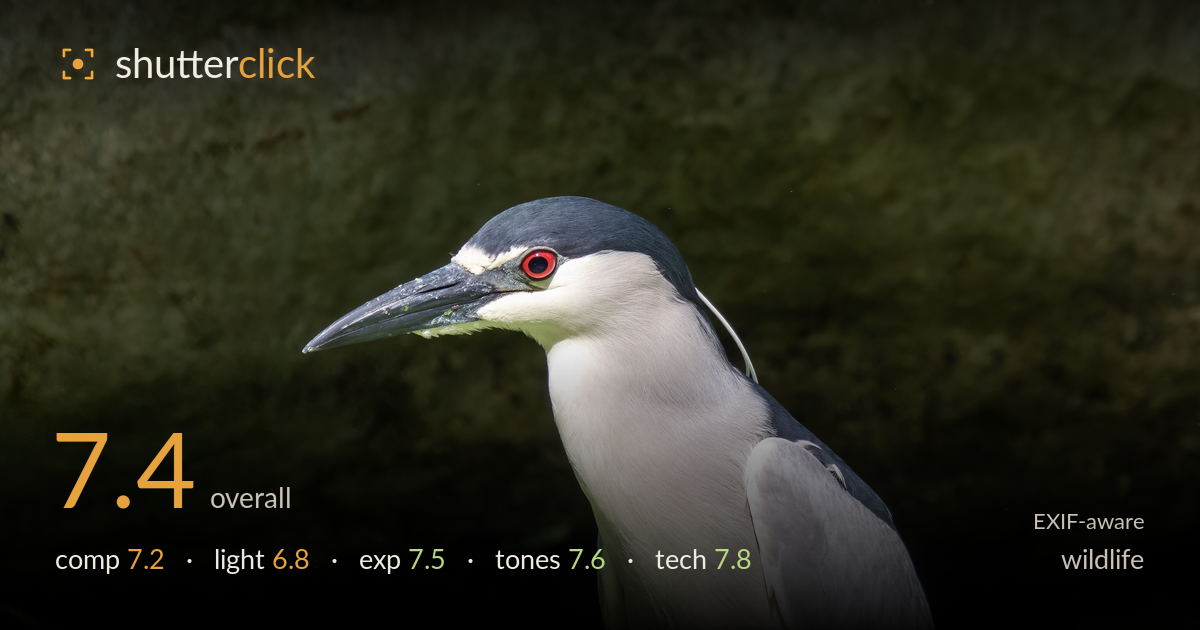
Night heron on a mossy rock
Photo by Rhododendrites

| Focal length | 200 mm |
| Aperture | f / 5.6 |
| Shutter | 1/500 s |
| ISO | ISO 800 |
| Exp. comp. | 0.0 EV |
| Shot at | 16:16 · May 23, 2021 |
A clean, sharp portrait of a black-crowned night heron with the red eye and white nape plume rendered crisply. The bird sits in near-perfect profile on a mossy rock, and the dark background isolates it well, while the green algae underfoot adds a complementary base. What most holds the shot back is the light: high, contrasty sun creates hard highlights on the white plumage and heavy shadow under the beak, and the pose is static — a standard perch shot rather than a moment of behaviour. Tighter placement and softer light would lift it from documentation toward something more compelling.
The profile pose reads clearly and the dark background gives strong subject separation. The bird occupies the right-of-centre space with the beak pointing left into open frame, which works. However, there is generous empty space above the head and the perch anchors the composition low and slightly awkwardly. The gray boulder on the left competes mildly for attention. A crop that reduces headroom and brings the eye and beak nearer a thirds intersection would tighten the read and lend the bird more presence in the frame.
Direct overhead sun produces hard, contrasty light that clips highlights on the white breast and throws a deep shadow beneath the beak and jaw. The dark rock behind does isolate the subject, but the harshness flattens texture in the brightest plumage and hardens the shadow edges. The red eye and crown catch enough light to hold detail, which helps. Softer, lower-angle light — overcast or early/late sun — would tame the whites and reveal more of the feather gradation on the breast.
Exposure is well judged for a difficult subject: the bright white plumage retains most of its detail without blowing out completely, and the shadow-rich background stays dark and clean without crushing distractingly. The midtones on the gray wing and green foreground sit comfortably. A few of the brightest breast highlights push near the top of the range, but nothing is critically lost. No exposure compensation was needed, and the histogram appears to sit sensibly across the range given the high-contrast scene.
The palette works: cool grays and clean whites on the bird set against the saturated green algae make an effective complementary contrast, and the red eye pops as a focal accent. White balance looks accurate and neutral. The gray wing feathers show pleasing tonal gradation. The green foreground is slightly heavy in saturation and pulls a touch of attention, but it stays believable. Shadow tones in the background are deep and clean, supporting the subject without going muddy.
The 40-150mm f/2.8 with the MC-20 at 200mm (400mm equivalent) is well suited to this wildlife subject, and the execution is sound. At f/5.6 the depth of field is enough to hold the whole bird acceptably sharp while the background falls away into clean separation. Focus is accurately placed on the eye — the red iris and surrounding feathers are crisp, and the plumage texture across the neck and breast resolves well. 1/500s comfortably freezes the static pose. ISO 800 is a sensible choice for a Micro Four Thirds sensor here, keeping noise low while maintaining shutter speed; noise is negligible in the final image. The teleconverter costs some maximum aperture and a little bite, but sharpness holds up well. Overall a competent technical package. For a more dynamic result, a faster shutter would provide margin for any sudden movement, and a wider aperture where DOF allows would soften the foreground algae further.
What would elevate it
Tags
Shot something like this?
Expert photo critique, on demand — scored across six categories, EXIF-aware. Start with 3 free critiques, no credit card.
critique my photo — free