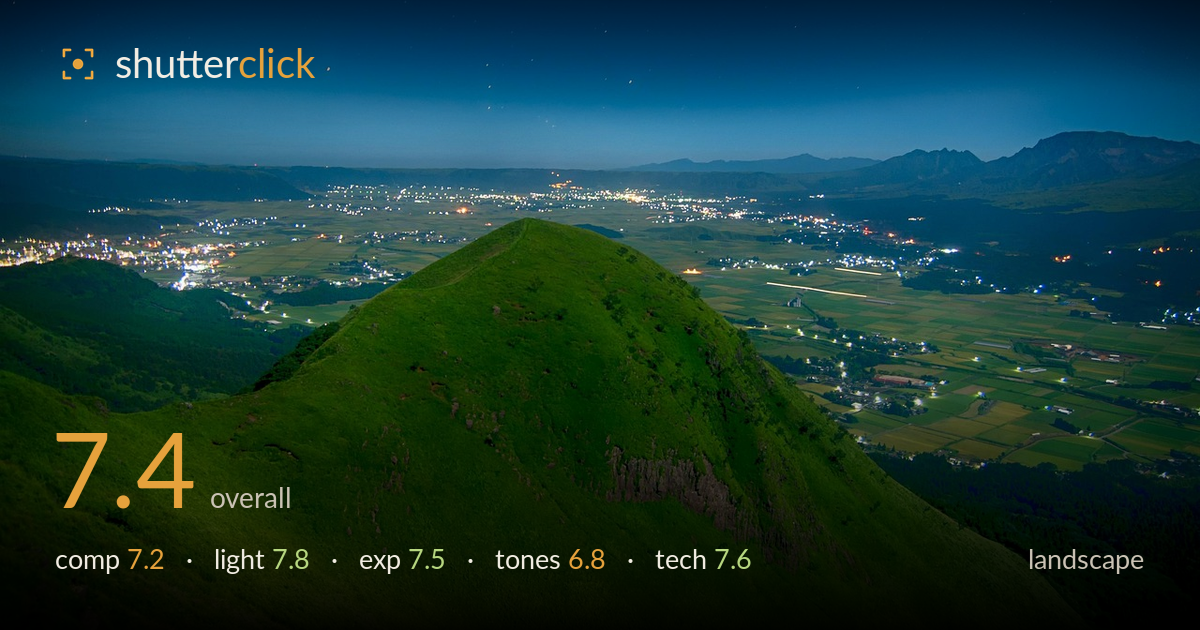
Night lights across the valley
Photo by DeltaWorks

No EXIF metadata in this file
Technical analysis based on visual assessment only.
A confident nightscape that uses a grassy foreground peak to anchor a sweeping valley of scattered town lights beneath a graduated blue-hour sky. The layering — foreground ridge, illuminated valley, distant mountain silhouette, star-flecked sky — creates genuine depth and scale. What most holds it back is the colour: the green foreground reads unnaturally vivid and slightly poisonous against the cool sky, likely from an aggressive white balance and saturation push under low light. The central placement of the peak is bold but leaves the composition feeling slightly split. Strong material with a grade that would benefit from restraint.
The foreground peak works as a solid anchor and its ridgeline draws the eye up into the valley, establishing clear depth from near to far. The distant mountain range and star field close the frame nicely at the top. The horizon sits high, which suits the emphasis on the valley below. The weakness is the near-central peak, which splits attention and pushes the brighter cluster of town lights to the left edge, leaving the right side comparatively empty. Offsetting the peak would balance the light distribution.
Blue-hour timing is well chosen — enough residual sky glow to render the mountains as layered silhouettes while the town lights read as distinct points rather than blown blobs. The gradient from deep upper blue to lighter horizon is handled cleanly and adds atmosphere. The foreground appears lit brighter than ambient moonlight alone would allow, which flattens the peak's modelling somewhat. A raking, lower-angle natural light would have carved more texture into the grass slopes rather than the even, frontal illumination present here.
A well-judged balance for a difficult scene. The town lights hold their form without significant clipping, and shadow detail survives in the mountain ridges and valley fields. The sky retains smooth gradation with visible stars, indicating a controlled exposure that resisted over-brightening. The foreground carries plenty of detail. If anything the green slopes sit a touch hot relative to the darker valley, drawing the eye more than the scene warrants. Overall the histogram appears used across its range with deliberate intent.
This is the weakest area. The foreground green is pushed to an artificial, near-neon intensity that clashes with the naturalistic cool blue of the sky and doesn't read as a night scene. White balance leans heavily cool overall, which suits the sky but exaggerates the green cast on the grass. The blue gradient itself is lovely and the town lights carry believable warm-white and amber tones. Dialling saturation and luminance back on the greens, and warming the foreground slightly, would restore cohesion and believability.
Evidence points to a competent long-exposure night capture. The stars are rendered as crisp points rather than trails, suggesting a short-enough exposure or a wide fast lens, and the town lights are sharp without excessive bloom. Noise is well controlled across the sky and shadow regions, which is impressive given the low light — either a low ISO with a longer shutter on a stable tripod, or careful noise reduction in post. Depth of field is deep, holding the foreground grass and distant mountains acceptably sharp, appropriate for landscape work. Focus on the foreground peak is solid. The wide field of view captures the valley sweep effectively. The main technical caveat is that the foreground brightness and colour suggest heavy post-processing rather than a lighting or exposure fault at capture. Bracketing and blending, or a single cleaner exposure with a more restrained edit, would preserve the technical strengths while avoiding the processed look now visible in the grass.
What would elevate it
Tags
Shot something like this?
Expert photo critique, on demand — scored across six categories, EXIF-aware. Start with 3 free critiques, no credit card.
critique my photo — free