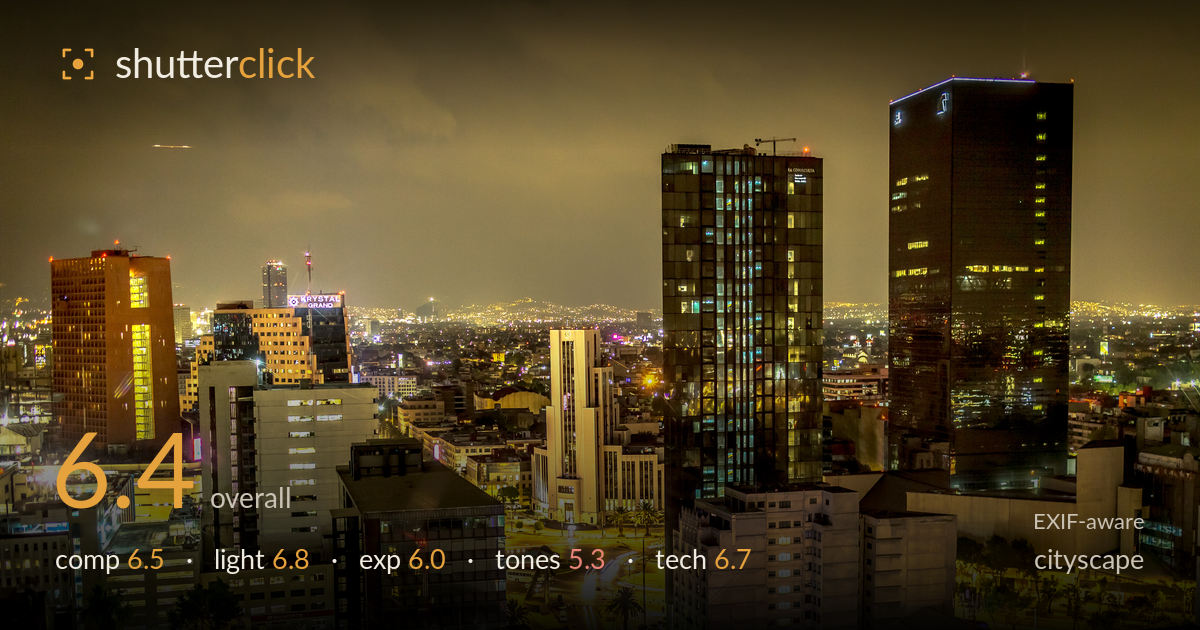
Night skyline over the city
Photo by Sebaso

| Focal length | 22 mm |
| Aperture | f / 2.2 |
| Shutter | 2.0 s |
| ISO | ISO 100 |
| Exp. comp. | 0.0 EV |
| Shot at | 06:02 · Jul 16, 2015 |
A dense, layered night skyline with strong depth from foreground rooftops back to the glowing haze on the horizon, but an aggressive HDR treatment is the main thing holding it back. The tone-mapping flattens contrast, muddies the shadows into grey, and pushes an overall yellow-green cast that robs the scene of clean night blacks. The two dark towers anchor the right side well and the lit avenue draws the eye, yet the framing lacks a single dominant subject or clear resting point. Reining in the processing and correcting white balance would let this genuinely strong vantage breathe.
The high vantage delivers real depth, stacking foreground rooftops, midground towers and a hazy horizon into distinct layers. The two dark skyscrapers on the right form a solid anchor, and the lit avenue snaking through the centre offers a leading line into the frame. What weakens it is the absence of a single dominant focal point — the eye wanders across competing clusters of buildings. The heavy grey sky occupies the top third without cloud interest to justify it; a tighter crop favouring the skyline would strengthen the balance.
The blue-hour timing has passed into full night, so the sky reads as flat overcast grey rather than a graded backdrop, which is a missed window for cityscape work. Where the light does work is at street level: the warm sodium glow along the avenue and roundabout gives the frame its energy, and the lit office windows scattered across the towers add texture. The mix of warm street light against the cooler distant haze creates depth, but a session caught 20–30 minutes earlier would have added colour to that empty sky.
The two-second exposure at ISO 100 gathers plenty of light and holds the bright window and street highlights largely in check. The problem is the shadows: the tone-mapping has lifted them into a flat grey-green, so the darker building faces never resolve into true black and the image loses its sense of night. The overcast sky sits as an undifferentiated bright mass. A lower shadow lift and a deeper black point would restore contrast and punch without sacrificing the recoverable detail already captured.
This is where the image struggles most. The HDR treatment casts a pervasive yellow-green tint across the whole frame — the sky, the grey buildings and the shadows all share the same murky hue, which flattens colour separation. White balance leans too warm overall, leaving no clean neutrals. The compressed tonal range gives the picture a hazy, low-contrast look that undercuts the dynamism of a night city. Pulling the green out, cooling the white balance and rebuilding contrast would transform the mood dramatically.
The core settings are sound for a static night cityscape. ISO 100 keeps noise negligible and the two-second exposure at f/2.2 gathers ample light while the tripod evidently held everything steady — the buildings render sharp edge to edge with no shake. The 22mm (roughly 35mm equivalent on the EOS M's crop sensor) is a reasonable field of view for this layered scene, though a slightly longer lens could have compressed and isolated the tower cluster more deliberately. The main technical caveat is aperture choice: f/2.2 is wide open for a deep-focus landscape, and while the distant subjects stay sharp, stopping down to f/8 would have improved corner sharpness and lens performance without meaningfully lengthening an already forgiving exposure. Some faint light-trail streaks from moving vehicles hint at the potential of a longer exposure to add motion interest. Overall the capture is competent and clean; the limitations lie almost entirely in the heavy post-processing rather than the in-camera execution.
What would elevate it
Tags
Shot something like this?
Expert photo critique, on demand — scored across six categories, EXIF-aware. Start with 3 free critiques, no credit card.
critique my photo — free