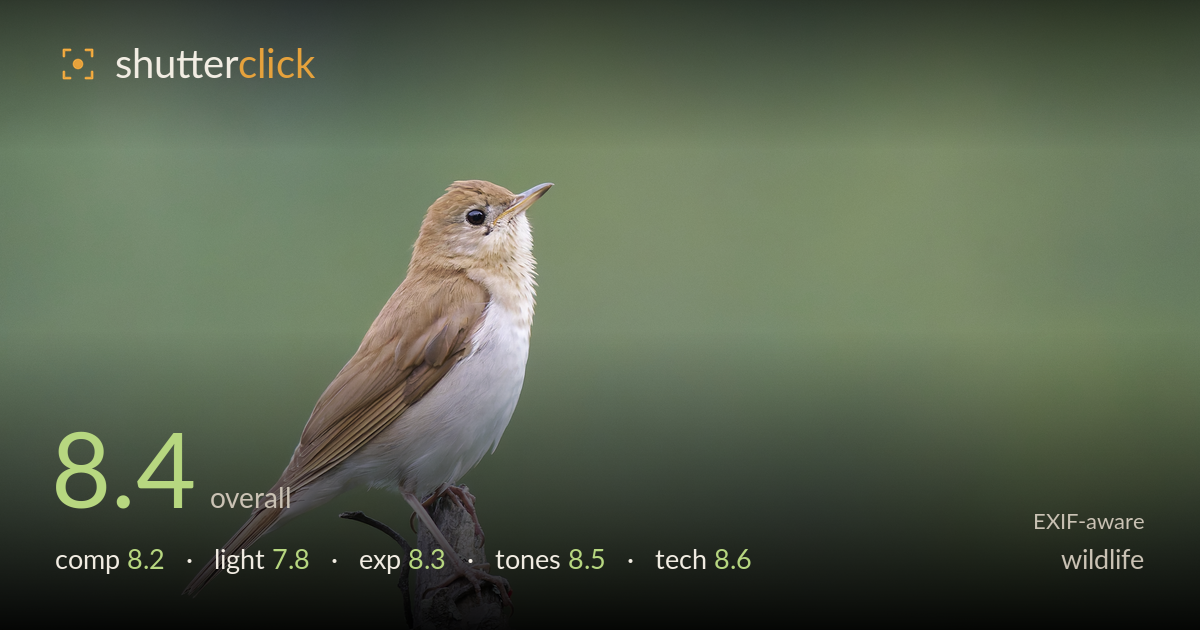
Nightingale on a mossy perch
Photo by Paul Danese

| Focal length | 840 mm |
| Aperture | f / 9.0 |
| Shutter | 1/1250 s |
| ISO | ISO 8000 |
| Exp. comp. | 0.0 EV |
| Shot at | 08:02 · Jul 1, 2025 |
A clean, textbook songbird portrait that lets the subject breathe against a beautifully smooth green wash. The nightingale is sharp where it counts, the perch is characterful, and the generous negative space to the right gives the bird room to look into. What most holds the frame back is the light: it's flat and even, adequate but lacking the directional shaping or catchlight that would lift the head from good to memorable. The composition is safe and well executed rather than daring. Strong fieldcraft and excellent background control carry this into genuinely accomplished territory.
The bird sits low-left on its lichened perch with the head turned into the open frame — a sound choice that gives the gaze room to travel. The wide right-hand negative space is clean and uncluttered, and the mossy stump anchors the base without competing. The perch is positioned near a vertical third. One slight tension: the subject is placed quite low, leaving a large empty upper region that feels marginally heavier than the payoff of the space to the right. A touch more balance between top and side breathing room would tighten it.
The light is soft and even, likely overcast or open shade, which renders the plumage cleanly and avoids harsh shadows across the pale breast. It flatters the warm rufous tones and keeps the whites from blowing. The trade-off is a lack of direction — the head reads a little flat, and there is no strong catchlight in the eye to bring it alive. A low, raking side light or a hint of directional sun would carve the feather contours and add the sparkle that separates a fine record shot from a striking one.
Exposure is well judged for a tricky subject. The white breast retains texture without clipping, and the shadowed underparts and dark eye still hold detail. The green background sits at a pleasant mid-value, neither muddy nor washed. At ISO 8000 the deep shadow areas remain clean, which speaks to careful metering. Nothing looks accidental here — the balance between the bright chest and the darker upper plumage is handled with room to spare in both directions. Highlight roll-off on the breast is smooth and controlled.
The colour palette is the image's quiet strength: warm cinnamon browns against a cool, desaturated green create a natural, complementary harmony that feels calm and unforced. White balance is neutral and accurate, with the breast reading true white and the plumage warm without going orange. The gradation across the background is exceptionally smooth. Saturation is restrained and believable. Only the flatness of contrast — a byproduct of the diffuse light — keeps the tonal range from feeling fully three-dimensional across the bird itself.
The 840mm reach (200-600 with 1.4x TC) delivers strong subject size while the f/9 aperture keeps the whole bird sharp and still melts the background into a creamy wash — a smart choice at this distance since depth of field is razor-thin even stopped down. Focus is placed accurately on the eye and the feather detail across the back and breast is crisp. 1/1250s comfortably freezes a small, twitchy perched passerine. ISO 8000 is high, but the R5-class sensor and the even light keep noise well managed; the shadows are clean and detail holds. This is a well-reasoned settings chain for the conditions — the only conservative note is that with a static bird, dropping to ISO 4000–5000 by opening slightly or accepting 1/800s would have bought cleaner files with margin to spare, though the current result shows no penalty worth worrying about. Handling of a heavy, long combination at this magnification is assured.
What would elevate it
Tags
Shot something like this?
Expert photo critique, on demand — scored across six categories, EXIF-aware. Start with 3 free critiques, no credit card.
critique my photo — free