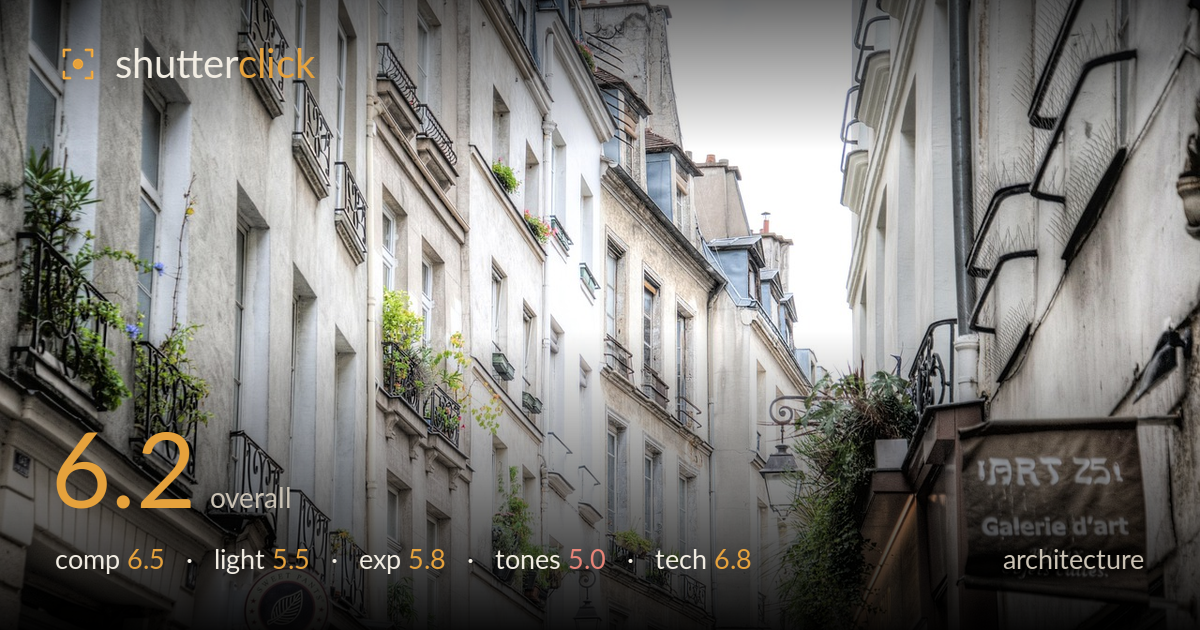
Old facades on a parisian street
Photo by ClickerHappy

No EXIF metadata in this file
Technical analysis based on visual assessment only.
A characterful slice of a Parisian street, with converging facades and window-box greenery that give the frame texture and depth. What most holds it back is heavy HDR processing: the tones are muddied by grey, low-contrast grading and haloing along roof edges against the blown-out sky. The upward tilt creates strong keystoning that reads as accidental rather than deliberate. The eye wanders without a clear anchor. Reining in the tone-mapping, recovering some sky, and committing to a stronger organising line — the receding facade or the gallery sign — would turn a busy record shot into a considered architectural image.
The receding line of facades on the left creates genuine perspective and pulls the eye into the frame, and the gallery sign anchors the right. But the frame is busy without a dominant subject — the eye bounces between window boxes, signage, and rooflines with nowhere to settle. The upward tilt sends verticals converging inward, which reads as an uncorrected accident rather than a deliberate look-up. A cleaner decision about whether the street recession or the sign is the subject would give the composition a spine.
Flat, overcast light does the facades few favours here. Without directional sun there is little to model the ornate ironwork, cornices, or the depth of the window reveals, so the stonework reads soft and dimensionless. The white sky offers no warmth or timing interest. Overcast can work for architecture when it is used for even, shadowless detail, but this needs raking side light to reveal the relief in the plasterwork and balconies. As lit, the scene lacks the sculpting that would make the textures sing.
The sky is fully blown to paper-white with no recoverable detail, and the roofline edges show halo artifacts where the tone-mapping fought the bright background. The facades themselves sit in a usable midtone range with shadow detail intact in the doorways and ironwork, so the building exposure is broadly sound. The core problem is the dynamic range being pushed too hard — the sky was sacrificed and the midtones lifted flat to compensate. A bracketed capture or a graduated adjustment would hold both ends more gracefully.
This is where the image struggles most. The HDR tone-mapping has flattened contrast across the whole frame, leaving a greyish, slightly grimy cast over stone that should read warm and creamy. Blacks are lifted and milky, so nothing feels grounded, and local-contrast enhancement has left crunchy edges and haloing. White balance drifts cool and muddy. Dialing back the tone-mapping, deepening the shadows, and warming the stone would restore the honeyed Parisian palette the scene clearly holds beneath the processing.
Focus is adequate across the plane of the facades, and depth of field appears sufficient to hold the receding buildings acceptably sharp, which suits the deep scene. Detail resolution is reasonable at the pixel level, so the underlying capture is competent. The limitations are processing-driven rather than optical: aggressive HDR merging has introduced haloing along high-contrast edges, particularly where rooflines meet the bright sky, and micro-contrast has been over-cooked, producing a slightly gritty, over-sharpened texture across the stone. There is no visible motion blur or noise of concern. A wider or shifted vantage, or perspective correction in post, would tame the converging verticals that a straight upward tilt produced. The strongest technical move would be a more restrained tone-mapping pass — a single well-exposed frame or a gentler blend would preserve detail without the artifacts that currently undermine an otherwise sharp, well-resolved image.
What would elevate it
Tags
Shot something like this?
Expert photo critique, on demand — scored across six categories, EXIF-aware. Start with 3 free critiques, no credit card.
critique my photo — free