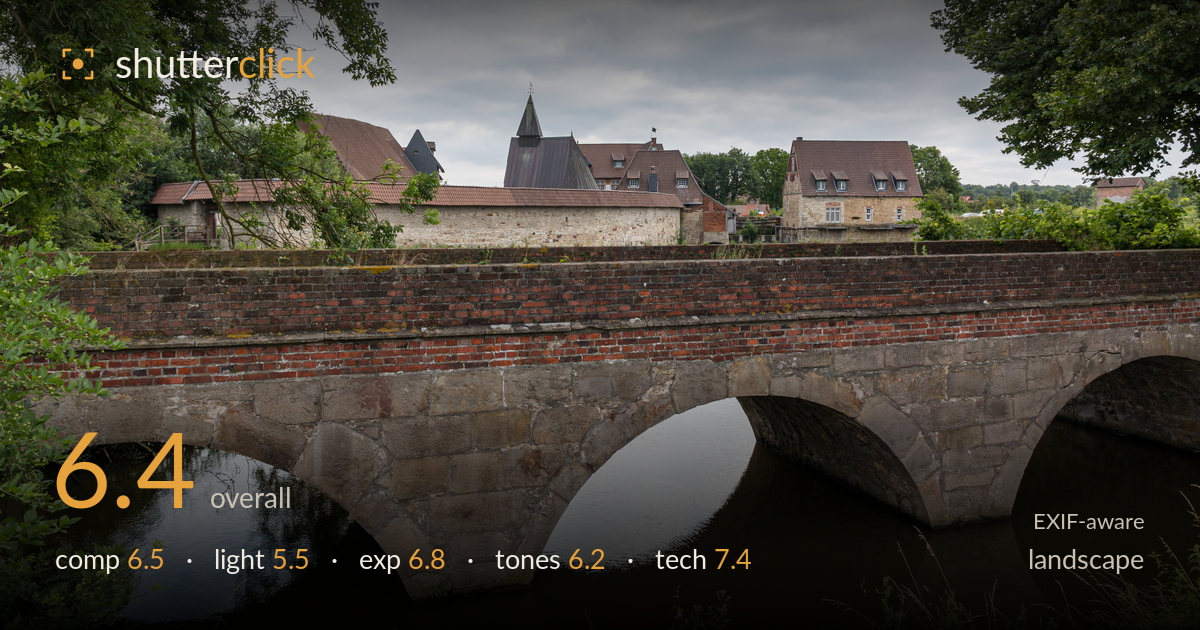
Old stone bridge below the village
Photo by Dietmar Rabich

| Focal length | 17 mm |
| Aperture | f / 9.0 |
| Shutter | 1/60 s |
| ISO | ISO 100 |
| Exp. comp. | 0.0 EV |
| Shot at | 07:45 · Jul 3, 2016 |
A well-organised village scene anchored by a handsome stone-and-brick arched bridge, but flat overcast light keeps it from lifting off the page. The framing trees on both sides do useful work containing the view, and the bridge's arches with their water reflections give the lower half real interest. What most holds it back is the timing: the heavy grey sky is dull and takes up a large, featureless portion of the frame, draining contrast and colour from the whole scene. Stronger directional light and a more decisive relationship between bridge and sky would transform the mood without changing the subject.
The overhanging trees on left and right frame the scene effectively and lead the eye toward the village behind the bridge. The bridge itself is the strongest element, its arches and reflections filling the lower third well. However, the composition is split into competing horizontal bands — bridge, wall, rooftops, sky — without a clear hierarchy, and the church spire, the natural focal accent, sits centred and somewhat buried against the busy roofline. The large expanse of empty grey sky adds little and could be reduced.
The flat, overcast light is the main limitation. It renders the brick, stone and foliage evenly but without modelling, so the bridge's texture and the depth of the arches read softer than they could. There is no directional light to separate the layers of village buildings or to bring out the warmth of the stonework. The diffuse sky does avoid harsh shadows and blown highlights, but for a scene this reliant on texture and depth, raking side light near golden hour would add far more dimension.
Exposure is handled competently for difficult conditions. The bright overcast sky retains detail in the clouds without clipping, and the shadowed undersides of the arches still hold information. Midtones across the brick and stone sit at a reasonable level. The overall reading is slightly flat, which is a consequence of the light rather than an exposure error. A touch more brightness in the shadowed arch interiors, or a graduated approach to hold the sky while lifting the foreground, would balance the tonal spread more evenly.
White balance is neutral and accurate, and the earthy reds of the brick and the warm sandstone are rendered honestly. The problem is that the grey sky drags contrast and saturation down across the whole frame, leaving the greens muted and the stonework lacking punch. The tonal range is compressed toward the middle with few deep blacks or clean highlights. A modest contrast lift and selective warmth on the stone would give the image more life without pushing it into artificiality.
The settings are well matched to the subject. At 17mm and f/9, depth of field is more than sufficient to hold the bridge, village and background trees all acceptably sharp, and the aperture sits in the lens's sweet spot for corner-to-corner detail. ISO 100 keeps noise negligible and preserves clean tonal gradation in the sky. At 1/60s the static architecture is rendered sharply, and image stabilisation on this lens comfortably supports handholding at this focal length. Focus appears accurately placed on the bridge and buildings. The verticals of the houses stay reasonably upright, indicating the camera was kept level, which matters for a scene with this much architecture. The only technical caveat is that the flat light limits how much the resolving power and clean files can show — the execution is sound, but the conditions cap the payoff. A polariser could have deepened the sky and cut glare on the water for a modest gain.
What would elevate it
Tags
Shot something like this?
Expert photo critique, on demand — scored across six categories, EXIF-aware. Start with 3 free critiques, no credit card.
critique my photo — free