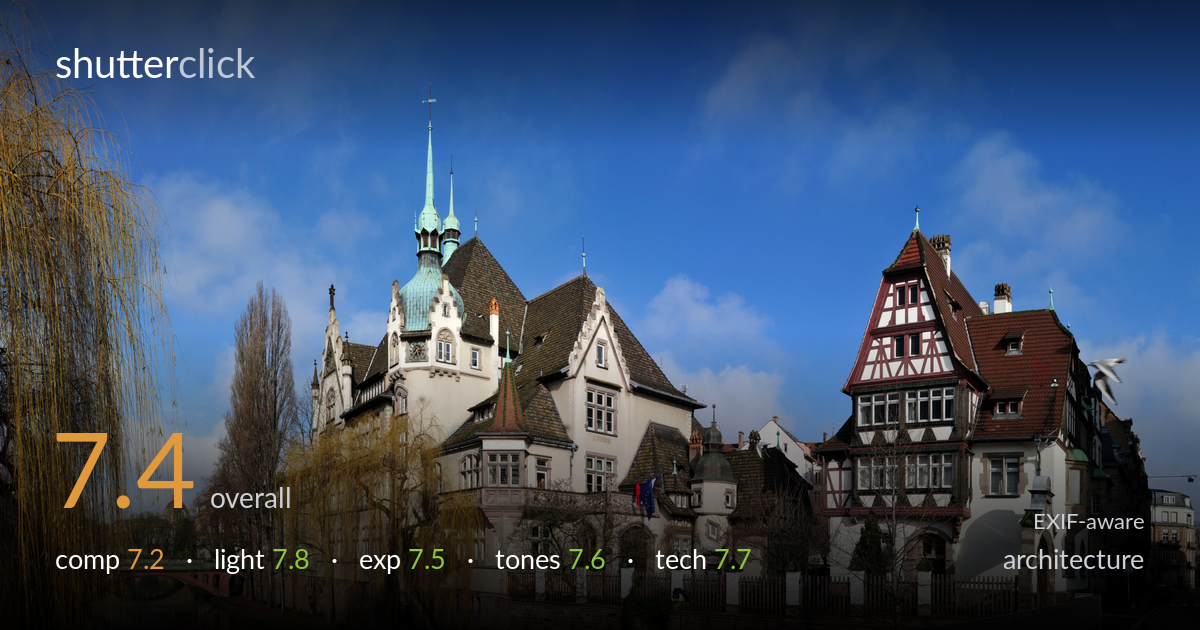
Old town facades along the canal
Photo by Ralf Roletschek

| Focal length | 24 mm |
| Aperture | f / 9.0 |
| Shutter | 1/320 s |
| ISO | ISO 200 |
| Exp. comp. | 0.0 EV |
| Shot at | 12:13 · Feb 2, 2014 |
A handsome rendering of Alsatian architecture, anchored by the convergence of canal, road, and roofline that pulls the eye into the frame. The light is the strongest asset — late-afternoon sun raking across the half-timbered facades with a clean blue sky behind. What most holds it back is the panoramic stitch's tension: the building masses crowd the centre-right while the left side leans on the willow as a soft frame, and verticals on the right house tilt slightly outward. Tighter perspective correction and a more deliberate balance of the wide foreground road would elevate an already pleasing scene.
The diagonal of the canal and the receding road on the right both lead inward, giving real depth, and the overhanging willow softens the left edge effectively. The trouble is balance: the architectural weight piles into the centre-right while the lower-right road carries a large, comparatively empty wet expanse that competes for attention. The bridge and reflection on the left are an asset but sit small and underplayed. A composition that gave the canal side more room, or cropped the dead road area, would tighten the read considerably.
Low, warm sunlight rakes across the facades from the left, modelling the half-timbering and the textured rooflines with genuine dimension. The blue sky and scattered cloud give a clean, uncluttered backdrop that lets the spires read crisply. Shadow direction is consistent and the green oxidised spires pick up cool contrast against the warm masonry. The only limitation is that the right-side house falls into slightly flatter, more frontal light than the museum building, costing it some of the same sculptural quality the left enjoys.
Exposure is well managed across a demanding range — bright sky against shadowed masonry and dark roof tiles. Highlights in the clouds hold texture rather than blowing out, and the white facades retain detail. Shadow areas under the eaves and within the trees stay open enough to read. The wet road and canal reflections sit at sensible midtones. Nothing looks accidental here; the ISO 200 base and moderate aperture kept the file clean and the histogram balanced for the conditions.
White balance leans slightly cool, which suits the blue sky and the oxidised copper spires but pushes the white facades a touch toward grey. Contrast is healthy without crushing, and the saturation feels natural — the brick-red roofs, ochre willow, and teal spires all coexist without any single hue shouting. The blue sky gradates cleanly from deep zenith to lighter horizon. A marginally warmer balance would restore some of the masonry's intended cream and add a little welcome warmth to the overall palette.
The 24mm focal length on the D300S (roughly 36mm equivalent) suits the scene, though this reads as a multi-frame stitch given the field of view and the panoramic aspect. f/9 is the right call for architecture, delivering front-to-back sharpness across the buildings, the willow, and the distant bridge without diffraction softening. ISO 200 keeps noise negligible and tonal gradation smooth, and 1/320s easily froze the scene — generous for static subjects but sensible if shooting handheld for a pano. Focus is accurate across the frame. The chief technical weakness is perspective: the right-side house shows outward-leaning verticals and the stitch introduces some subtle curvature in the rooflines and the long fence rail. A shift lens or careful perspective correction in post would straighten the convergence that architecture rewards. Sharpness, depth of field, and exposure execution are all sound; geometry control is the area with the most headroom.
What would elevate it
Tags
Shot something like this?
Expert photo critique, on demand — scored across six categories, EXIF-aware. Start with 3 free critiques, no credit card.
critique my photo — free