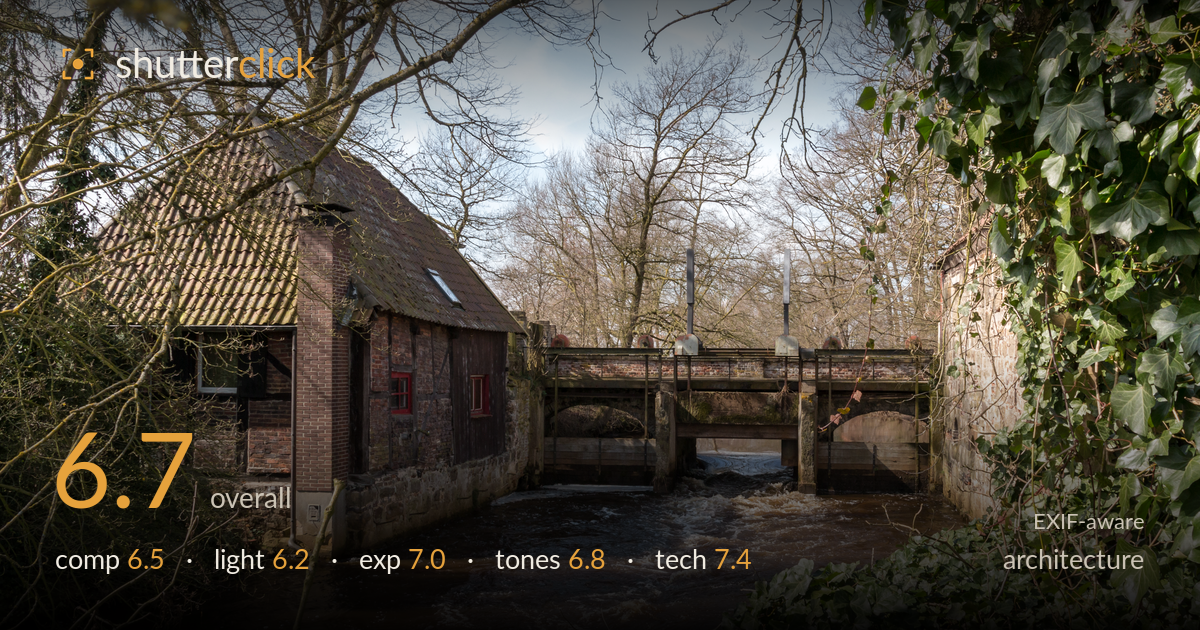
Old watermill above the weir
Photo by Dietmar Rabich

| Focal length | 17 mm |
| Aperture | f / 10.0 |
| Shutter | 1/200 s |
| ISO | ISO 320 |
| Exp. comp. | 0.0 EV |
| Shot at | 14:48 · Apr 3, 2015 |
A watermill and weir framed by winter branches and ivy — an atmospheric location shot that reads more as scene than as architectural study. The old mill's brickwork, half-timbering and red-shuttered windows carry genuine character, and the churning water gives the frame energy. What most holds it back is the busy foreground: bare branches slice across the sky and intrude from every edge, softening the geometry rather than framing it cleanly. The bridge and weir compete with the mill for attention without a clear hierarchy, and flat midday light keeps the architecture from gaining depth. A more decisive vantage point would let the building's forms carry the image.
The framing uses overhanging branches and ivy as a natural border, which suits a woodland setting, but the branches crossing the upper sky are more clutter than frame and pull the eye away from the architecture. The mill on the left and the bridge/weir on the right split attention with no clear primary subject. The rushing water leads the eye into the frame effectively, a genuine strength. A cleaner sightline on the mill, or a lower angle emphasising the weir's arches, would give the composition a firmer anchor.
The light is flat, high, and hard — typical bright midday cover with patchy blue sky. It leaves the mill's textured brickwork and roof tiles without the raking shadow that would reveal their relief, and the mixed sun-and-cloud gives uneven patches across the scene. The white water holds together without blowing out, which is fortunate under this contrast. Softer overcast, or the low angled light of early morning, would model the building's forms and warm the brick far more than this overhead illumination manages.
Exposure is well controlled for a high-contrast scene. The turbulent white water retains texture rather than clipping to paper white, and shadow detail survives in the shaded brick and undergrowth. The bright sky patches sit near the top of the range but hold. Overall the histogram appears balanced with no reckless losses at either end. The 0 EV choice at f/10 was sound here; the scene's dynamic range is wide but has been handled without noticeable highlight burn or crushed shadow, suggesting deliberate metering.
The palette is naturally muted — winter browns, weathered brick reds, and the green ivy providing the one saturated accent. White balance leans slightly cool, which reinforces the damp late-winter mood but leaves the brick a touch lifeless. The red window shutters are a welcome tonal punctuation. Contrast is moderate and the midtones sit a little flat, echoing the light. A gentle warmth in the brick and a small contrast lift would give the tonal range more presence without pushing the scene into artificiality.
At 17mm on the EF-S 15-85, f/10 delivers the deep depth of field this layered scene needs — foreground branches, mill, bridge, and background trees all render acceptably sharp, an appropriate aperture choice for architecture at this distance. ISO 320 is modest and keeps noise invisible. 1/200s comfortably froze the flowing water, though for this weir a slower shutter on a tripod would have blurred the water into silk and cleaned up the foreground's busy detail, trading one look for another. Focus sits well on the mill and holds through the frame. The lens is a sensible walkaround choice and diffraction at f/10 on this sensor is negligible. Verticals are largely upright, with no gross keystoning — commendable for a handheld wide shot. The main technical opportunity is not the settings themselves but the decision to shoot handheld at a fast shutter when the subject rewards a tripod and a long exposure. Execution is clean and competent throughout.
What would elevate it
Tags
Shot something like this?
Expert photo critique, on demand — scored across six categories, EXIF-aware. Start with 3 free critiques, no credit card.
critique my photo — free