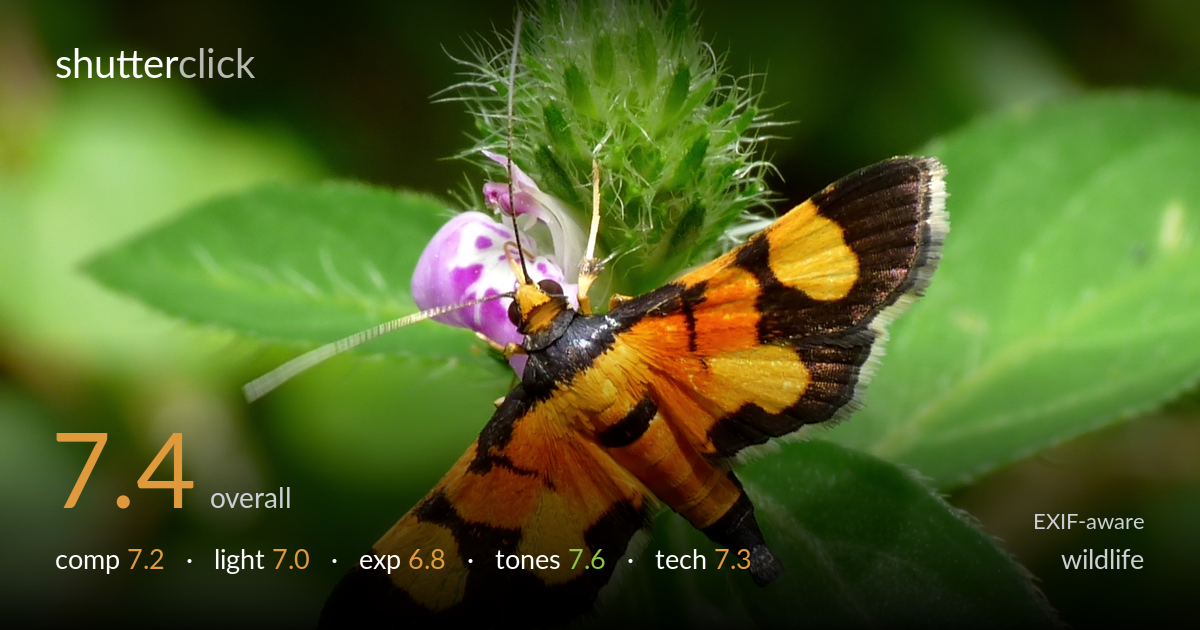
Orange moth feeding on a purple flower
Photo by Jeevan Jose, Kerala, India

| Shot at | 12:23 · Sep 11, 2010 |
A vivid, well-timed capture of an orange-and-black moth feeding on a purple flower, with the wing patterning rendered in genuinely striking colour. The dorsal wings-open view is uncommon and rewards the patience that earned it. The frame's central placement is balanced but slightly static, and a few bright highlights on the body and thorax clip toward pure white. The verdant background reads cleanly but borders on the busy near the flower head. Sharpness sits on the wings rather than the eye, the priority plane for living subjects. Strong source material held back chiefly by focus placement and highlight control.
The moth sits near centre with wings spread into a pleasing triangular spread, and the purple flower adds a welcome colour accent against the green. The diagonal leaf running lower-right gives the frame some structure. Placement is a touch static, though — the subject lands almost dead-centre, and a position favouring the lower-left third would let the wings open into negative space. The cluster of green flower-head texture above competes a little with the moth's head. The clean foliage backdrop otherwise isolates the subject well.
Soft, diffused daylight wraps the scene evenly, avoiding harsh shadows and letting the wing colours read fully. That even quality suits the subject and keeps the green background luminous rather than blocked up. The trade-off is a slightly flat result on the body — there's little directional modelling to give the thorax and abdomen form, and the few specular highlights on the dark body have caught the brightest light. A touch of raking side light would have added dimension to the moth's structure without sacrificing the gentle overall quality.
Exposure is broadly well judged for the green midtones, holding plenty of foliage detail. The orange wings retain saturation without bleeding. The weak point is the highlights: the white scales on the wing tips and the specular spots on the dark thorax and abdomen tip push to clipped white with no recoverable detail. Pulling exposure down roughly a third to half a stop would have protected those small but conspicuous blowouts. The shadows in the black wing bands hold up adequately, with detail still visible in the scaling.
Colour is the photograph's strongest asset — the orange-to-yellow gradient across the wings against the saturated green reads with real punch, and the purple flower provides a complementary accent that lifts the whole frame. White balance sits accurately in neutral daylight. Contrast between the black bands and bright wing patches is bold without crushing. The greens edge toward heavy saturation in places, which can feel slightly artificial; easing them a fraction would keep the moth as the clear chromatic centre rather than competing with the background.
Shot on a Panasonic DMC-FZ28 superzoom, the result is creditable for a small-sensor bridge camera at macro-range distance. Depth of field is sufficient to hold most of the wing plane sharp while throwing the background into smooth blur — a good balance for this subject. The critical issue is focus placement: the sharpest plane sits on the wings and thorax, while the head and eye, the priority for any living subject, fall slightly soft. The long antenna and proboscis are rendered with surprising detail given the gear. Noise is well controlled, suggesting a low ISO and adequate light. The shutter speed has frozen the moth cleanly with no motion blur. For this camera class the detail retrieval is strong, but a focus point biased toward the eye, or a slightly smaller aperture to extend the in-focus zone forward onto the head, would have locked down the most important element. Overall a solid technical execution within the limits of the equipment.
What would elevate it
Tags
Shot something like this?
Expert photo critique, on demand — scored across six categories, EXIF-aware. Start with 3 free critiques, no credit card.
critique my photo — free