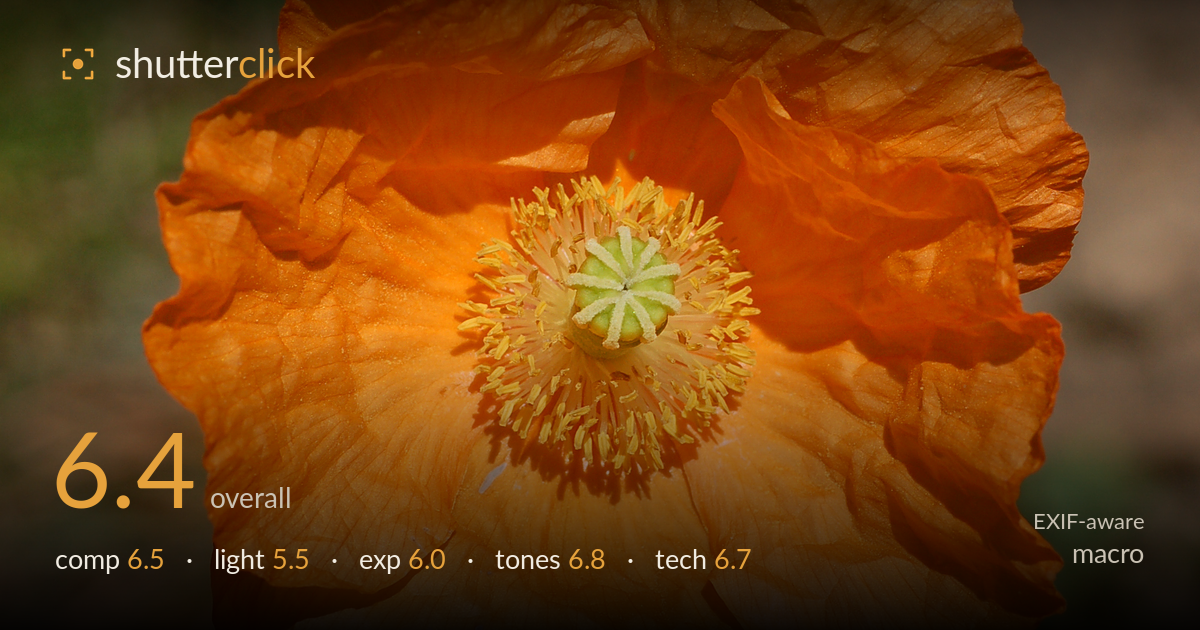
Orange poppy in the sun
Photo by Photo by and (c)2008 Derek Ramsey (Ram-Man). Co-attribution must be given to the

| Focal length | 70 mm |
| Aperture | f / 11.0 |
| Shutter | 1/640 s |
| Exp. comp. | 0.67 EV |
| Shot at | 12:35 · May 25, 2008 |
The papery translucence of the poppy petals is the real reward here — backlight and side light catch the crumpled tissue texture beautifully, and the yellow-green stamen crown reads as a clean, sharp focal anchor. What most holds the image back is harsh midday sun: it blows the upper petals toward washed-out highlights and casts a hard shadow of the stamens across the lower petals, splitting the flower's tonal unity. The bloom sits slightly high and the stem intersects the bottom edge awkwardly. Softer light and a cleaner base would lift this from competent record shot to something with real presence.
The flower fills the frame confidently and the central stamen sits close to a thirds intersection, giving the eye a clear landing point. The single stem descending to the bottom edge anchors the bloom naturally. However, the flower crowds the top edge, with the uppermost petal nearly touching it, leaving little breathing room above while the lower portion has more space. The stem cutting through the bottom-centre is slightly stiff. A fraction more room at the top and a stem placed off-centre would balance the frame more gracefully.
This is the weakest element. Direct overhead midday sun creates hard, contrasty light that washes the upper petals into near-white and throws a distracting hard-edged shadow of the stamens across the lower petals. The backlight does earn its keep by revealing the petals' translucent, tissue-like structure — a genuine strength — but the overall harshness flattens the delicate colour and creates uneven exposure across the bloom. Overcast light or a diffuser would soften the shadows and hold the highlight detail the direct sun is losing.
The +0.67 EV compensation was a reasonable call for a bright subject, but the upper petals still push into blown highlights where the sun hits hardest, losing texture in the lightest areas. The shadowed lower petals and blurred background retain detail. The stamen centre is well exposed and holds its yellow-green tones. Overall it reads as a mostly deliberate exposure fighting difficult light rather than an error, but the clipped highlights on the top petals are the cost of shooting in full sun.
The warm orange gradient — deeper and more saturated at the crumpled outer petals, fading to a paler, translucent apricot below — is attractive and cohesive. White balance looks accurate, with the yellow-green stamen reading naturally against the warm petals. The muted green-brown background provides a complementary, unobtrusive foil. Saturation feels honest rather than pushed. The main tonal weakness traces back to the light: the harsh highlights on the upper petals break the smooth tonal transition, creating a hot patch that pulls the eye from the softer gradations elsewhere.
At 70mm, f/11, 1/640s the settings are sound for a static flower in bright sun. The narrow aperture delivers enough depth of field to hold the stamen crown and much of the near petals sharp — the stamens are crisp and detailed, which is exactly the plane that matters. The fast shutter froze any breeze, and background separation is clean with a pleasantly smooth blur despite f/11, thanks to the close working distance. Focus landed accurately on the central stamens. The 70mm focal length on the D50's crop sensor gives a comfortable working distance without perspective distortion. The trade-off is that f/11 in full sun forced reliance on harsh light rather than allowing a wider aperture in softer conditions. Focus stacking wasn't needed here given the flower's relatively flat presentation to the camera, and the single frame holds the critical detail well. A slightly wider aperture in diffused light would have retained the same key sharpness with better tonal control.
What would elevate it
Tags
Shot something like this?
Expert photo critique, on demand — scored across six categories, EXIF-aware. Start with 3 free critiques, no credit card.
critique my photo — free