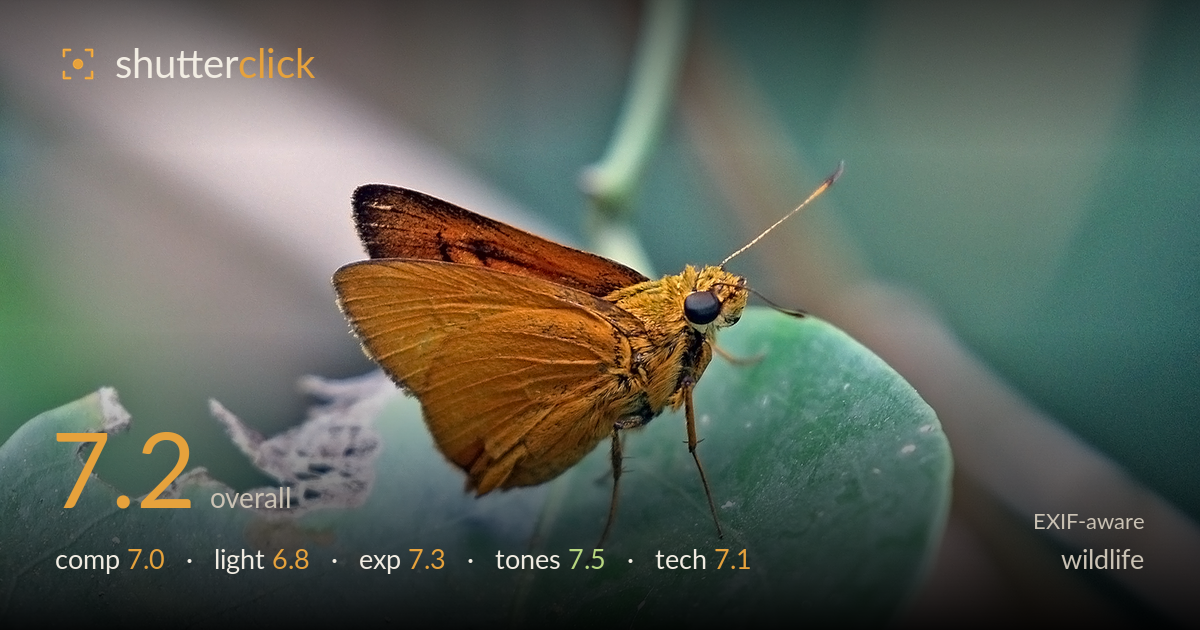
Orange skipper on a torn leaf
Photo by Charles J. Sharp

| Focal length | 400 mm |
| Aperture | f / 5.6 |
| Shutter | 1/100 s |
| ISO | ISO 800 |
| Exp. comp. | 0.33 EV |
| Shot at | 14:36 · Apr 11, 2017 |
A well-observed skipper portrait carried by warm, saturated wing colour set against cool green foliage — a pleasing complementary palette. The eye is sharp with a clean catchlight, and the head and thorax detail read well. What holds it back is the shutter speed: 1/100s at 400mm is marginal, and the wing tips and hindwing show softness that costs the shot critical bite. The perch leaf is torn and cluttered on the left, pulling attention. Placement is reasonable but the empty upper-left bokeh dominates more frame than the subject warrants. A cleaner setting and faster shutter would elevate this.
The skipper sits right of centre facing into open frame, which gives the antennae and gaze room to breathe. The diagonal stem in the upper right adds structure. However, the torn, decaying leaf edge on the left is distracting and its ragged white lace competes with the subject. The large soft upper-left area is somewhat dead space that could be trimmed. The subject occupies a modest portion of the frame given 400mm of reach — a tighter framing would give the insect more presence and reduce the cluttered foreground's pull.
The light is soft and diffuse, likely overcast or shaded, which suits the delicate wing detail and avoids blown highlights on the orange scales. Direction is gentle and frontal-left, giving modest modelling on the furry thorax and a clean catchlight in the eye. The trade-off is a somewhat flat, low-contrast result that lacks the raking sculpting which would reveal wing texture and scale relief. A touch more directional light, or a shot angled to catch a low sidelight, would add dimensionality without sacrificing the highlight control already achieved.
Exposure is well managed. The bright green leaf holds detail without clipping, and the orange wings retain saturation and structure rather than glowing out. The +0.33 EV compensation was a sensible nudge against the leaf's brightness. Shadow areas within the folded wings and under the thorax keep detail. Midtones sit comfortably. The dark forewing tip approaches deep shadow but retains subtle gradation. Overall a clean, deliberate reading of a scene with a wide brightness range between the dark wing edge and the pale leaf surface.
The colour relationship is the strongest asset: warm burnt-orange wings against desaturated cool-green foliage create natural complementary contrast that makes the subject pop. White balance reads accurate and neutral. Saturation is healthy without tipping into garish. The greens carry a slightly muted, silvery cast from the leaf's waxy surface, which reads authentically. Tonal range spans the dark forewing tip to the pale leaf highlights with smooth gradation. If anything, the background greens are a touch flat and could carry marginally more separation in the midtones.
The EF100-400mm II is an excellent choice and f/5.6 wide open at 400mm delivers pleasingly smooth background separation while keeping enough depth for the head and near wing. Focus was placed correctly on the eye, which is critically sharp with a clean catchlight — the priority in any insect shot. The limiting factor is 1/100s at 400mm. Even with the lens IS, that shutter is slow for a live, twitchy subject at this magnification, and it shows: the forewing tips and hindwing edges are softer than diffraction or depth of field alone would explain, suggesting slight subject or camera movement. ISO 800 on the 70D is well judged — noise is controlled and unobtrusive. Raising ISO to 1600 or 3200 to buy 1/400s or faster would have frozen the insect and likely sharpened the entire wing plane. A monopod or bracing would also help at this focal length. Fundamentals are sound; the shutter decision is what to revisit.
What would elevate it
Tags
Shot something like this?
Expert photo critique, on demand — scored across six categories, EXIF-aware. Start with 3 free critiques, no credit card.
critique my photo — free