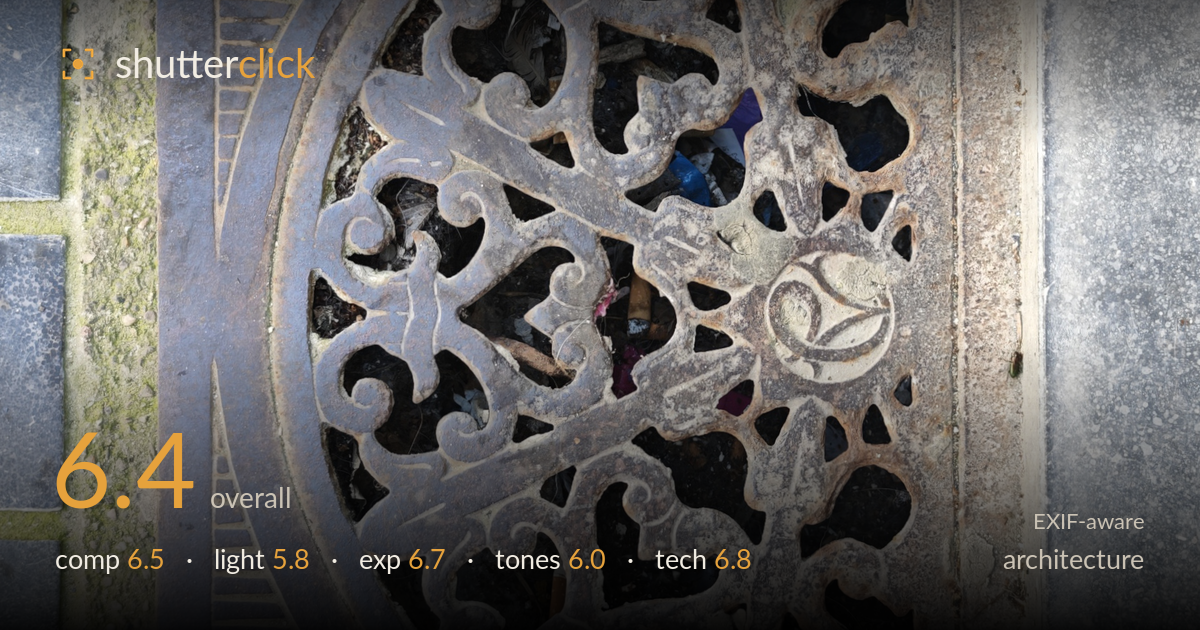
Ornamental iron drain cover
Photo by Reda Kerbush

| Focal length | 9 mm |
| Aperture | f / 1.63 |
| Shutter | 1/100 s |
| ISO | ISO 80 |
| Exp. comp. | 0.0 EV |
| Shot at | 11:50 · Apr 8, 2026 |
A detailed cast-iron drain cover, shot top-down, that succeeds as a study of ornamental ironwork and radiating line pattern. The half-circle scrollwork paired with the fan of engraved rays gives the frame genuine graphic rhythm, and the tight overhead angle keeps the geometry honest. What holds it back most is flat, directionless light: the raised metalwork loses much of its depth, and the surface texture that makes cast iron interesting sits muted. The framing also leaves uneven margins of surrounding paving that dilute the subject. A raking light and a more deliberate crop would lift this considerably.
The plate is placed slightly left, letting the surrounding brick and slab paving read as context, and the fan of engraved rays plays nicely against the semicircular scrollwork. The top-down angle is the right call for this subject and keeps lines true. However, the border of paving is uneven — generous below and right, tight at top-left — which unbalances the frame. The bright scuffed slab in the lower-right corner pulls the eye off the ironwork. A crop squaring the plate within consistent margins would strengthen the geometry.
Soft, overcast, near-frontal light gives even coverage but almost no modelling. The raised scrollwork and the depth of the pierced openings barely register as three-dimensional because there are no directional shadows to carve them out. For ornamental metalwork, this is the weakest element: the relief and casting texture need cross-light to come alive. The flat light does keep highlights controlled and avoids harsh hotspots on the metal, but the trade-off is a surface that reads flatter and less tactile than it should.
Exposure is well judged for the flat conditions. The rusted iron holds midtone detail across the plate, the darker pierced voids retain some information rather than blocking to pure black, and the brighter slab paving stays just short of clipping. The histogram sits comfortably in the middle with no meaningful loss at either end. It's a safe, accurate rendering — appropriate given the even light. A touch more midtone contrast in post would give the surface more presence without risking the highlights.
A muted palette of rust-brown iron against cool blue-grey paving, with green moss in the joints. White balance leans slightly cool, which suits the stone but leaves the iron a little lifeless. Tonal separation between the metal and the surrounding slabs is modest, so the plate doesn't lift off its background as much as it could. Contrast is gentle throughout — faithful to the overcast day but flattening. A small boost to contrast and warmth in the iron would give the ornament more richness.
The f/1.63 aperture is the phone's default wide lens, but at this working distance and with a flat, coplanar subject shot straight down, depth of field isn't a concern — everything on the plate sits in one plane and reads acceptably sharp. ISO 80 keeps noise negligible and the file clean. 1/100s handheld is fine for a static subject and shows no visible shake. Focus lands on the scrollwork where it should. The 9mm (roughly 23mm equivalent) lens introduces mild wide-angle stretch, most noticeable toward the frame edges where the paving lines splay slightly; a longer focal length, or stepping back and cropping in, would keep the plate's proportions truer. Detail resolution is good — the casting texture and engraved rays are well recorded. Overall a technically clean capture; the main limitation is the lens choice for a flat rectilinear subject rather than any error in exposure or focus.
What would elevate it
Tags
Shot something like this?
Expert photo critique, on demand — scored across six categories, EXIF-aware. Start with 3 free critiques, no credit card.
critique my photo — free