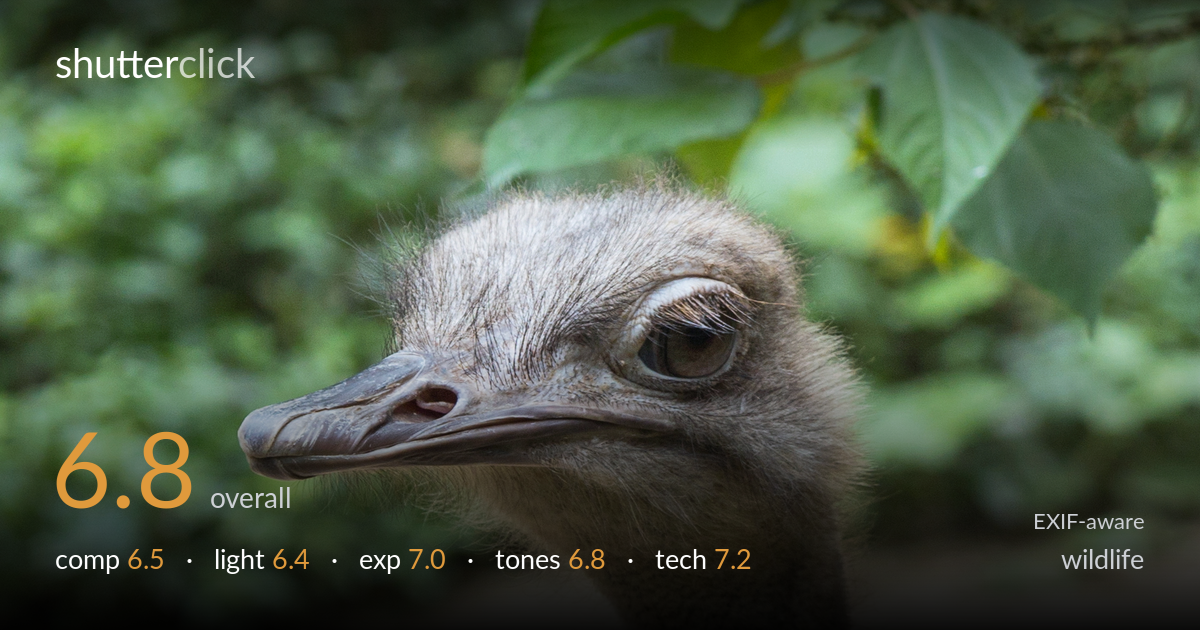
Ostrich peering from the shade
Photo by Marcin Konsek

| Focal length | 105 mm |
| Aperture | f / 6.3 |
| Shutter | 1/250 s |
| ISO | ISO 400 |
| Exp. comp. | 0.0 EV |
| Shot at | 05:20 · Feb 11, 2016 |
A characterful ostrich head-and-neck portrait with a sharp, expressive eye and good detail in the beak and feathered crown. The shallow depth of field separates the subject cleanly from the green backdrop. What most holds the frame back is the placement: the neck runs straight down the centre-right and the head sits high, leaving the bird's gaze pressed against negative space rather than flowing into it. The overhead foliage competes for attention, and the flat, shaded light keeps the textures from fully popping. A reframe and a touch more directional light would lift this from a solid record shot to a portrait with presence.
The head occupies the upper third with the neck dropping straight down the right of the frame, which gives a natural sense of the bird's anatomy but leaves the gaze running off the left edge into compressed space. Giving the look more room ahead would settle the balance. The overhead branch frames the top but also crowds and competes with the head. The lower sandy foreground is large and empty; a slightly tighter crop would concentrate attention on the eye and beak where the interest lives.
The light is soft and shaded, typical of an enclosure under tree cover, which avoids harsh highlights but also flattens the fine feather texture on the neck and crown. There is no strong directional shaping to model the form, so the head reads slightly two-dimensional. A catchlight in the eye is present but subdued. Light angling across the bird from the side would rake the feather texture and add the dimensionality the diffuse overcast currently keeps muted, while still protecting against blown highlights.
Exposure is well judged for the conditions. The eye and beak retain full detail, the neck feathers hold midtone texture without crushing, and the bright sandy foreground is controlled rather than blown. Highlights on the leaves stay in range and shadow areas keep information. Nothing clips destructively. The histogram sits comfortably in the middle with a slightly bright base. A touch of negative exposure compensation could have deepened the sand and pulled more attention upward, but the result is clean and usable.
The greens dominate and read a little uniform and slightly cool, while the warm sand at the base offers welcome contrast. White balance is believable for shade. The bird's muted greys and browns sit naturally against the foliage but lack much tonal punch, partly because the soft light keeps contrast low. The eye and beak carry the richest tones. A modest contrast and clarity lift on the subject, with the background greens calmed slightly, would let the ostrich stand out more decisively.
At 105mm, f/6.3, 1/250s and ISO 400 on the 6D, the settings suit a static subject well. Focus lands accurately on the near eye, which is the critical plane for wildlife, and the lashes and beak detail resolve crisply. The 1/250s shutter comfortably freezes a still bird, though it would be marginal if the head moved quickly. f/6.3 yields enough depth to keep the whole head sharp while throwing the background into pleasant blur, a good compromise. ISO 400 keeps noise negligible. The 24-105 f/4L is a versatile choice but not a long reach; 105mm forced a relatively close working distance, which works here but limits framing flexibility with a wary animal. Overall the execution is technically sound — sharp where it counts, clean files, and appropriate settings. A longer lens would have allowed more standoff and a creamier background, and a slightly faster shutter would add insurance against sudden head movement.
What would elevate it
Tags
Shot something like this?
Expert photo critique, on demand — scored across six categories, EXIF-aware. Start with 3 free critiques, no credit card.
critique my photo — free