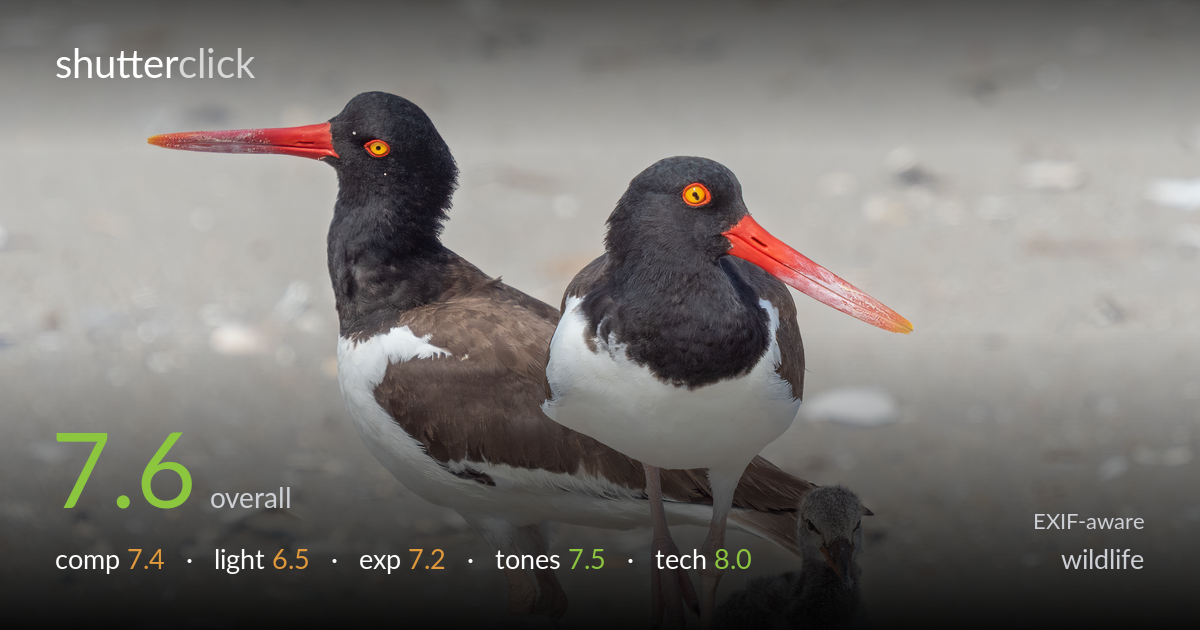
Oystercatcher family on the beach
Photo by Rhododendrites

| Focal length | 300 mm |
| Aperture | f / 6.3 |
| Shutter | 1/1250 s |
| ISO | ISO 320 |
| Exp. comp. | 0.7 EV |
| Shot at | 16:03 · Jul 26, 2020 |
A family group that tells a story — two adult American oystercatchers with a downy chick tucked at their feet, a moment that earns its keep. The clean, soft beach backdrop isolates the subjects well and the chick adds genuine narrative value. What holds it back most is the flat, near-midday light, which leaves the black plumage reading as a featureless mass and flattens the modelling on the birds. The two adults also overlap in a way that slightly muddles separation between them. Sharp eyes, accurate focus, and strong colour in the bills carry the image. Better light would lift it considerably.
The triangular arrangement of two adults and the chick reads naturally and the foreground rock anchors the group on the beach. Subject placement sits left of centre with breathing room into the open background, which works. The two adults overlapping creates a slightly congested mass where their dark bodies merge, and the rear bird's bill crosses awkwardly into the front bird's space. The chick is the emotional payoff but sits low and partly hidden. A half-step that separated the adults, or a frame favouring the chick, would clarify the group.
The light is the weakest element. It appears to be open, high, fairly hard daylight that falls flat across the birds, leaving the black head and breast plumage as a near-textureless block with little of the subtle brown-black gradation oystercatchers carry. Catchlights in the eyes are present and help, but there's no directional modelling to give the bodies form. Softer, lower side light from early morning or late afternoon would rake across the feathers and reveal structure, while warming the overall palette away from this cool, neutral cast.
Exposure is well managed for a tricky high-contrast subject — the +0.7 EV compensation lifts the bright sand and the white breasts without blowing them, and detail holds in the whites of the chick and adults. The black plumage retains just enough information to avoid crushing, though it sits close to the floor. The overall brightness suits the airy beach setting. The risk with this much black against bright sand is metering pulling the blacks down; here it's balanced. Highlight headroom on the pale background looks intact.
The orange-red bills and yellow eyes pop cleanly against the muted, sandy neutral background, and that colour contrast is the image's strongest tonal asset. White balance reads slightly cool, giving the sand a flat grey cast that drains warmth from the scene. The black plumage lacks tonal separation — it would benefit from recovering the brown undertones. Saturation on the bills is convincing without tipping into garish. The overall palette is restrained and natural, but a touch more warmth would make the whole frame feel less clinical.
Solid execution from the E-M5 II with the 40-150mm and MC-20 at 300mm (600mm equivalent). f/6.3 is a sensible choice on this teleconverter combination, giving enough depth to keep all three birds acceptably sharp on roughly the same plane while still melting the background into clean bokeh. 1/1250s is more than ample for stationary birds and freezes any subtle head movement cleanly. ISO 320 keeps noise negligible and the files clean. Focus lands accurately on the eyes of both adults, with crisp detail in the bill texture and the chick's down. The teleconverter's slight resolution penalty is well controlled here — feather detail in the white breasts is genuinely sharp. The reach is appropriate for keeping a respectful distance from a nesting family. The only technical caveat is that depth of field leaves the rear adult's far side softening, but that's an unavoidable consequence of the focal length and a defensible trade. Strong, clean capture overall.
What would elevate it
Tags
Shot something like this?
Expert photo critique, on demand — scored across six categories, EXIF-aware. Start with 3 free critiques, no credit card.
critique my photo — free