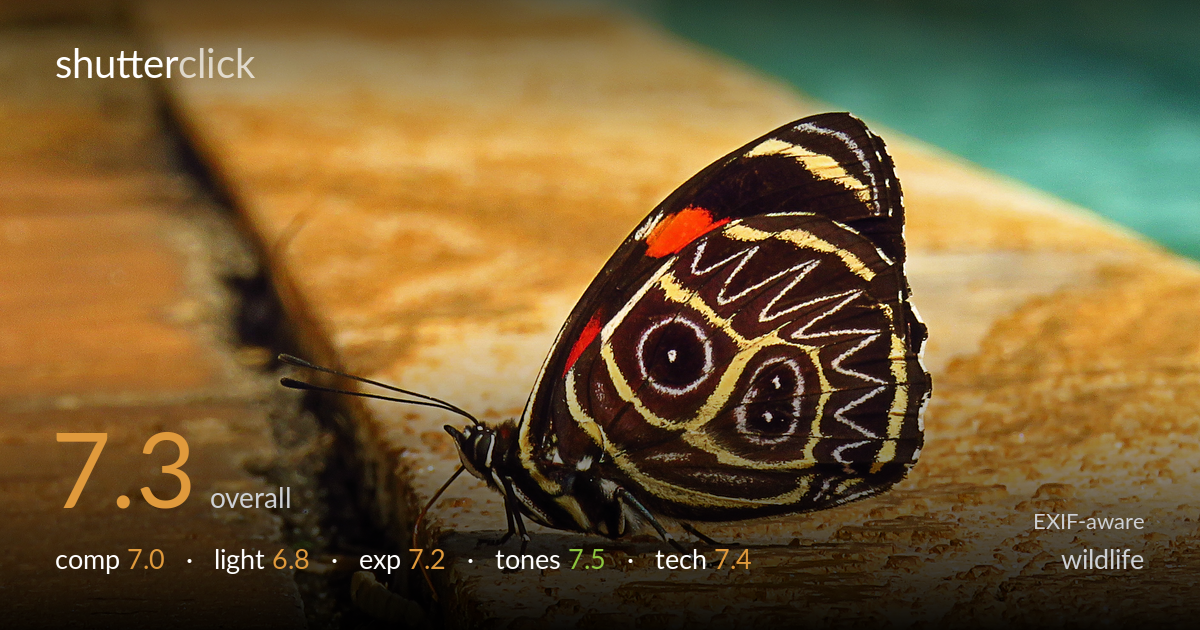
Patterned butterfly on a sunlit beam
Photo by Francisco Boratto

| Focal length | 29 mm |
| Aperture | f / 8.0 |
| Shutter | 1/500 s |
| ISO | ISO 160 |
| Exp. comp. | 0.33 EV |
| Shot at | 09:30 · Apr 24, 2016 |
A striking subject — the wing's intricate eyespot and zigzag pattern is captured with strong detail and the eye-level perspective along the wooden beam gives genuine intimacity. The patterned underwing reads beautifully against the warm wood, with a cool teal background slice adding welcome separation. What holds it back most is harsh midday light that flattens dimension and pushes the wood into hot, near-blown territory in the lower right. The subject sits a touch tight to the right frame edge, and the antennae nearly clip the left margin. A softer light and slightly looser framing would let this lovely subject breathe.
The diagonal of the wooden beam draws the eye naturally toward the butterfly, and placing the subject right of centre with the head facing into the frame works well. The teal water strip top-right provides clean colour contrast and separation. However, the wing crowds the right edge and the antennae reach close to the left margin, creating tension on both sides. A little more room on the right and lower would let the patterned wing dominate without feeling boxed. The cluttered groove at left competes mildly for attention.
Hard, direct overhead sun rakes across the scene, which does lift the wing's pattern and the wood grain texture but at a cost. The light is flat and frontal on the wing, giving little modelling or sense of form, and it drives the lower-right wood into glaring, washed-out highlights. The narrow band of shaded teal water is the most pleasing tonal note. Softer, lower-angle light — early or late in the day, or a diffused overcast — would render the wing's iridescence and the wood with far more dimension.
Exposure is largely well judged: the wing pattern retains full detail in both the dark browns and the cream banding, and the central eyespot holds its structure. The +0.33 EV compensation suits the bright scene without crushing the subject. The weakness is the sunlit wood in the lower right, which approaches clipping and loses surface detail in the brightest patches. Pulling exposure down a third of a stop, or shading that area, would preserve more texture. Shadow detail in the groove is adequately retained.
The warm amber wood against the cool teal water is the image's strongest tonal asset — a clean complementary contrast that makes the subject pop. The butterfly's palette of deep browns, cream-yellow, white scrollwork and the red flash reads richly and the white balance leans warm but believably so under sun. Saturation is healthy without tipping garish. The main limitation is the wood's hot highlights, which compress the upper tonal range and reduce the wood's tonal gradation in the brightest zones. Overall a pleasing, cohesive colour story.
At f/8 the depth of field is generous, and it pays off: the entire patterned wing sits in sharp focus, with the eyespots, white zigzags and scale texture all crisply resolved. Focus lands accurately on the wing and head. The 1/500s shutter comfortably freezes the stationary butterfly with no motion blur, and ISO 160 keeps noise negligible and tonal transitions clean. The 29mm focal length on this superzoom puts the lens at its sharper short end, which helps. The trade-off of f/8 is that the background isn't melted into total softness — the wood and water are only moderately blurred, leaving some texture competing behind. A wider aperture would have isolated the subject more, but would have sacrificed wing sharpness given the depth of the patterned wing relative to the sensor plane. For this superzoom bridge camera, this is a well-executed capture that extracts strong detail from a small sensor.
What would elevate it
Tags
Shot something like this?
Expert photo critique, on demand — scored across six categories, EXIF-aware. Start with 3 free critiques, no credit card.
critique my photo — free