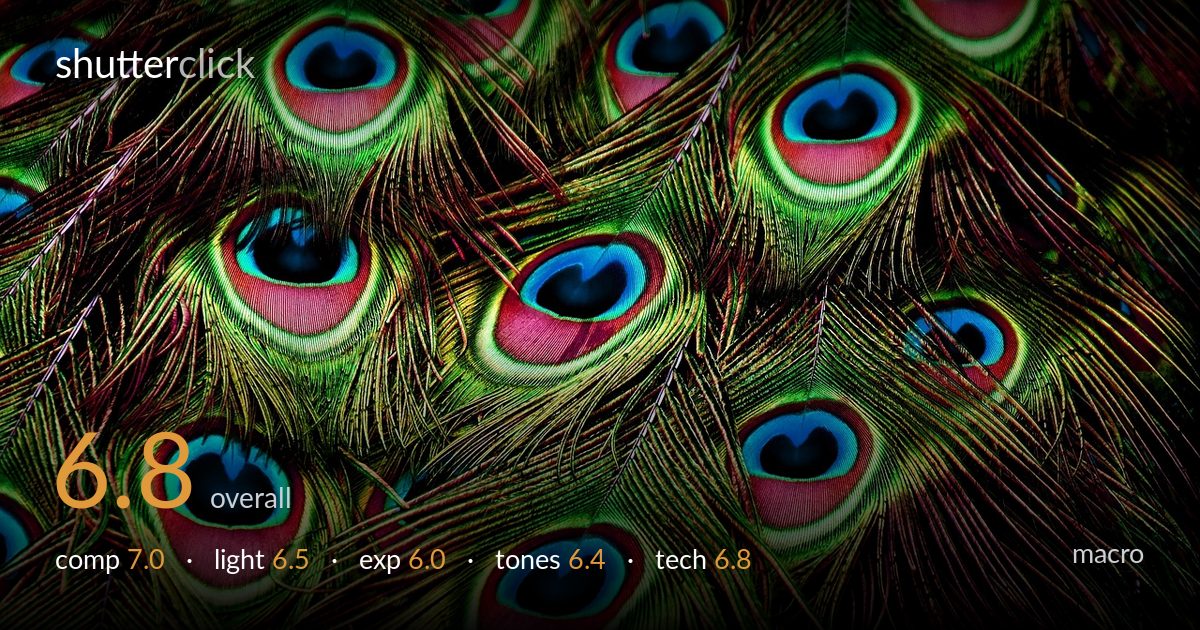
Peacock feather eyes in close-up
Photo by Alexas_Fotos

No EXIF metadata in this file
Technical analysis based on visual assessment only.
A pattern-driven frame that leans on the natural rhythm of peacock eye-spots, with the diagonal sweep of the barbs giving the repetition direction and energy. The strongest asset is the layered repetition of eyes scrolling toward the upper right. What most holds it back is colour handling: saturation is pushed well past natural, the magentas and greens edging into electric, and several eye-spot centres block up to pure black, swallowing the iridescent detail that makes these feathers worth shooting. A more disciplined grade and a touch more shadow recovery would let the structure breathe.
The frame fills edge to edge with eye-spots, and the diagonal flow of barbs running lower-left to upper-right gives the repetition a sense of motion rather than a flat grid. The clustering of spots in the upper portion against the looser, more linear lower-right works as a tension between pattern and texture. It does feel slightly busy and without a clear anchor — no single dominant eye-spot to settle on. Letting one feather sit sharper and larger as a focal lead would organise the eye.
The light is soft and even, which suits the iridescence by avoiding harsh specular blowouts across the curved barbs. That same evenness, though, flattens the three-dimensional quality of the feathers — there's little sense of which spots sit forward and which recede. Iridescent surfaces reward raking, directional light that shifts colour across the structure. A single low side light would carve more depth and make the blues and greens shimmer and shift rather than read as a uniform painted surface.
Exposure is the weakest link. The dark centres of the eye-spots are clipped to pure black, losing the subtle blue-black gradation that gives them dimension, and the deep shadow gaps between feathers also block up. The bright greens sit near the top of the range without quite clipping. The overall placement reads a touch dark to protect highlights at the cost of shadow detail. Lifting the deepest tones slightly and exposing for the midtone iridescence would recover the structure now lost in the blacks.
Colour is vivid to the point of distraction. Saturation is clearly boosted — magentas glow unnaturally and greens push toward neon, which costs the image credibility and flattens tonal separation between adjacent hues. White balance leans warm-magenta overall. The natural peacock palette is already spectacular; restraint would serve it better. Pulling global saturation back, particularly in the reds and magentas, and restoring a cooler, truer green would let the genuine iridescence carry the frame rather than the slider. Contrast in the centres is too crushed.
Focus appears accurate across the central cluster of eye-spots, with the fine barb structure resolving cleanly where it matters, and the apparent depth of field is well managed for a near-parallel feather plane — enough sharpness across the spots without everything collapsing into mush. The trade is that the lower-right barbs drift soft, which reads as either a slightly off focal plane or shallow depth at this magnification; for a flat pattern subject, stopping down a little or stacking a couple of frames would carry edge-to-edge crispness. Noise is not an issue and the resolution holds fine detail well. The main technical concern is in post rather than capture: the aggressive saturation and crushed blacks are processing decisions that undermine otherwise solid execution. The barb texture and the iridescent sheen are captured with real fidelity — the raw file clearly holds more than the current grade reveals. Dialing back the global adjustments would surface detail already recorded.
What would elevate it
Tags
Shot something like this?
Expert photo critique, on demand — scored across six categories, EXIF-aware. Start with 3 free critiques, no credit card.
critique my photo — free