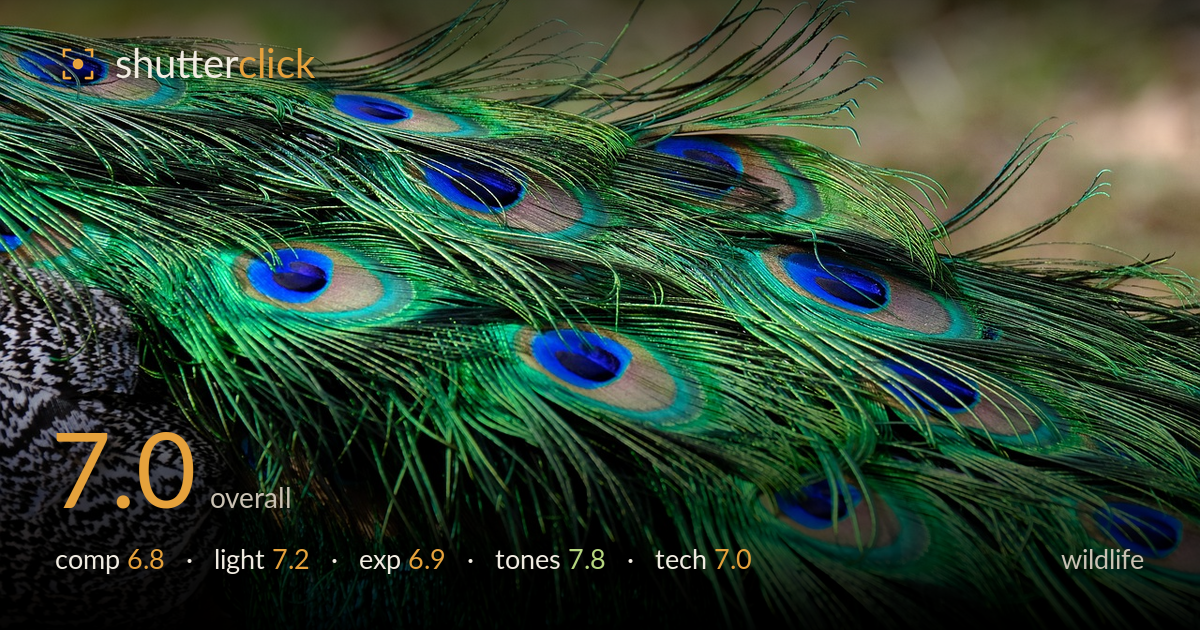
Peacock feathers in raking light
Photo by NickyPe

No EXIF metadata in this file
Technical analysis based on visual assessment only.
The diagonal sweep of iridescent eye-spots carries this frame, and the colour rendering of the peacock plumage is genuinely rich. What holds it back is that it reads as a texture study rather than a wildlife image — there is no eye, no head, no behaviour, so the animal itself is absent as a subject. The barred body feathers at lower left add welcome variety, but the composition drifts toward pattern for its own sake. A cleaner focal anchor and a decision about where the sharpest plane sits would lift it from a pleasing abstract to a purposeful photograph.
The eye-spots march along a strong diagonal from lower right to upper left, giving the frame rhythm and a natural read direction. The barred grey feathers at the lower left offer a useful contrast of texture and stop the green from becoming monotonous. Where it wavers is focus of attention: the repeating ocelli compete rather than build toward one anchor, so the eye wanders without landing. A slightly tighter framing on the two or three most saturated spots, or including the bird's head, would give the pattern a purpose.
Soft, slightly directional daylight rakes across the plumage and brings out the metallic sheen in the green barbs — the iridescence needs exactly this kind of glancing light to register, and it does. The eye-spots hold their blue-to-copper transitions without harsh specular blowouts. The background falls into gentle, warm out-of-focus tones that keep attention on the feathers. The main limitation is that the light is even enough to flatten some of the three-dimensional layering; a touch more raking angle would separate the feather planes more distinctly.
Exposure is well judged for a saturated, high-chroma subject. The deep blues of the ocelli retain detail rather than clipping to black, and the bright green highlights on the barbs stay under control. Shadow areas in the lower feather mass go quite dark and lose some structure, which is acceptable for mood but hides a little detail. The background is a stop or so brighter, which suits the separation. Overall the midtones sit where they need to for the plumage to read fully.
This is the strongest aspect — the colour is vivid without tipping into the oversaturated, artificial look that peacock feathers so often invite. The green-to-blue-to-copper gradient within each eye-spot is rendered cleanly, and white balance holds neutral against the warm background. Contrast is well pitched, letting the metallic sheen read without crushing the darker barbs. The monochrome barred feather at lower left adds a valuable tonal counterpoint. If anything, a fractional pullback of green saturation would let the blues sing even more distinctly.
Focus lands on the central band of eye-spots, which are crisp enough to show the fine barb structure, and the shallow depth of field throws the background into pleasant blur. That said, the plane of sharpness is narrow relative to the tilted feather mass, so the upper-left spots and the lower feathers soften noticeably — a study of a flat-ish subject shot at an angle where a slightly smaller aperture would have carried more of the pattern in focus. Noise is well controlled and the image holds together at this magnification without visible smearing. The lens renders the iridescence faithfully. The core technical question is intent: for a wildlife frame the eye of the animal is the priority, and here the sharpest plane sits on decorative feathers rather than any anatomical focal point. Choosing which two or three ocelli must be tack-sharp, and stopping down enough to hold them together, would resolve the slightly scattered sharpness across the frame.
What would elevate it
Tags
Shot something like this?
Expert photo critique, on demand — scored across six categories, EXIF-aware. Start with 3 free critiques, no credit card.
critique my photo — free