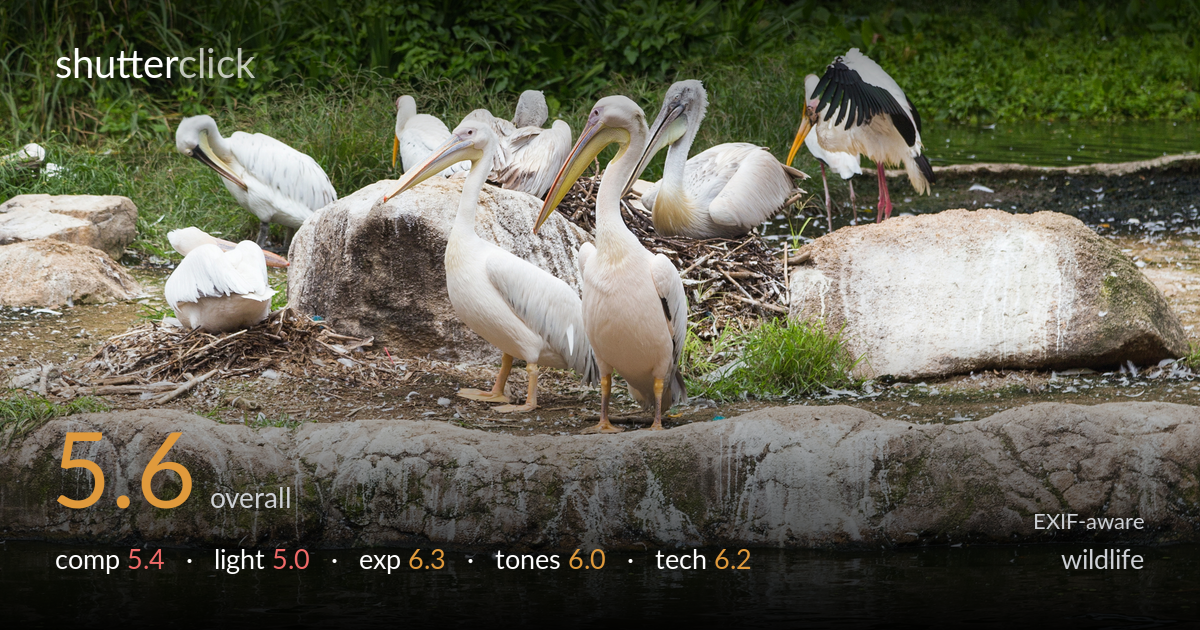
Pelican colony resting
Photo by Marcin Konsek

| Focal length | 105 mm |
| Aperture | f / 5.6 |
| Shutter | 1/250 s |
| ISO | ISO 200 |
| Exp. comp. | 0.0 EV |
| Shot at | 05:02 · Feb 11, 2016 |
A busy colony scene that documents pelicans and a painted stork on their nesting island but lacks a single clear subject to anchor the eye. The frame reads as a record shot: too many birds competing, none isolated, and a flat overcast light that flattens the white plumage. The foreground band of stained rock and dark water eats a third of the frame without adding interest. There's potential here — the cluster of pink-tinged pelicans is appealing and detail holds in the plumage — but tighter framing on a pair or trio, lower angle, and softer directional light would lift this from inventory to image.
The image tries to hold an entire colony at once, and the result is scattered: pelicans, a stork, and rocks all compete without hierarchy. The two foremost pelicans make the natural subject, but they sit dead-centre while the surrounding birds clutter the edges. The lower third — guano-stained rock and flat water — is dead space that adds little. Cropping to the central pair or the stork would create a clear read. The high horizon of green vegetation is a clean backdrop, but the overall arrangement reads as documentation rather than a deliberate composition.
Flat, overcast midday light blankets the scene with no direction or modelling. The white pelican plumage, which carries subtle pink and grey tones, loses its form without a raking light to define feather texture and the curve of the bodies. Shadows are weak and uninformative, so the birds sit flatly against the background. There are no catchlights in the eyes to bring them alive. Soft light avoids harsh blown whites, which is its one virtue here, but the absence of shape and sparkle leaves the subjects looking lifeless.
Exposure is handled competently for a tricky white-on-dark scene. The pelican plumage retains detail without clipping to pure white, which is the main risk with bright birds under open sky, and the stained rock holds midtone information. The darker water and shaded vegetation keep shadow detail rather than blocking up. The histogram looks well controlled with no significant loss at either end. The trade-off is a slightly flat overall result, but that owes more to the soft light than to the exposure decision, which appears deliberate and safe.
The pink-cream of the pelican plumage is the most appealing colour note and renders naturally, with the orange bill and stork legs adding welcome accents. White balance is neutral and believable. The dominant green background is a touch heavy and slightly muddy, pulling the eye and not entirely flattering. Overall contrast is low, a direct consequence of the flat light, leaving the image feeling soft and a little lifeless tonally. A modest contrast and clarity lift in post would give the plumage and rock textures more presence.
The 105mm at f/5.6 yields adequate depth of field for the cluster, keeping the front pelicans and much of the nesting birds acceptably sharp, though the reach is modest for wildlife and forces the inclusion of a wide, cluttered scene rather than an isolated subject. Focus appears to land on the central pelicans, with reasonable detail in the bill and plumage, but it is not tack-sharp on any eye — partly the soft light, partly the lens at this distance. ISO 200 keeps noise negligible and tonal quality clean. 1/250s is sufficient here since the birds are largely static, though it would not freeze a sudden movement. A longer lens, or moving closer, would have allowed a tighter, more selective frame at a wider aperture to throw the background out of focus and separate the subject. The gear performed within its limits; the limitation is reach and the resulting inability to isolate.
What would elevate it
Tags
Shot something like this?
Expert photo critique, on demand — scored across six categories, EXIF-aware. Start with 3 free critiques, no credit card.
critique my photo — free