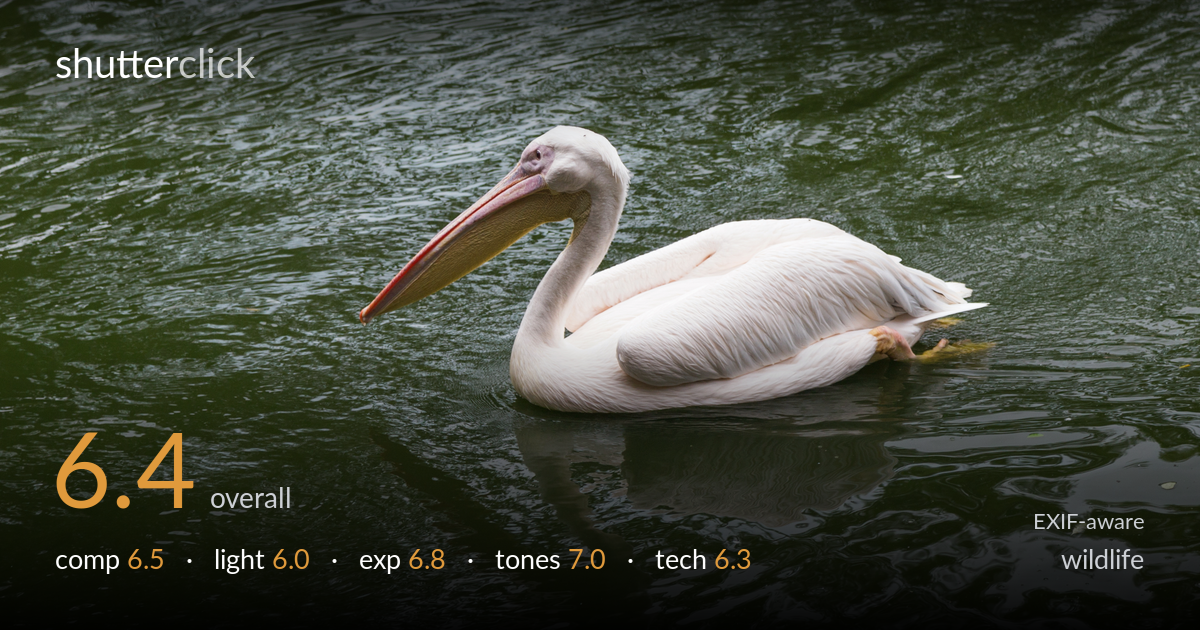
Pelican on green water
Photo by Marcin Konsek

| Focal length | 105 mm |
| Aperture | f / 5.6 |
| Shutter | 1/200 s |
| ISO | ISO 200 |
| Exp. comp. | 0.0 EV |
| Shot at | 05:01 · Feb 11, 2016 |
A clean, well-isolated pelican against an unbroken green ground — the pink-and-coral bird pops against the deep water, and the partial reflection adds a quiet vertical anchor. What most holds the frame back is the side-profile presentation with the bird facing into a tight left margin: the beak nearly touches the edge, cramping the gesture and leaving the heavy green expanse behind it underused. Light is flat overcast, kind to the plumage but offering little shaping or catchlight. The eye, the make-or-break point in wildlife, reads soft. Solid, repeatable work that needs a sharper eye and more breathing room ahead of the subject.
The pelican sits low and right, with its reflection adding a satisfying downward weight. But the bird faces hard into the left frame edge and the beak tip nearly exits the picture, leaving no room for the gaze to travel — the direction of movement is choked off. Convention favours space ahead of a moving subject, and here the empty green sits behind instead. The unbroken water makes a clean, distraction-free ground. A wider margin on the beak side would let the composition breathe.
Soft, even overcast light wraps the pale plumage gently and avoids blowing out the white feathers — a forgiving choice for a bright subject. The trade-off is flatness: there is no directional modelling to separate the wing folds, and the eye lacks a catchlight, which costs the bird life and presence. The coral beak still carries enough warmth to register. Directional side light, or a low-angle window of sun, would have given the form dimension and sparked the eye.
Exposure is well judged for a tricky subject — the white-to-pink plumage holds detail across the body without clipping, and the dark water retains tonal separation rather than blocking up. The histogram appears to sit comfortably in the middle with no panic at either end. The bird's underside and the shadowed near-wing keep gradation. If anything, a touch more exposure on the bird alone would lift it further from the murky ground, but the current balance is safe and clean.
The colour relationship is the strongest element: the warm pink and coral of the bird against the cool, saturated green water is a clean complementary pairing that does most of the visual work. White balance reads neutral, and the plumage avoids any muddy cast. The green is a little heavy and uniform, which flattens the depth, but it serves as an effective negative ground. Highlight roll-off on the feathers is smooth. A slight desaturation of the green would let the bird sing more.
At 105mm, f/5.6, 1/200s and ISO 200, the settings are reasonable for a slow-moving subject on calm water, but the execution falls just short where it matters most. The eye — the critical focus plane in wildlife — reads soft, and overall the frame lacks the bite that makes feather detail crisp; focus appears to have landed somewhere on the body or water rather than locked on the eye. 1/200s is adequate here given the gentle motion, though a faster speed would have insured against any subtle drift. f/5.6 yields enough depth to hold the bird while keeping the water clean, a sensible aperture. ISO 200 keeps noise a non-issue. The 24-105 is a versatile travel lens but lacks the reach of a dedicated telephoto, forcing a relatively close working distance and a flatter rendering. Single-point AF placed precisely on the eye, plus a slightly faster shutter, would have delivered the sharpness this composition needs.
What would elevate it
Tags
Shot something like this?
Expert photo critique, on demand — scored across six categories, EXIF-aware. Start with 3 free critiques, no credit card.
critique my photo — free