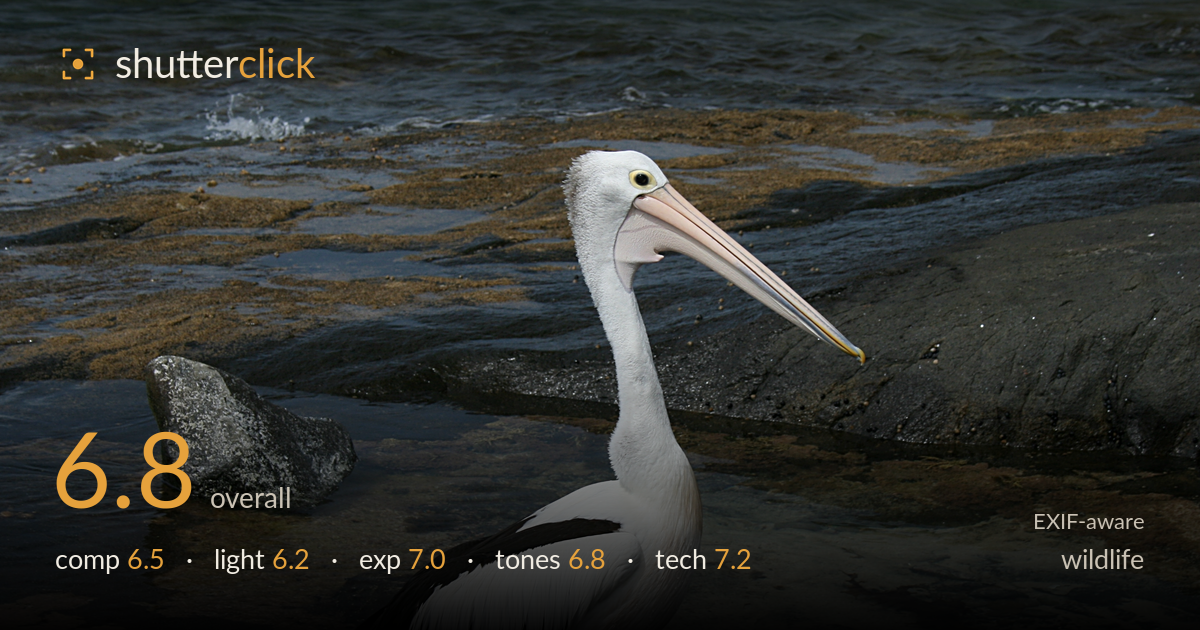
Pelican on the wet rocks
Photo by Toby Hudson

| Focal length | 55 mm |
| Aperture | f / 10.0 |
| Shutter | 1/200 s |
| ISO | ISO 200 |
| Exp. comp. | -0.33 EV |
| Shot at | 15:13 · Dec 27, 2009 |
A clean, well-exposed portrait of an Australian pelican with a sharp eye and good detail across the plumage. The bird reads clearly against the wet rock and shallow water, and the profile pose shows the diagnostic beak and eye well. What most holds it back is the placement: the pelican sits low and left with its beak running nearly to the frame edge, giving little breathing room ahead of the gaze. The flat, hazy light also mutes what could be striking whites-and-blacks contrast. A stronger moment or interaction, and cleaner light, would lift this from a solid record shot toward something more memorable.
The pelican is placed low-left in profile, and while the crisp side view shows the species well, the long beak points hard toward the frame edge, cramping the space the eye wants to travel into. More room ahead of the gaze would balance the pose. The diagonal rock band behind adds some structure, and the small foreground rock at left offers a secondary anchor. The water and rock separate the subject cleanly, though the busy, textured background competes for attention near the head.
The light is soft and fairly flat, likely overcast or hazy, which keeps the white plumage from blowing out but robs the bird of modelling and dimension. The subtle catchlight in the eye is present, which helps the face read as alive. Shadows under the wing and chin are gentle rather than sculpting. Directional side or low-angle light would carve out the feather texture and give the black wing coverts and white body a more dynamic separation from the dark, wet rock behind.
Exposure is well judged for a tricky white-and-black subject. The bright plumage retains detail without clipping, and the dark rock keeps enough tonality to avoid crushing the shadows entirely. The slight -0.33 EV compensation was a sensible call to protect the whites. The eye and beak hold their gradation, and the shallow water shows through with midtone detail. Nothing looks accidentally dark or blown; the histogram appears to sit comfortably across the range with intentional midtone placement.
White balance leans slightly cool, which suits the wet-rock and shallow-water setting and keeps the whites neutral rather than dingy. The subtle pink and yellow of the beak read accurately. Contrast is on the gentle side, matching the flat light, and the muted greens and browns of the background are believable if a touch flat. A modest contrast and clarity lift would give the black wing feathers more punch against the white body and lend the overall frame more separation and life.
At 55mm, f/10, 1/200s and ISO 200, the settings suit a cooperative, stationary bird at moderate distance. Focus lands accurately on the eye and beak, which is exactly where it needs to be for wildlife, and the plumage detail holds well across the body. f/10 gives generous depth of field, keeping the bird sharp front to back, but it also renders the background sharp enough to compete for attention — a wider aperture would have thrown the rock and water into softer relief and isolated the subject more. The 55mm focal length means the shot was taken fairly close, which works here but offers little standoff distance for a wilder subject. 1/200s comfortably freezes a still pelican, though it would be marginal if the bird moved or preened. ISO 200 keeps noise clean throughout. Solid, dependable execution; the main technical lever left unused is aperture for subject separation.
What would elevate it
Tags
Shot something like this?
Expert photo critique, on demand — scored across six categories, EXIF-aware. Start with 3 free critiques, no credit card.
critique my photo — free