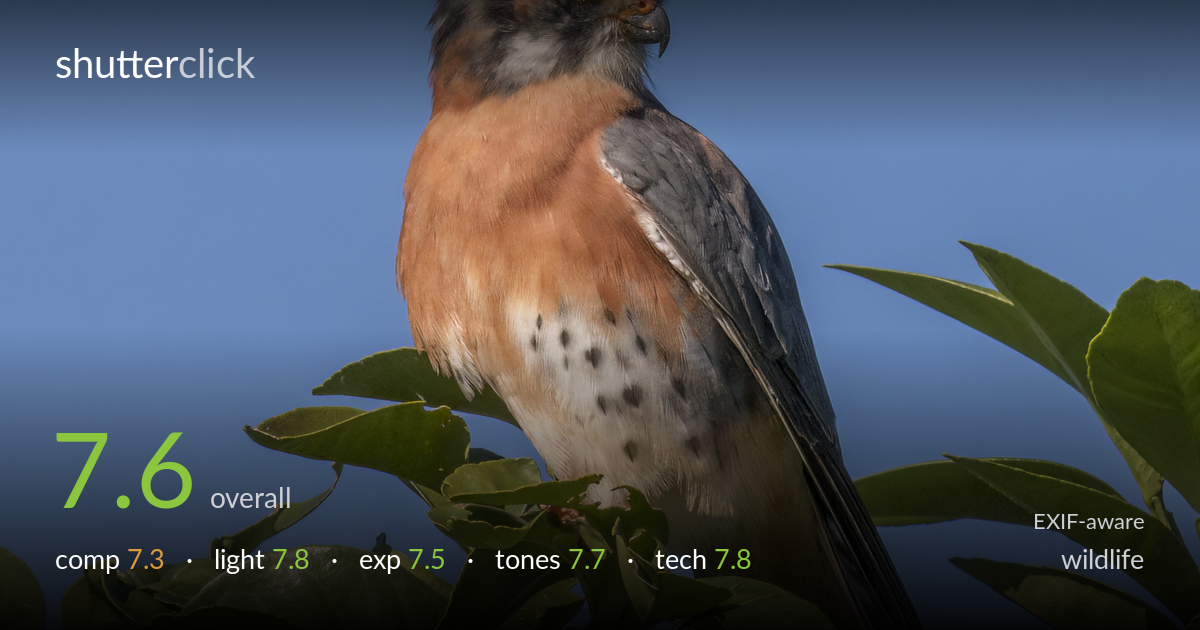
Perched kestrel portrait
Photo by Charles J. Sharp

| Focal length | 400 mm |
| Aperture | f / 11.0 |
| Shutter | 1/1000 s |
| ISO | ISO 800 |
| Exp. comp. | 0.0 EV |
| Shot at | 17:26 · Feb 18, 2016 |
A clean, well-executed portrait of an American kestrel that rewards the patient approach to a perched raptor. The bird sits sharp against an uncluttered blue sky, with warm low light shaping the rufous plumage and a clear catchlight in the eye. The foliage perch grounds the subject naturally. What holds it back most is the framing: the bird sits high and tight against the upper-left third while a large expanse of empty sky dominates the top half, leaving the composition slightly unbalanced and the subject smaller than it needs to be. A tighter, more deliberate crop would let the kestrel command the frame it deserves.
The kestrel is placed near the upper-left intersection, which works, and the leafy perch anchors it with a natural foreground. The clean sky isolates the subject cleanly. However, the upper half of the frame is a large unbroken field of blue that does little work, leaving the bird small in the frame and the weight bottom-heavy with foliage. The head room is generous to a fault. Cropping down from the top to reduce dead sky, and giving the bird more room in its gaze direction, would tighten the balance considerably.
Low, warm directional light rakes across the bird from the front-right, modelling the chest feathers and bringing out the rufous and slate-grey tones nicely. A clear catchlight sits in the eye, which is essential for a raptor portrait, and the orange eye-ring glows. Shadows are soft enough to retain detail on the shaded flank. The light direction leaves the far side of the head slightly underlit, but overall the timing near golden hour serves the plumage well and separates the bird crisply from the sky.
Exposure is well judged for a high-contrast subject against bright sky. The white breast feathers and spotting retain texture without clipping, and the darker grey wing and tail hold detail. The blue sky is rendered at a natural brightness rather than blown out. Shadow areas on the shaded side of the bird and within the foliage stay readable. Nothing here looks accidental; the balance between a bright background and a detailed subject is handled cleanly, with only minor headroom lost in the brightest breast highlights.
The colour rendering is pleasing and natural. The rufous chest, slate-blue wings, and crisp white throat read true, and the warm light adds richness without oversaturation. White balance is accurate, with the sky a believable blue rather than a cyan cast. The green foliage is healthy and not overcooked. Contrast suits the subject, keeping separation between the bird's tonal zones. The kestrel's plumage offers a strong colour palette and it is rendered faithfully, with good gradation across the chest.
At 400mm on the 70D's crop sensor, the reach is well used and the kestrel's eye and feather detail are sharp where it counts. The 1/1000s shutter freezes the static perched bird easily with margin to spare. ISO 800 is modest and noise is well controlled, leaving the plumage clean. The f/11 aperture choice is the one debatable call: it delivers ample depth of field to keep the whole bird sharp, but it also rendered the foliage perch in front of the bird with more definition than ideal, and at that focal length a wider aperture around f/6.3 to f/8 would have softened the foreground leaves and sky transitions while still holding the bird sharp, allowing a lower ISO too. Focus is accurately placed on the eye. Lens selection is ideal for the subject. Overall a technically sound capture; the main refinement would be opening up the aperture to lift the subject further from its surroundings.
What would elevate it
Tags
Shot something like this?
Expert photo critique, on demand — scored across six categories, EXIF-aware. Start with 3 free critiques, no credit card.
critique my photo — free