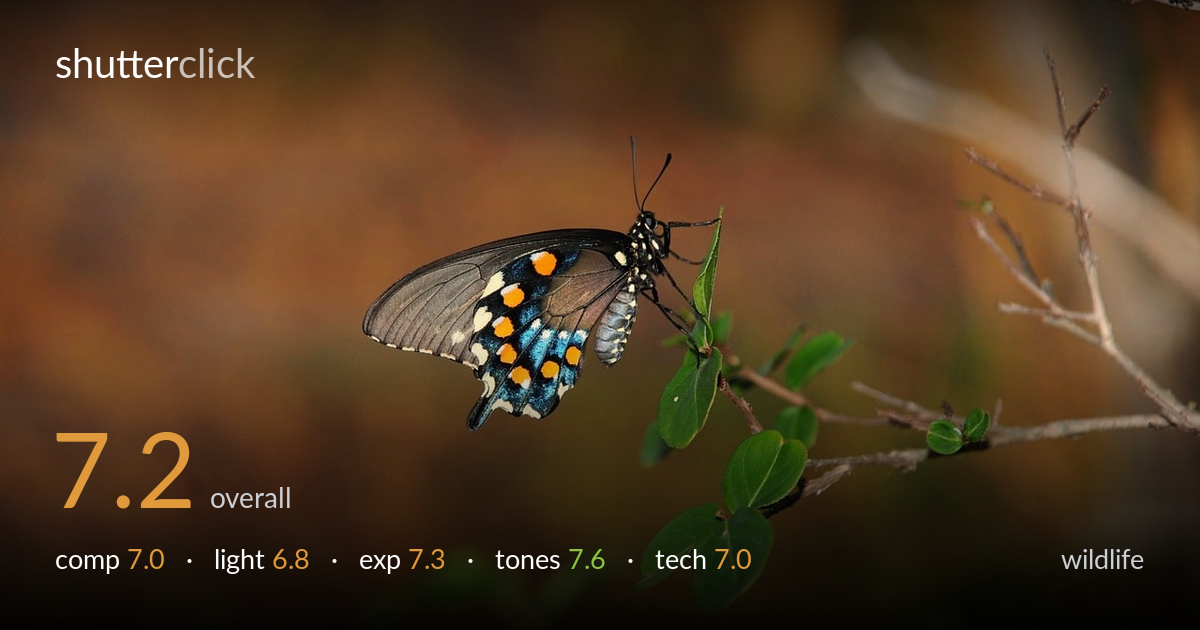
Perched swallowtail butterfly
Photo by anselmo7511

No EXIF metadata in this file
Technical analysis based on visual assessment only.
A well-isolated pipevine swallowtail rendered against a warm, painterly background that lets the blue and orange wing spots sing. The creamy bokeh and complementary palette are the strongest assets here. What most holds the image back is focus placement: the sharpest detail sits on the wing markings while the body and head fall slightly soft, and the antennae read a touch fuzzy. The leftward-facing subject also leaves it slightly cramped against the right twigs while opening empty space behind. A frame giving the butterfly more room to 'look' into would lift this from a solid record shot toward a stronger portrait of the insect.
Placing the butterfly left of centre with the perch entering from the right gives a workable diagonal, and the cascading leaves below add anchoring foreground interest. The trouble is the subject faces left into the heavier, busier side of the frame while the open negative space sits behind it, so the gaze leads out of rather than into the picture. The thin twigs at upper and lower right are slightly distracting against the soft wash. A reframe that opens space ahead of the head would resolve the directional tension and let the wing pattern breathe.
Soft, diffused light — likely overcast or shaded — keeps the wing markings free of harsh specular hotspots and renders the orange and blue spots evenly, which suits the delicate subject. The flat quality, however, does little to model the body or separate the dark wing from the dim background on the right, where butterfly and shadow merge. A touch of directional or raking light would have revealed the scale texture and added dimensionality. As it stands the lighting is safe and clean rather than expressive, but it serves the colour well.
Exposure is well judged for a tricky subject: the bright cream and orange spots hold their detail without clipping, and the dark wing membrane retains some internal structure rather than blocking to pure black. The warm background sits at a pleasant mid-brightness that keeps attention on the insect. Shadow areas where the body meets the darker right side lose a little separation, but nothing critical is buried. Overall the histogram appears controlled and deliberate, with no signs of accidental under- or over-exposure. A slight lift in the body shadows would recover the final bit of detail.
This is the image's strongest dimension. The warm amber and rust background forms a natural complementary backdrop to the cool blue wing scales and orange spots, and the colour interplay is genuinely pleasing. White balance reads accurate and the saturation is restrained enough to feel authentic rather than pushed. The green leaves provide a fresh tonal counterpoint without competing for attention. Contrast is gentle and appropriate to the soft light. If anything, a marginally cooler background would deepen the colour contrast further, but the existing grade is harmonious and well controlled.
Depth of field is shallow and the background melts to a smooth wash, which is exactly right for isolating a small subject. The focus, however, lands on the patterned mid-wing rather than the head and eye, which is the priority plane in wildlife work — the antennae and head read noticeably softer than the bright spots. Because the butterfly sits roughly side-on, more of it could have been held sharp by stopping down a stop or two while still preserving the creamy background, given the subject distance. Noise is well controlled and there is no visible motion blur, so the shutter handled the still subject cleanly. The lens renders colour and bokeh attractively. The core lesson is focus discipline: nailing the eye and head, even at the cost of a fraction of background blur, would elevate the technical execution from competent to convincing. A slightly closer working distance would also bring more usable detail to the markings.
What would elevate it
Tags
Shot something like this?
Expert photo critique, on demand — scored across six categories, EXIF-aware. Start with 3 free critiques, no credit card.
critique my photo — free