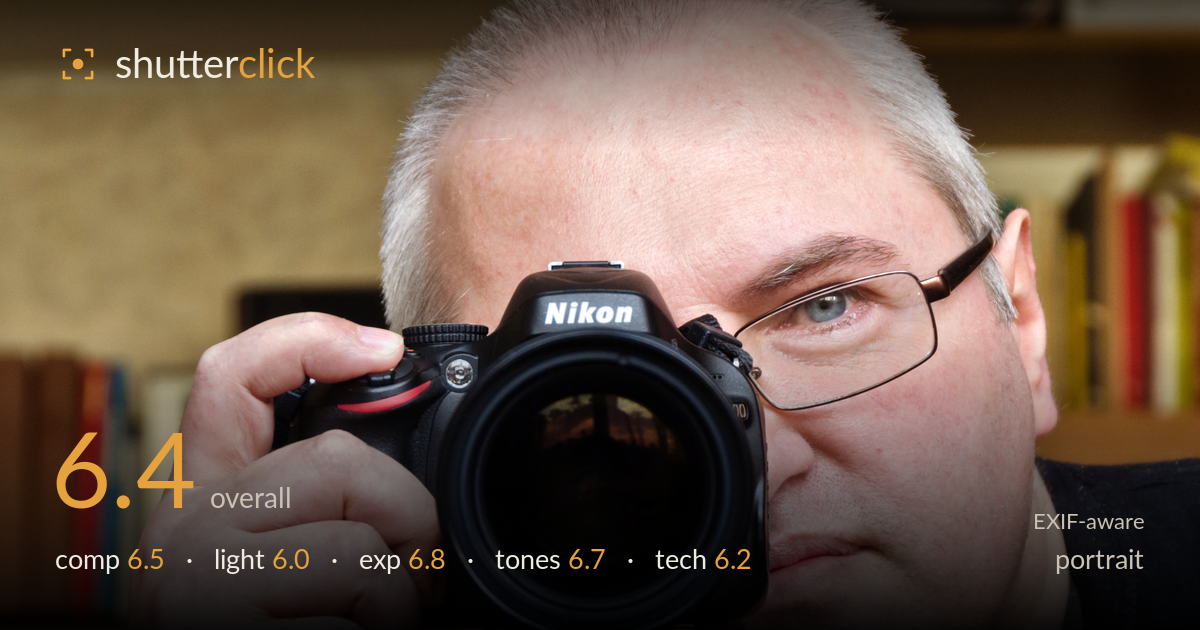
Photographer behind the viewfinder
Photo by Jacek Halicki

| Focal length | 75 mm |
| Aperture | f / 8.0 |
| Shutter | 1/20 s |
| ISO | ISO 800 |
| Exp. comp. | 0.0 EV |
| Shot at | 14:52 · Apr 12, 2014 |
A self-aware environmental portrait built on a clever concept — the camera obscuring half the face while the visible eye locks onto the viewer, creating a photographer-meets-viewer tension. The single exposed eye is the strongest element, sharp and engaging. What holds the shot back is focus placement and light: the sharpest plane sits on the camera body rather than the eye, and the flat, frontal room light does little to model the face. The bookshelf background is fitting context but muddy and dim. A defined key light and focus locked on the eye would lift this from a competent gag to a genuinely arresting portrait.
The half-hidden-face conceit works — the camera splits the frame and the one visible eye carries the connection. The tight crop fills the frame and the bookshelf grounds the subject as a photographer. Balance is slightly awkward: the hand and lens dominate the left while the face crowds the right edge, leaving the chin and jaw clipped low. A touch more room on the right and a fraction lower framing would keep the eye near a thirds line without cramping the features against the border.
Soft, frontal ambient light keeps the face evenly lit but flat — there is little directional modelling to give the features shape or the eye drama. The catchlight is weak, so the standout element loses some sparkle. Shadows fall gently under the brow and chin without sculpting form. The background sits noticeably darker, which helps separation, but the overall effect reads as available-room light rather than a considered setup. A single off-axis key would carve dimension into the face and put life in the eye.
Exposure is well judged for the conditions. The skin tones hold detail across the forehead and cheek without clipping, and the darker background retains just enough information to read as bookshelves. The exposed eye and glasses frame are cleanly rendered. The black camera body sits deep without crushing the important edges. Highlights on the scalp are slightly hot but recoverable. Overall a balanced frame that avoids the common trap of blowing the near skin against the dim room behind it.
White balance leans warm, which suits the wood-and-book environment and keeps the skin natural rather than sallow. Contrast is moderate and the tonal range is honest, though mid-tones in the face are a little muddy and could use more separation. Saturation is restrained and believable. The background reds and yellows of the book spines add welcome colour accents without competing. A slight lift in mid-tone clarity on the face would give the skin more presence against the softer surroundings.
At f/8 and 75mm the depth of field is generous, but the plane of critical focus appears to have landed on the camera body and lens rather than the eye — the standard portrait priority. The visible eye reads acceptably but not tack-sharp, softening the shot's key element. The 1/20s shutter is slow for a handheld-feeling scene; the tripod under the subject's camera helps, but any movement of the photographer's own camera at that speed risks softness, and it likely contributes to the eye not being crisp. ISO 800 on the D5100 is well controlled, with only mild noise in the shadows. The 18-200 superzoom at 75mm and f/8 is a sensible sharp-aperture choice, though this lens is not the sharpest wide open, and stopping down was reasonable. Focusing on the eye, opening up a stop or two for separation, and a faster shutter would tighten execution considerably.
What would elevate it
Tags
Shot something like this?
Expert photo critique, on demand — scored across six categories, EXIF-aware. Start with 3 free critiques, no credit card.
critique my photo — free