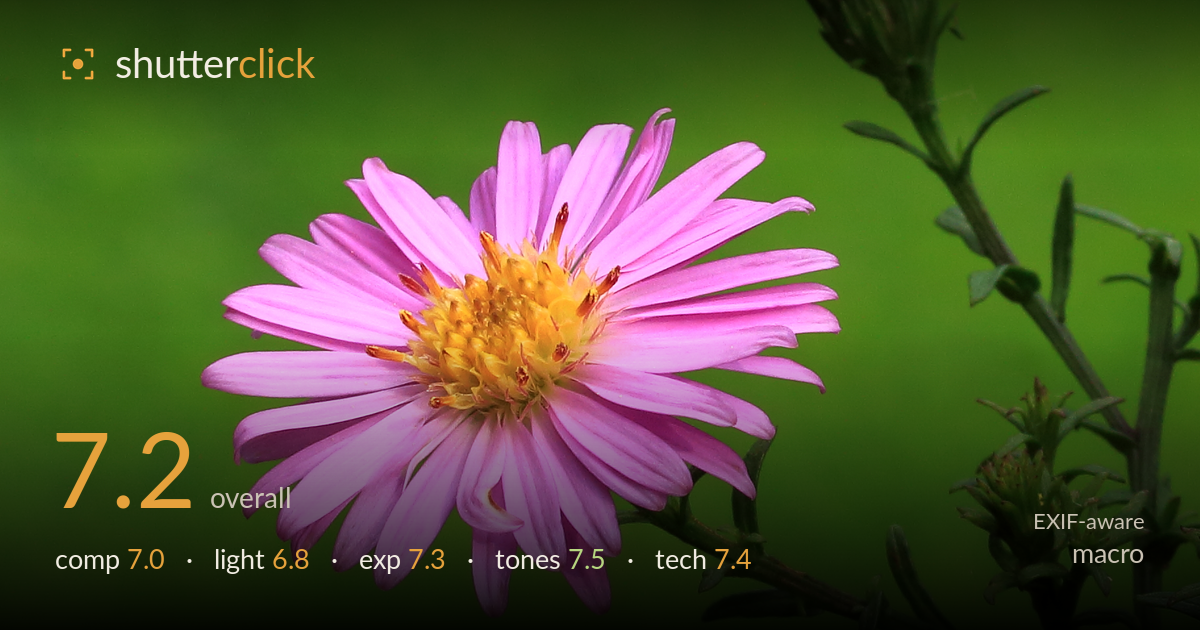
Pink aster against green
Photo by Dominicus Johannes Bergsma

| Focal length | 60 mm |
| Aperture | f / 13.0 |
| Shutter | 1/125 s |
| ISO | ISO 200 |
| Exp. comp. | -0.67 EV |
| Shot at | 14:30 · Sep 29, 2014 |
A clean, well-separated aster set against a smooth green field of grass — the colour contrast between magenta petals and green backdrop carries the image. The open bloom is the anchor, with a supporting bud and stem sweeping up from the lower right to add diagonal energy and context. What holds it back most is the light: flat and even, it leaves the petal ridges and central disc without the raking dimension that macro rewards. The focus favours the near petals over the disc florets, softening the most detailed part of the flower. Strong colour separation, but the crop and light leave headroom.
The diagonal stem carrying eye from the lower-right bud up to the main bloom gives the frame a natural flow, and the open flower sits comfortably off-centre to the left. The secondary bud top-right adds a life-cycle narrative without competing. The lone open flower reads slightly low and left, leaving a large expanse of empty green above it that feels more accidental than intentional negative space. A crop tightening the top, or repositioning the bloom higher, would balance the frame better. The clipped bud at the far right edge is a minor distraction.
Soft, diffused overcast light keeps the magenta petals evenly saturated and avoids blown highlights on the pink — kind to colour. But it is directionless, and macro thrives on raking light that separates individual petals and rakes across the yellow disc florets to reveal their texture. As rendered, the central disc reads somewhat flat, and the petal ridges lack the shadow definition that would give the bloom sculptural depth. A low side light, or a reflector to add a hint of modelling, would lift the subject from pleasant to dimensional.
The -0.67 EV compensation was a sound call, protecting the bright pink petals from clipping and holding detail across the highlight-prone magenta. The yellow centre retains texture rather than glowing out, and the green background sits at a rich, controlled midtone. Shadows within the petals stay open. If anything the overall exposure is a touch conservative, leaving the image slightly muted; a small lift in the midtones would add sparkle without threatening the highlights. Overall a clean, deliberate exposure with no serious clipping at either end.
The magenta-against-green complementary pairing is the image's strongest asset, and the white balance renders both colours naturally without an obvious cast. Petal saturation is convincing rather than oversaturated, and the yellow disc adds a warm accent that completes the palette. The green background is uniform and pleasant. Contrast is on the gentle side, matching the soft light, though a slightly punchier tone curve would make the pink separate even more crisply. Overall a harmonious, well-judged colour treatment with only minor room for added depth.
The f/13 aperture on the 60mm macro was a reasonable choice to pull enough depth of field across a three-dimensional bloom, and at 1/125s with ISO 200 the settings are clean with no visible noise. But the focus plane favours the front-facing petals rather than the disc florets, which are the most detail-rich part of the subject and where sharpness matters most — the yellow centre reads slightly soft. The flower's tilt means the far petals also fall off. For this subject, focusing on the central disc (or a modest focus stack of two or three frames) would place critical sharpness where the eye lands. The shutter was fast enough to freeze the bloom, though any breeze on such a slender stem is a risk worth guarding against with a faster speed. Background rendering from the 60mm is smooth and clean. Solid execution overall; the focus placement is the one decision that costs the most detail.
What would elevate it
Tags
Shot something like this?
Expert photo critique, on demand — scored across six categories, EXIF-aware. Start with 3 free critiques, no credit card.
critique my photo — free