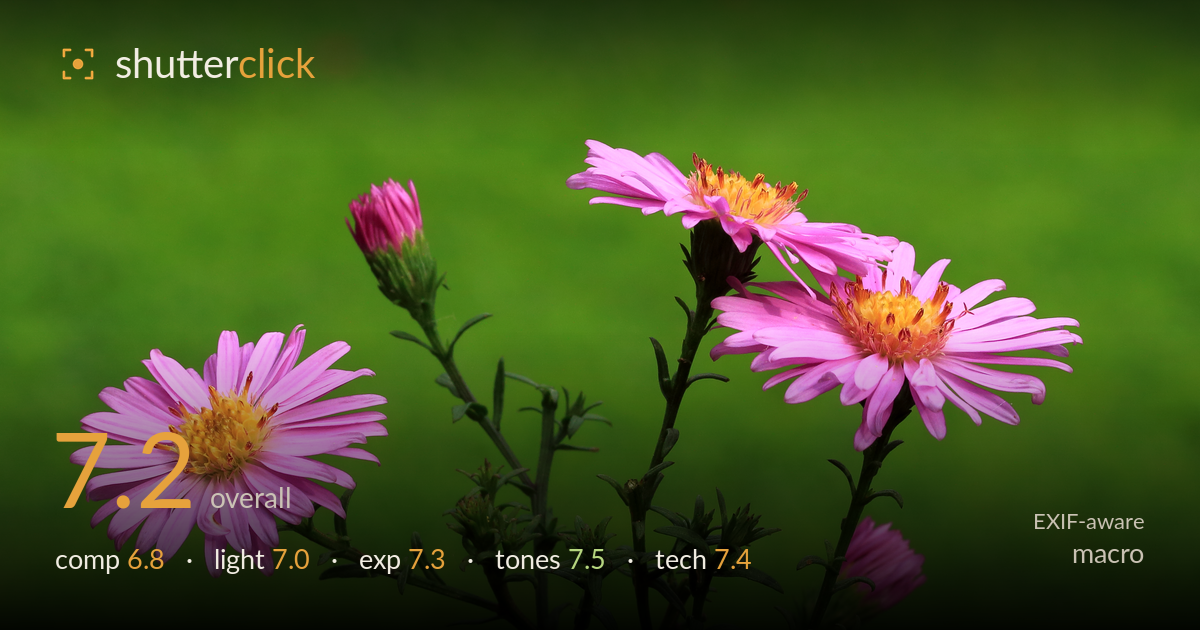
Pink asters against green
Photo by Dominicus Johannes Bergsma

| Focal length | 60 mm |
| Aperture | f / 13.0 |
| Shutter | 1/125 s |
| ISO | ISO 200 |
| Exp. comp. | -0.67 EV |
| Shot at | 14:30 · Sep 29, 2014 |
A clean, cheerful study of pink asters against a smooth green field of grass, carried by strong colour contrast and pleasing petal detail. The complementary pink-against-green pairing does most of the work here, and the completely dissolved background isolates the blooms well. What holds it back is arrangement: the cluster reads slightly scattered, with the two main flower groups pulling to opposite edges and the tangle of stems and buds in the lower centre competing for attention. Tightening the composition, resolving where the eye should settle, and adding a touch of directional light to model the petals would lift this from a solid record shot to a more deliberate botanical portrait.
The complementary colour separation is the strength — pink flowers pop cleanly against the green. But the arrangement feels unresolved: the left bloom and the right cluster sit at opposite edges with a busy knot of stems, leaves and buds filling the lower middle, so the eye has no clear resting point. The diagonal stem rising through the frame gives some structure, yet the blooms face different directions, weakening cohesion. A tighter frame on the right cluster, or a viewpoint that overlaps the flowers into one reading, would unify it.
The light is soft and even, likely overcast or open shade, which keeps the pink petals free of blown highlights and renders colour faithfully. That flatness is also the limitation: with little directional modelling, the petals and their radial texture look somewhat two-dimensional and the yellow centres lack the sparkle that a slight side or backlight would bring. The background greens are pleasantly uniform under this light. A raking side light would carve out petal separation and add dimensionality without risking harsh shadows on such delicate subjects.
Exposure is well judged. The -0.67 EV compensation protects the bright pink and yellow highlights, holding petal and disc-floret detail that would otherwise clip on saturated colours. Shadows in the darker stem tangle retain enough information without muddying, and the midtones sit comfortably. The green background is bright but not overexposed. Overall a deliberate, controlled reading of a high-chroma scene with no obvious clipping. Marginally more shadow lift in the lower foliage would recover some of the darker structural detail that currently sinks toward black.
Colour is the standout: the saturated magenta-pink petals read vividly against a clean, uniform green without oversaturation tipping into artificiality. White balance is neutral and the yellow flower centres are warm and inviting. The tonal range is handled well for such a colour-driven image, with smooth gradation across the petals. The green background is perhaps a touch electric and single-note, which flattens depth. A slight tonal variation or gradient in the background — or a cooler shade behind — would give the greens more nuance and stop them dominating.
Settings are sensible for the subject. f/13 on the 60mm macro delivers enough depth of field to hold most of the left bloom and much of the right cluster acceptably sharp, a reasonable compromise given how the flowers sit on different planes — though even f/13 can't render every petal crisp across that spread, so some outer petals soften. Focus lands well on the right cluster's centres, where the disc florets and stamens show good detail. ISO 200 keeps noise negligible and preserves clean colour. 1/125s is adequate for still flowers but risks softness if there was any breeze on these top-heavy stems; a slightly faster shutter or a diffuser to still the plant would guarantee critical sharpness throughout. The lens is well suited and rendering is clean. Overall competent execution; the main technical gain would come from focus stacking to bring every bloom fully sharp, or a plane of focus chosen to favour one primary subject.
What would elevate it
Tags
Shot something like this?
Expert photo critique, on demand — scored across six categories, EXIF-aware. Start with 3 free critiques, no credit card.
critique my photo — free