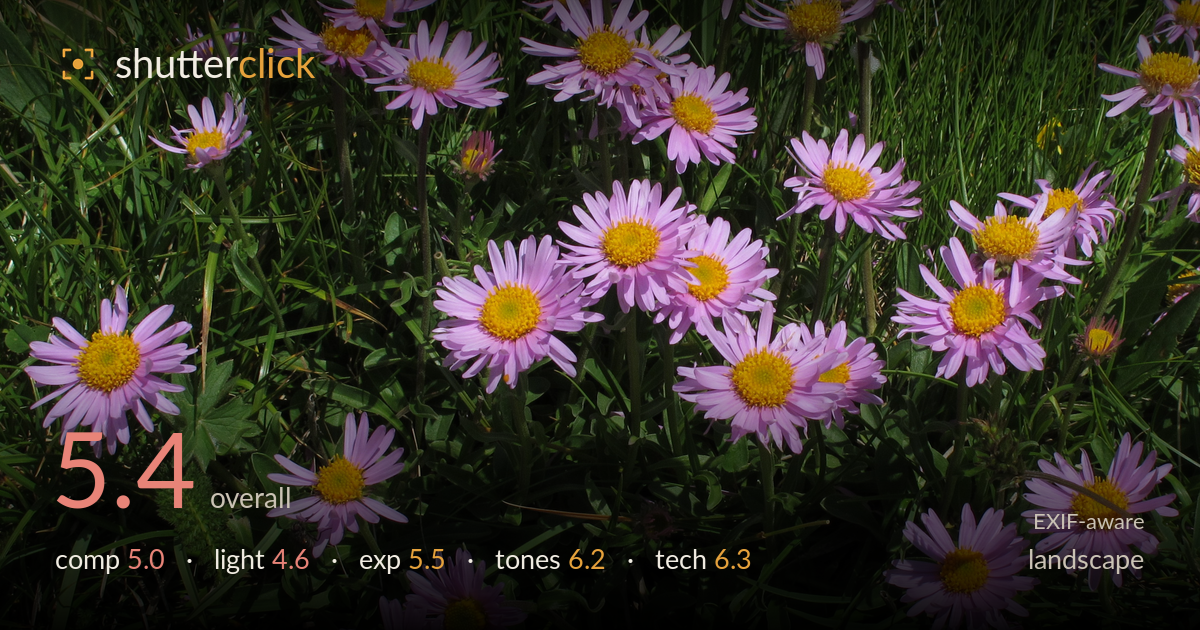
Pink asters in a meadow
Photo by Robert Flogaus-Faust

| Focal length | 12 mm |
| Aperture | f / 6.3 |
| Shutter | 1/640 s |
| ISO | ISO 100 |
| Exp. comp. | -1.0 EV |
| Shot at | 15:34 · Jul 23, 2013 |
A dense field of pink alpine asters photographed under harsh midday sun, with plenty of colour but no clear organising structure. The frame reads as an even carpet of blooms with no single anchor, no depth cue, and no negative space to let any flower breathe. The hard overhead light flattens form and blows the brightest petals while the grass beneath sinks into shadow. There's genuine subject appeal and pleasant colour contrast between the magenta petals, yellow centres, and green grass — but the shot needs a compositional decision: one hero bloom, a cleaner background, and softer light to become memorable.
The frame is packed edge to edge with blooms of equal weight, so the eye has nowhere to rest or settle. Several flowers are clipped at the top and side margins, which pulls attention outward rather than in. As a botanical carpet it documents the meadow, but there's no foreground-to-background progression and no dominant subject to lead the eye. Selecting one or two well-lit foreground blooms against a quieter backdrop, with breathing room around them, would give this the anchor and depth it currently lacks.
Direct overhead midday sun is the biggest limiter here. It produces hard specular highlights on the brightest petals, deep unfilled shadows in the grass, and no directional modelling to reveal the flowers' cupped form. The light is flat where it matters and harsh where it doesn't. Soft overcast light, or the low raking angle of early morning or late afternoon, would render the petal texture and translucency far more gracefully and even out the extreme range between the sunlit tops and shaded stems.
The -1.0 EV compensation was a sensible call to protect the bright petals, and it largely works — the pink tones hold colour rather than clipping to white across most of the frame. A few of the most sun-struck petals still lose highlight detail. The trade-off is that the shaded grass falls quite dark, compressing shadow detail in the lower background. Overall the brightness is deliberate and defensible for the conditions, but the harsh light gave the sensor a dynamic range it couldn't fully hold.
Colour is the strongest aspect. The magenta-pink petals sit well against the yellow disc florets and saturated green grass, a naturally pleasing complementary palette. White balance looks accurate for direct sun and the greens read true rather than yellowed. Saturation is healthy without tipping into garishness. The main tonal weakness is contrast driven by the light — the shadows block up and a few highlights are near-white — but within those constraints the hues are clean and the overall rendering is faithful.
The settings suit the conditions well. At 1/640s and ISO 100 the flowers are frozen cleanly despite any breeze, and noise is a non-issue. f/6.3 on the G11's small sensor at 12mm yields deep depth of field, so nearly everything is rendered sharp — appropriate for a documentary meadow record, though it also means no selective focus to isolate a subject, which contributes to the busy, flat feel. Focus is accurate on the mid-frame blooms, and detail in the disc florets is crisp where the light isn't blown. The lens handles the scene without obvious distortion or fringing. Technically this is competently executed for the gear; the limitation is creative rather than mechanical. A wider aperture, or physically moving closer to a single bloom, would have let depth of field do compositional work — separating a hero flower from the tangle — which this deep-focus approach cannot provide.
What would elevate it
Tags
Shot something like this?
Expert photo critique, on demand — scored across six categories, EXIF-aware. Start with 3 free critiques, no credit card.
critique my photo — free