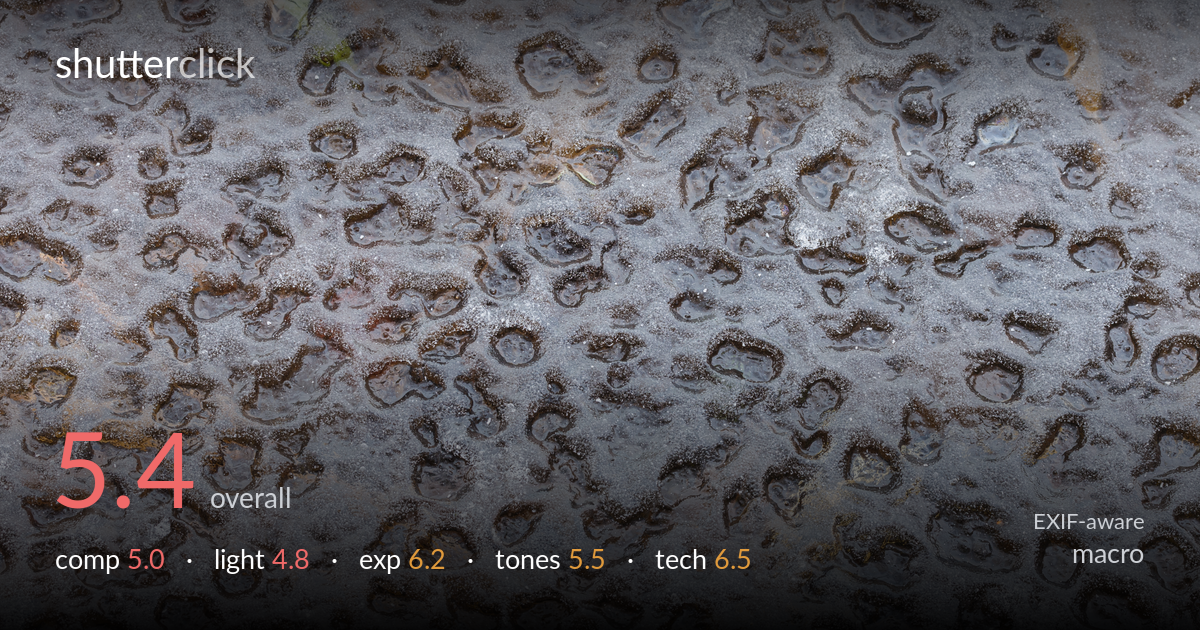
Pitted weathered stone surface
Photo by Dominicus Johannes Bergsma

| Focal length | 60 mm |
| Aperture | f / 11.0 |
| Shutter | 2/5 s |
| ISO | ISO 100 |
| Exp. comp. | 0.0 EV |
| Shot at | 10:59 · Jan 21, 2016 |
This is a flat-on texture study of a pitted, weathered rock surface — competent in execution but undirected as an image. The frame reads as an even, all-over field of pock-marks with no hierarchy: no anchor, no light gradient, no point of entry for the eye. The single green leaf fragment top-left is the only break in the repetition and is marooned in a corner rather than used. The diffuse overcast light flattens what could have been the photo's strongest asset — surface relief. The pattern itself is genuinely interesting; what holds it back is the lack of any compositional or lighting decision to shape it.
The frame is an uninterrupted field of similar pits with no focal hierarchy — the eye wanders without landing. As an abstract texture this all-over treatment can work, but it needs either a stronger rhythm or a deliberate anchor. The green leaf fragment in the upper-left is the one element of contrast and interest, yet it sits jammed in the corner where it pulls attention off-frame rather than organising it. A tighter section emphasising the largest pits, or placing that leaf as a considered counterpoint, would give the repetition purpose.
Soft, even overcast light keeps the whole surface uniformly lit and free of blown highlights, but it's the wrong light for this subject. Pitted, three-dimensional relief lives or dies on shadow, and here the flat illumination collapses the depth of every hollow — the pits read as tonal patches rather than carved cavities. A low, raking side light would have skimmed across the surface and given each depression a defined shadow edge, transforming the texture into something sculptural. As shot, the light records the pattern but does not reveal it.
Exposure is safe and well controlled. At ISO 100 with no exposure compensation the histogram sits in the midtones with no meaningful highlight clipping and retained shadow detail in the deeper pits. Nothing is lost. The trade-off is that this even, middle-weighted exposure reinforces the flatness — there's no tonal drama because there's nothing in the scene driving it. The brightness is accurate and deliberate; it simply has little to work with given the diffuse light. Technically clean rather than expressive.
The palette is a muted grey-brown with patches of rust and ochre staining, plus the lone green accent. White balance looks neutral and believable for the stone. Contrast is low, which suits the soft light but flattens the image further — the pits and the surrounding surface occupy a narrow tonal band. The subtle warm staining is the most interesting tonal feature and could be pushed gently. As rendered, the colour is honest but inert; a touch more local contrast would let the texture separate without looking artificial.
The settings are well matched to the subject. f/11 on the EF-S 60mm Macro is the sweet spot for a flat-on texture study — enough depth of field to hold the whole pitted plane sharp without drifting into diffraction softening, and on a parallel surface like this the focus plane is well managed. ISO 100 keeps the file clean, and the 0.4s shutter is no concern on what is clearly a tripod-supported, static subject. Detail rendering is good: the grain of the surface, the sandy rims of the pits, and the staining all hold up. The 60mm focal length on the EOS M crop sensor gives a working distance and magnification suited to this. The execution is the strongest part of the photo — focus, aperture, and ISO are all the right calls. What the gear can't fix is the lighting decision, which is where this image needed the most intervention. Technically sound, creatively under-served.
What would elevate it
Tags
Shot something like this?
Expert photo critique, on demand — scored across six categories, EXIF-aware. Start with 3 free critiques, no credit card.
critique my photo — free